Why Misinterpreting Scrum Masters, Product Owners, and Agile Coaches Kills Enterprise Velocity
It is Sprint 14, and your flagship enterprise software launch is spiraling into chaos. The Product Owner is bypassing sprint backlogs to force ad-hoc feature requests directly onto developers. The Scrum Master is functioning like a traditional, micromanaging taskmaster, demanding hourly status updates. Meanwhile, a newly appointed Agile Coach is issuing high-level governance mandates that completely contradict the engineering team’s daily workflows. Scope creep is compounding, release dates are slipping, and your top senior developers are handing in their resignations.
The common corporate myth is that adopting Agile naturally removes structural hierarchy and replaces rigid management with effortless, self-organizing harmony. Too many enterprise organizations assume that simply re-titling legacy project managers as Scrum Masters or Agile Coaches magically transforms project outcomes. In reality, slapping new titles on old behaviors without establishing definitive role clarity creates boundary confusion, authority clashes, and operational friction.
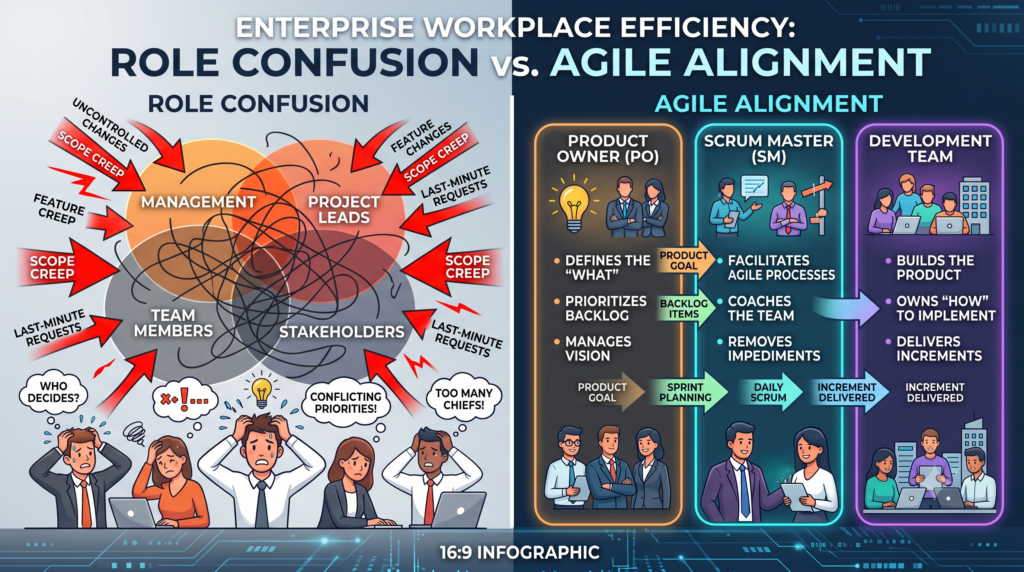
Deconstructing the Core Agile Triad
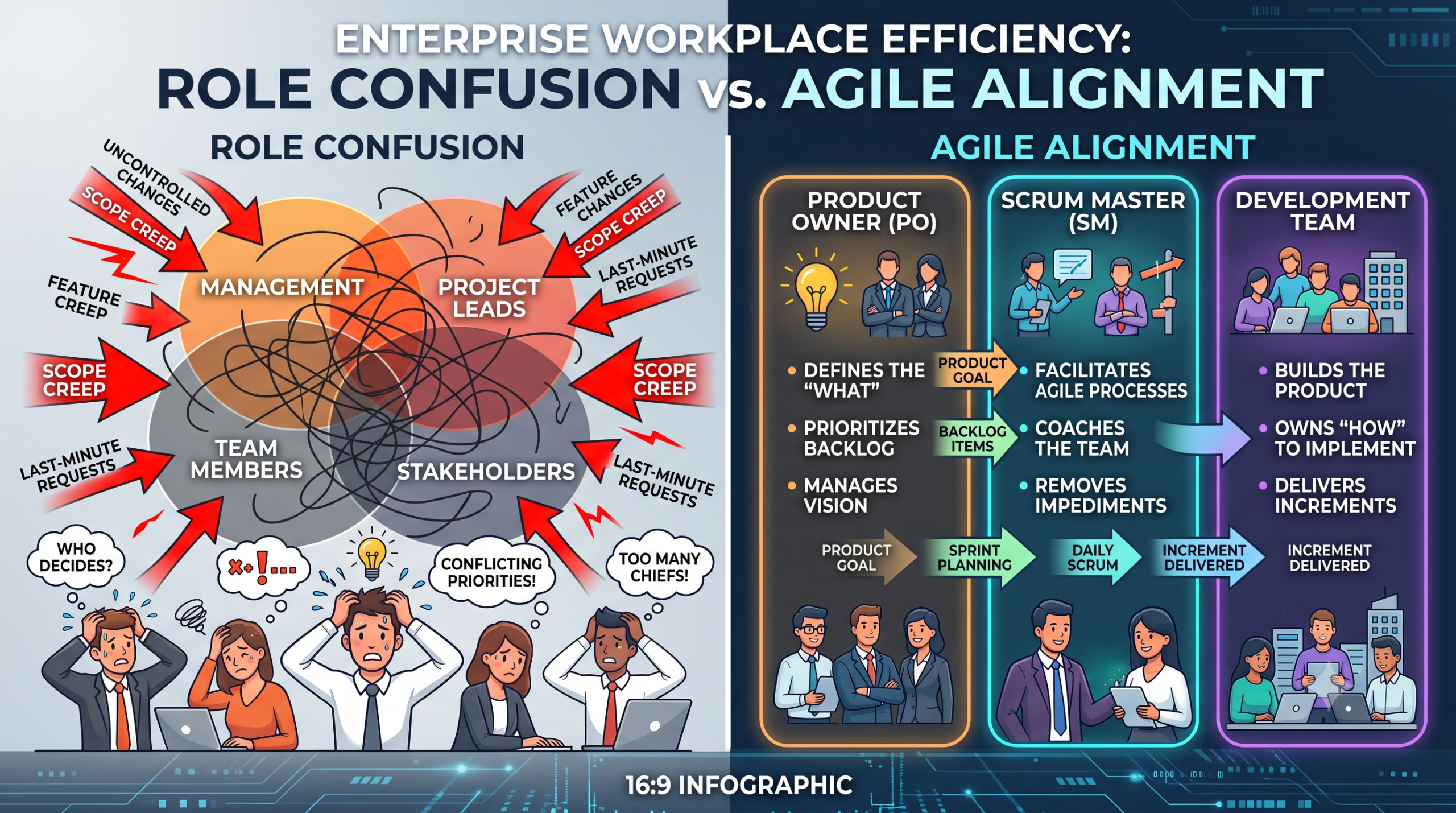
Achieving high-velocity delivery requires total clarity around the primary pillars of the Agile team structure. Each role serves a distinct purpose within the delivery ecosystem.
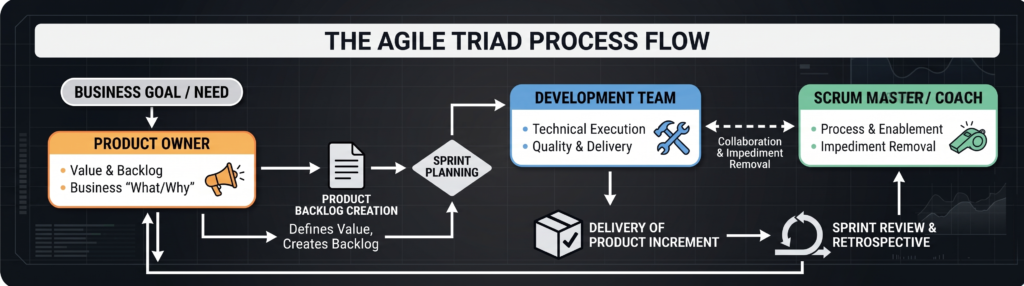
1. The Product Owner: Value Champion and Scope Gatekeeper
The Product Owner (PO) is the single point of accountability for maximizing the value of the product resulting from the team’s work. The PO bridges the gap between commercial strategy and technical execution.
Backlog Ownership: Curating, prioritizing, and maintaining the product backlog to ensure clear alignment with customer needs and corporate objectives.
Value Definition: Articulating the “what” and “why” behind every feature, defining acceptance criteria, and ensuring user stories are fully refined before sprint planning.
Stakeholder Management: Balancing competing demands from internal executives, external clients, and market requirements into a single, cohesive delivery roadmap
2. Scrum Master vs. Agile Coach: Navigating Enterprise Taxonomy
In modern enterprise environments, the titles Scrum Master and Agile Coach are frequently used interchangeably depending on corporate taxonomy or scaling frameworks such as SAFe. However, understanding their functional nuances is vital for organizational design:
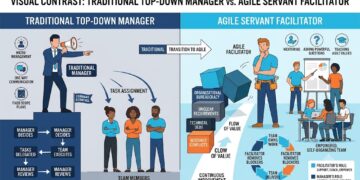
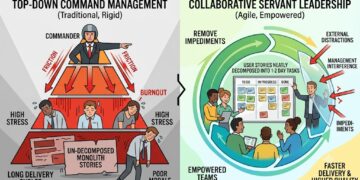
Scrum Master (Team-Level Facilitator): Primarily focuses on optimizing execution within one or two dedicated delivery teams. They act as servant leaders who protect sprint integrity, facilitate standard ceremonies, and clear daily operational blockers.
Agile Coach (Organizational Catalyst): Operates at a broader enterprise or multi-team level. They focus on systemic digital transformation, executive mentoring, readiness assessments, and scaling methodologies across departments.
Despite variations in operational scale, both roles share an identical core mandate: acting as process enablers, removing impediments, and fostering an environment where cross-functional teams thrive without top-down coercion.
3. The Cross-Functional Development Team: The Execution Engine
The Development Team consists of professionals who execute the technical work required to deliver a increment of product.
Self-Organization: Determining “how” to turn backlog items into working product increments.
Cross-Disciplinary Synergy: Combining engineering, quality assurance, design, and architecture expertise within a single unit to eliminate external handoff dependencies.
Collective Accountability: Owning the quality and delivery of sprint commitments as a cohesive team rather than isolated individuals.
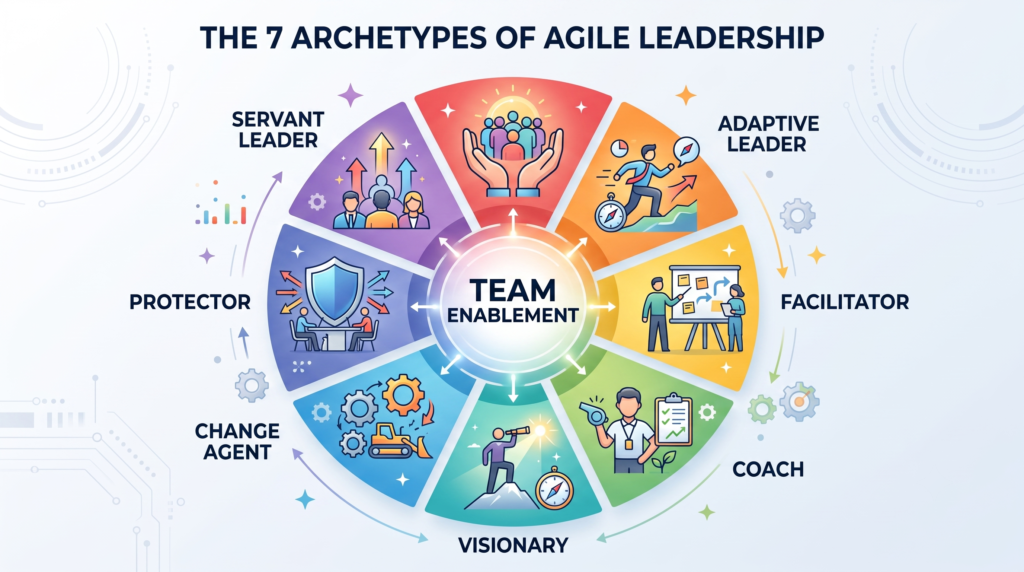
Leadership Spectrum: The 7 Archetypes of Agile Delivery
Agile leadership is not a rigid, static management style. Effective leaders adjust their style based on team maturity, organizational context, and project dynamics.
| Leadership Archetype | Core Focus & Responsibilities | Practical Application |
| Servant Leader | Puts team success first; prioritizes support, enablement, and bottleneck removal. | Clearing administrative blockers so developers can maintain flow state. |
| Adaptive Leader | Adjusts leadership style dynamically based on environmental context and situational stress. | Switching from passive coaching during stability to decisive facilitation during critical outages. |
| Facilitator | Provides structured environments and neutral platforms for autonomous problem-solving. | Structuring retrospective workshops that encourage open, constructive problem identification. |
| Coach | Mentors individuals to unlock potential, emphasizing long-term growth and systemic awareness. | Guiding team members to uncover root causes independently rather than prescribing immediate fixes. |
| Visionary | Articulates compelling strategic outcomes, unifying teams around shared purpose. | Framing complex technical migrations around overall business transformation goals. |
| Change Agent | Drives broader organizational evolution, process optimization, and cultural shifts. | Re-engineering legacy procurement and finance approvals to support rapid sprint releases. |
| Protector | Shields the delivery team from toxic external interference, executive pressure, and scope distortion. | Serving as a shock absorber against unvetted mid-sprint executive demands. |
The Protector Trap: Balancing Cushioning with Transparency
While serving as a “Protector” is essential for keeping teams focused, falling into the Protector Trap can backfire. Total insulation from organizational reality can breed complacency, mask delivery bottlenecks, and create a disconnect between developers and key business goals.
Effective Agile leaders practice transparent buffering. They absorb emotional stress and unvetted demands from senior management while maintaining open communication about business realities, strategic constraints, and stakeholder expectations.
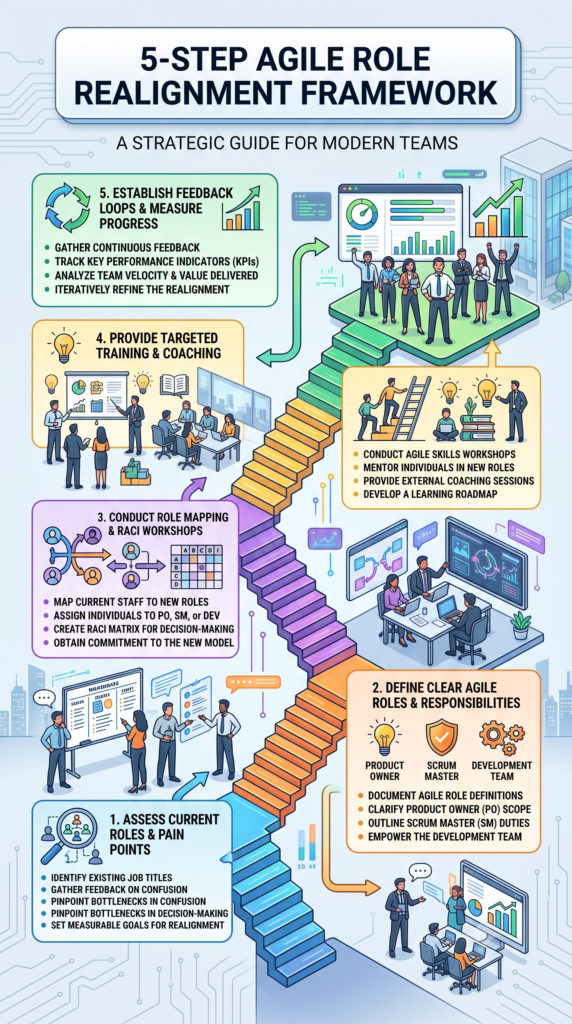
The 5-Step Agile Role Realignment Framework
To transition your organization from role ambiguity to high-performing alignment, implement this step-by-step framework.
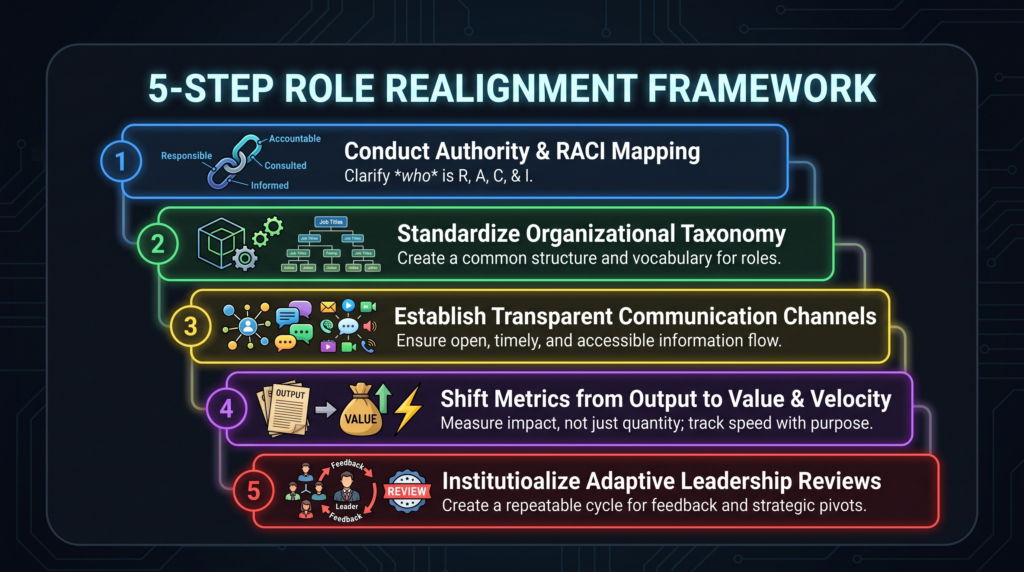
Step 1: Conduct Authority and RACI Mapping
Clarify decision rights across your delivery pipeline. Define who holds final authority for product scope (Product Owner), process mechanics (Scrum Master / Agile Coach), and technical implementation (Development Team). Eliminate overlapping permissions that cause friction.
Step 2: Standardize Organizational Taxonomy
Clarify job descriptions across your enterprise. Whether your organization uses the title Scrum Master, Agile Coach, or Delivery Lead, ensure clear baseline expectations for team-level facilitation versus enterprise-level coaching.
Step 3: Establish Transparent Communication Channels
Implement information radiators, big visible charts (BVCs), and structured daily standups to maintain broad visibility. Ensure team members understand stakeholder priorities, performance metrics, and operational risks.
Step 4: Shift Metrics from Output to Value and Velocity
Move away from tracking hours worked or micro-managing individual tasks. Evaluate success using empirical metrics such as sprint velocity, lead time, cycle time, and delivered feature value
Step 5: Institutionalize Adaptive Leadership Reviews
Train project leaders and managers to regularly evaluate their leadership approach. Encourage them to alternate between coaching, facilitating, and buffering based on team maturity and project urgency.
Transforming Organizational Chaos into Elite Delivery
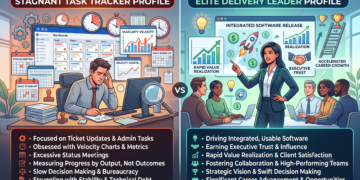
Establishing distinct boundaries between Product Owners, Scrum Masters, Agile Coaches, and Delivery Teams transforms team performance.
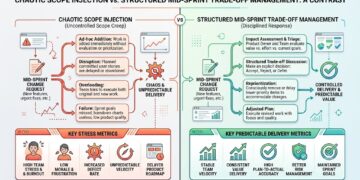
Eliminating Scope Friction: Clear Product Owner authority prevents mid-sprint disruptions, keeping developers focused on sprint goals.
Removing Operational Blockers: Dedicated Scrum Masters and Agile Coaches clear impediments systematically, boosting predictable delivery.
Preventing Burnout: Balanced buffering shields teams from toxic external chaos, maintaining sustainable execution pace.
Accelerating Product Releases: Self-organizing teams with high clarity deliver customer value faster and with higher quality.
For project leaders, mastering role clarity, servant leadership, and adaptive team management elevates your career trajectory. Moving beyond basic task tracking to become an adaptive transformational leader positions you as a critical driver of business success.
Mastering Agile Delivery with Skillsetify
Navigating Agile roles, frameworks, and enterprise transformations requires practical, real-world execution skills rather than simple theoretical knowledge.
If you are ready to stop guessing, move up the corporate ladder, and learn project management the right way, reach out to Skillsetify. We do not just teach frameworks: we show you your exact career growth trajectory.