Why the Best Agile Leaders Are Facilitators, Not Fixers
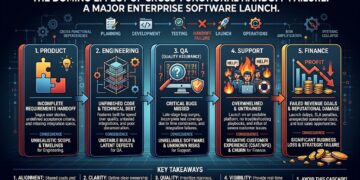
A critical system integration fails three days before a scheduled global software release. The project manager panics, takes control of the emergency call, overrides senior software architects, and mandates a rushed temporary fix. Fast forward two weeks: that quick fix triggers three major downstream database corruption errors, the engineering team disowns the problem because they were merely following orders, and the overall product delivery date slips by a full month.
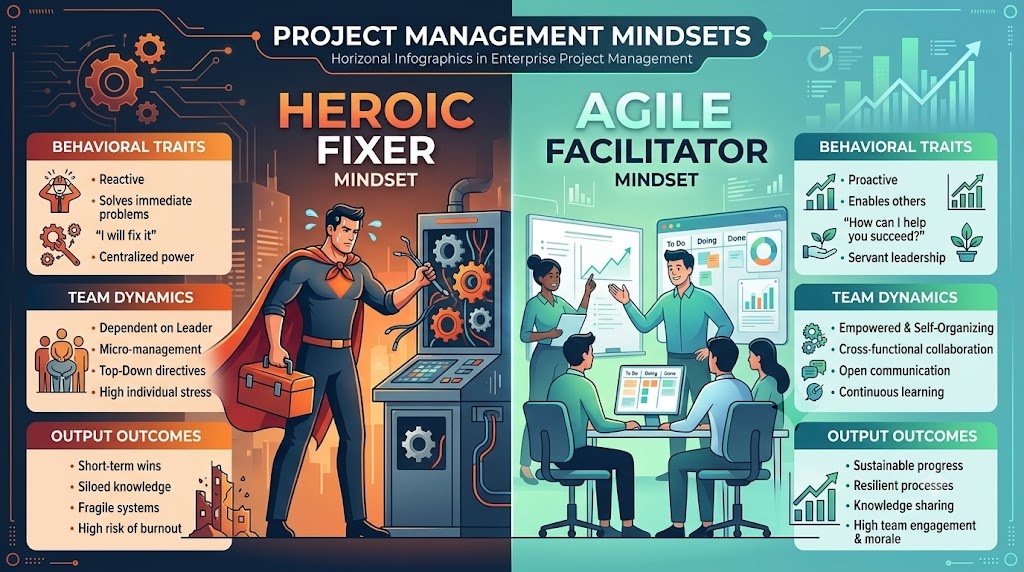
This painful pattern unfolds across corporate organizations every single day. Leaders repeatedly fall into the heroic trap: the mistaken belief that authority requires having every answer and driving every fix. In high-complexity, fast-moving technical environments, this command-and-control instinct crushes team initiative, inflates delivery risk, and leads directly to management burnout.
The most damaging myth in corporate project management is that leadership means step-by-step problem-solving. True Agile leadership flips this dynamic completely. The facilitator role does not exist to solve technical or operational problems for the team, but to construct and protect a conducive environment where teams solve problems independently.
Decoding the Facilitator Role in Modern Agile Leadership
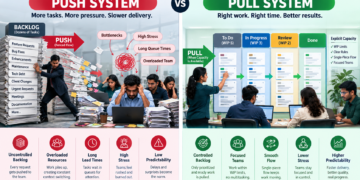
In traditional project management frameworks, leaders act as central routers. Tasks flow down, status updates flow up, and key decisions bottleneck at the executive layer. When blockers emerge, traditional managers intervene directly to dictate solution pathways.
An Agile facilitator operates as an environmental architect. Rather than directing traffic, the facilitator establishes a structured space engineered for independent problem-solving, team self-organization, and collaborative friction reduction. The primary goal is not to supply immediate answers, but to ask questions that illuminate options, clear organizational blockers, and optimize team dynamics
The Four Core Mechanics of Facilitative Leadership
Environmental Stewardship: Building the physical, digital, and psychological conditions required for focused execution and open communication.
Contextual Clarity over Directives: Defining the strategic parameters and business goals of a challenge while leaving technical solution ownership entirely to engineering expertise.
Active Neutrality: Guiding problem-solving discussions impartially without imposing personal technical biases onto the team’s resolution.
Impediment Shielding: Clearing systemic cross-departmental bottlenecks so team members can focus uninterrupted on high-value delivery.
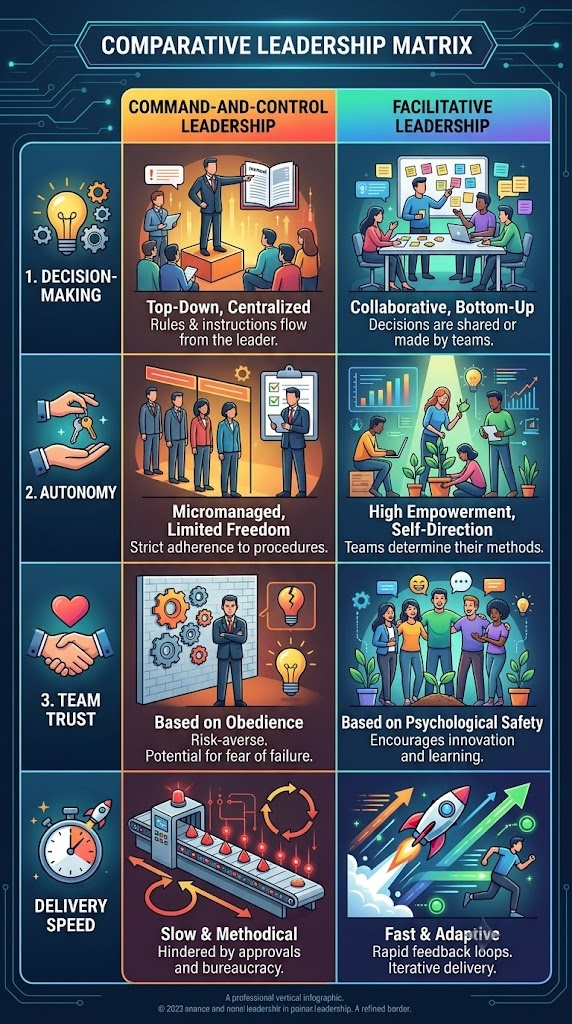
Command-and-Control Leadership vs. Facilitative Agile Leadership
| Dimension | Traditional Command-and-Control Leader | Agile Facilitative Leader |
| Primary Approach | Dictates solutions and assigns specific fix tasks | Provides strategic context and guides root-cause discovery |
| Team Autonomy | High dependency on manager approval loops | Self-organizing execution within established guardrails |
| Decision Ownership | Resides solely with the project manager | Owned collectively by domain experts |
| Velocity Impact | Constrained by manager bandwidth and availability | Escalates throughput via distributed execution |
| Risk Profile | Vulnerable to single-point-of-failure decision bottlenecks | Resilient, highly adaptable risk mitigation |
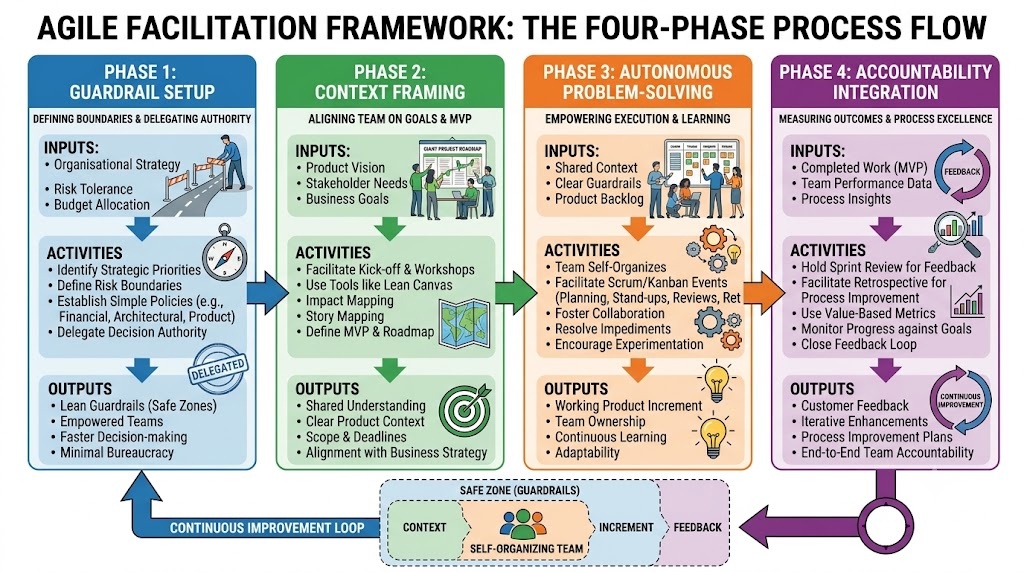
The Step-by-Step Facilitation Framework for Project Managers
Transitioning from a directive project manager to an elite Agile facilitator requires a repeatable, structured approach. This four-phase framework enables project leaders to foster problem-solving independence across enterprise delivery teams.
Phase 1: Establish Environmental Guardrails and Psychological Safety
Define Explicit Operational Boundaries: True team autonomy requires clear constraints. Establish non-negotiable parameters regarding budgets, security compliance standards, and release criteria before problem-solving begins.
Cultivate Psychological Safety: Ensure team members can highlight early project risks, admit technical errors, and test unconventional ideas without fear of executive reprimand.
Codify Team Working Agreements: Establish clear rules regarding communication channels, decision protocols, and focus blocks to minimize operational friction during critical sprints.
Phase 2: Frame the Challenge with Contextual Clarity
Isolate the Business “Why” and “What”: Frame technical challenges around end-user impact and business objectives rather than prescribing specific technical mechanisms.
Expose Visual Data Artifacts: Display sprint metrics, error logs, or customer feedback on shared digital dashboards to ground problem-solving discussions in objective facts.
Collaboratively Define Success Criteria: Guide the team to specify what a successful solution looks like before jumping into solution generation.
Phase 3: Guide Autonomous Problem-Solving Execution
Deploy Structured Collaboration Protocols: Replace unstructured, noisy open debates with systematic techniques such as Silent Brainstorming or 5-Why Root Cause Analysis to prevent dominant voices from hijacking outcomes.
Practice Intentional Silence: When silent pauses occur during critical discussions, resist the urge to jump in with immediate answers. Give team members space to process ideas and contribute.
Apply Consent-Based Decision Protocols: Shift team evaluation from asking for unanimous perfection to testing whether a proposed solution is safe to try and advances the project goal.
Phase 4: Enforce Autonomous Accountability
Transfer Action Item Ownership: Ensure team members directly assign, track, and document resolution steps on shared visual management workspaces.
Conduct Targeted Process Retrospectives: Analyze both the technical fix and the quality of the collaborative process itself during post-resolution reviews to continuously refine team dynamics.
Focus Manager Energy on Macro Impediments: Redirect project management efforts toward removing systemic organizational friction, resource dependencies, or cross-functional approval delays.
Transforming Operational Chaos into High-Performing Autonomy
Moving from directive management to master facilitation fundamentally upgrades an enterprise delivery capability. Teams break free from reactive firefighting, eliminate endless status check calls, and remove single-point-of-failure dependencies. In their place, a resilient delivery engine takes shape, one where self-organizing teams proactively flag risks, streamline technical workflows, and take complete ownership of business outcomes.
For project managers and Scrum Masters, this transformation marks a decisive career turning point. When you step back from acting as a task dispatcher, your daily bandwidth expands exponentially. You move from tactical task tracking to strategic value orchestration. Senior executives rarely promote managers for tracking line items; they elevate strategic enablers who build self-sustaining teams capable of predictable, scalable delivery. Mastering facilitation is the most powerful lever for accelerating your leadership trajectory in modern enterprise environments.
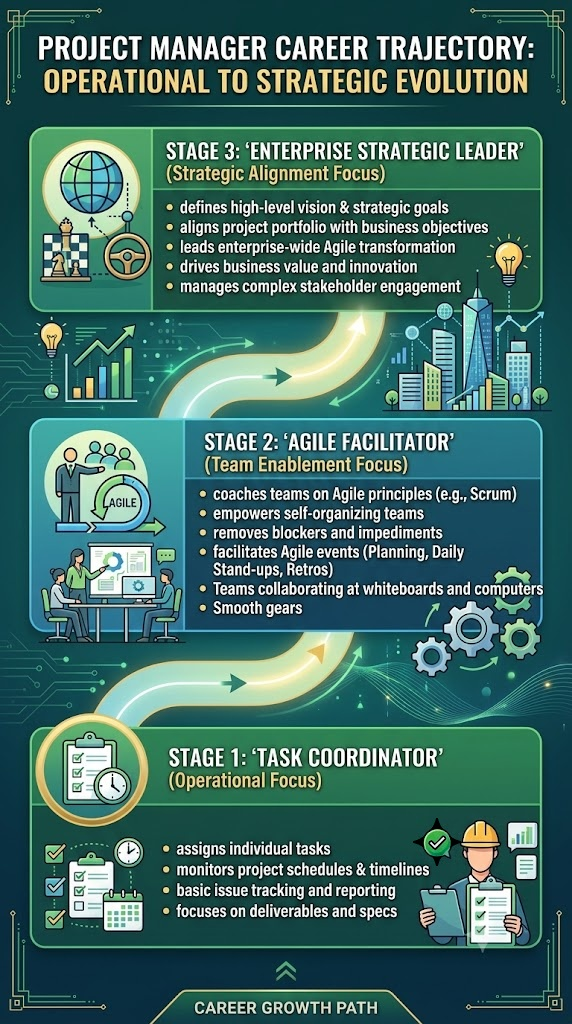
Transitioning your leadership style from directive control to empowering facilitation is how you build high-velocity teams, clear operational bottlenecks, and position yourself as an indispensable driver of organizational value.
If you are ready to stop guessing, move up the corporate ladder, and learn project management the right way, reach out to Skillsetify. We do not just teach frameworks: we show you your exact career growth trajectory