Why Cross-Functional Handoffs Fail (And How Swimlane Mapping Fixes It)
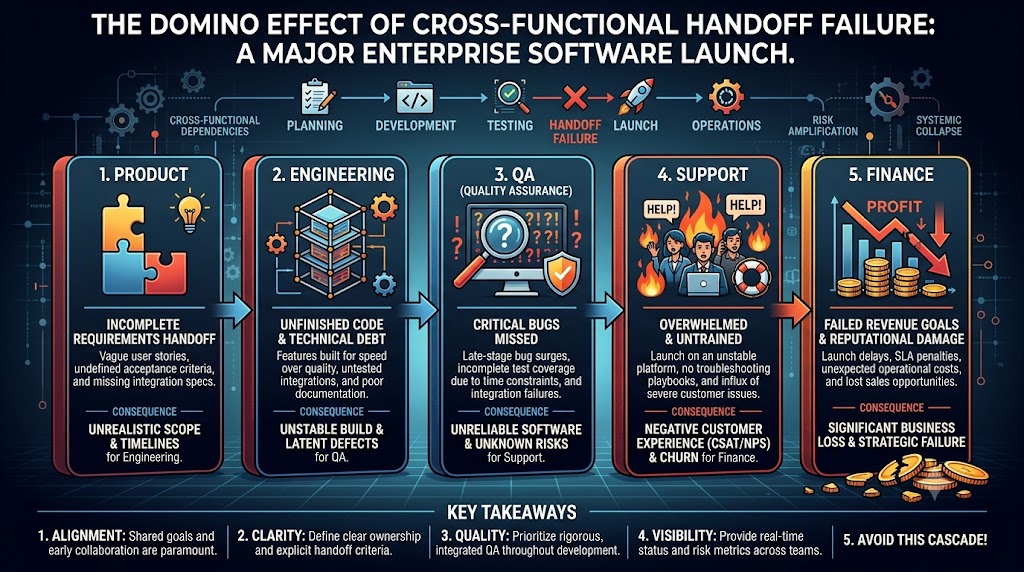
Imagine launch day for a critical enterprise software update. The product manager marks the feature epic as complete. Marketing releases the multi-channel promotional campaign. Sales account executives start demoing the feature to tier-one clients. Then the system crashes under load. Customer support is flooded with hundreds of escalation tickets, yet nobody on the support team was trained on the update. Engineering claims QA approved the deployment, QA claims they only tested a staging build, and Finance freezes software licensing payments because vendor milestone sign-offs were missing.
This scenario plays out in enterprise environments every single day. Project leaders spend hours dissecting post-mortems, usually blaming poor communication or team negligence. However, the root cause is rarely team failure. It is systemic handoff failure. Tasks were moving across team task boards, but nobody mapped the connective tissue between departments.
Dispelling the Corporate Myth
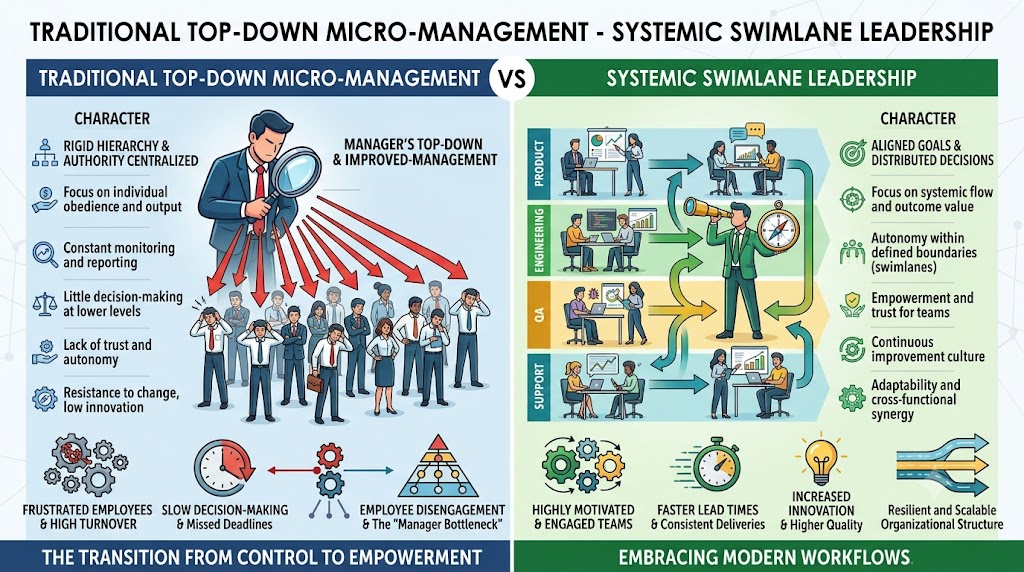
A pervasive myth in modern project management is that process mapping is a rigid, bureaucratic exercise designed for top-down micro-managers to police team output. Corporate leaders often view flowcharts as static documentation that sits in a dusty wiki page, forgotten as soon as it is drawn.
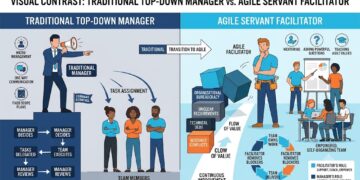
The reality is precisely the opposite. When executed correctly, swimlane process mapping is a dynamic, collaborative framework for servant leadership. It shifts the project manager’s role from top-down taskmaster to active facilitator, mentor, and impediment remover. Instead of policing individuals, swimlanes illuminate broken processes, enabling project managers to eliminate friction points so teams can perform at their highest level.
Anatomy of Swimlane Process Mapping: What, Why, and Core Mechanics
Traditional process maps and standard flowcharts suffer from a major structural flaw: they illustrate what steps happen in a workflow, but completely obscure who performs each step and where ownership transfers occur.
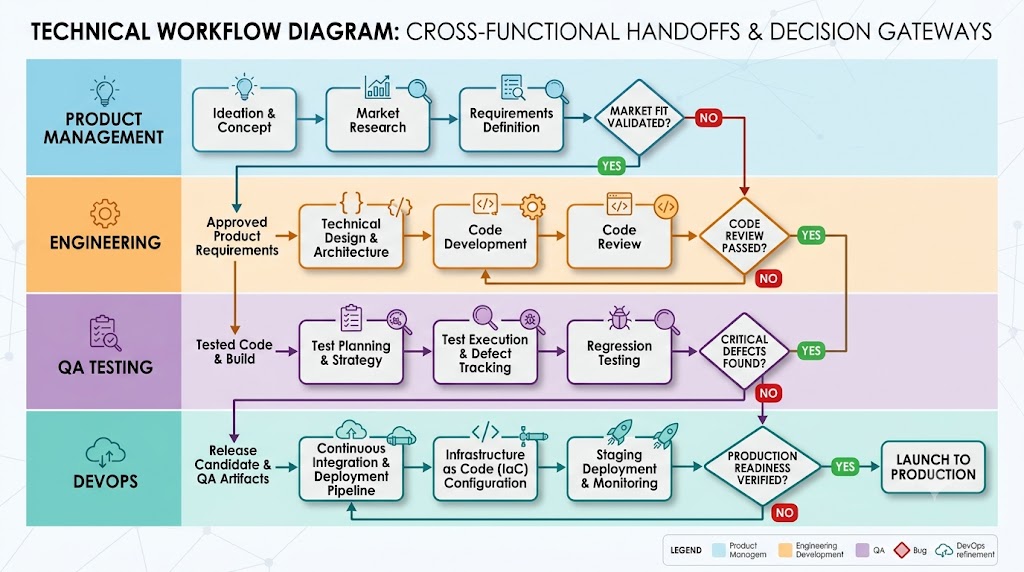
A Swimlane Diagram (also known as a cross-functional flowchart or Rummler-Brache diagram) solves this by organizing process steps into distinct horizontal or vertical lanes. Each lane represents a specific role, department, external vendor, or automated system. By delineating clear boundary lines between participants, swimlanes bring radical visual transparency to complex cross-functional workflows.
Core Visual Symbols and Mechanics
To build an authoritative swimlane map, project managers must master standard visual taxonomy:
Swimlanes (Lanes): Horizontal or vertical rows that categorize actions by actor, department, or system (e.g., Product Manager, Systems Developer, QA Engineer, Compliance Lead).
Terminal Points (Ovals): Represent the exact trigger where the process starts and the concrete deliverable where it terminates.
Activity Nodes (Rectangles): Specific actionable tasks performed by the assigned swimlane owner.
Decision Gateways (Diamonds): Branching logic points that evaluate specific conditions (e.g., “Is Code Coverage > 85%?”). These nodes explicitly route work forward or force loopbacks.
Connector Arrows: Flow lines showing the chronological progression of tasks and cross-lane handoffs.
The true power of a swimlane diagram resides in the arrows that cross lane boundaries. Every cross-lane arrow represents a functional handoff. In enterprise operations, every handoff is a high-risk zone for context loss, wait-time inflation, and misaligned expectations.
Integrating Swimlanes into Board Architecture and Flow Metrics
A static swimlane map on a whiteboard is only half the battle. To drive daily operational performance, elite project managers translate swimlane workflows directly into digital board architecture (such as Kanban or Scrum boards) and track continuous flow metrics.
When mapping a swimlane framework into board architecture, columns represent the stages of work, while horizontal swimlanes categorize work types, team roles, or functional ownership. This architecture allows leaders to track critical flow metrics that reveal hidden operational drag.
Essential Flow Metrics for Board Architecture
Work-In-Progress (WIP) Limits: Explicit caps placed on the number of active cards allowed in a given lane or column at any time. Unrestricted WIP creates multitasking, context switching, and delivery bottlenecks.
Lead Time: The total elapsed time from the moment a request or story is initially created in the backlog to its final deployment or delivery.
Cycle Time: The active duration from when a team member actually pulls a task into “In Progress” until it reaches “Done”.
Handoff Lag: The silent, non-value-added wait time spent when a task sits idle in a queue waiting for another department or role to pull it into their swimlane.
Lead time is mathematically expressed as the sum of active cycle time and non-value-added wait time:
When project managers analyze swimlanes through this lens, they quickly discover that project delays are rarely caused by slow execution (cycle time). Instead, 80% of project inflation stems from wait time during cross-functional handoffs.
The 5-Step Implementation Framework for Project Managers
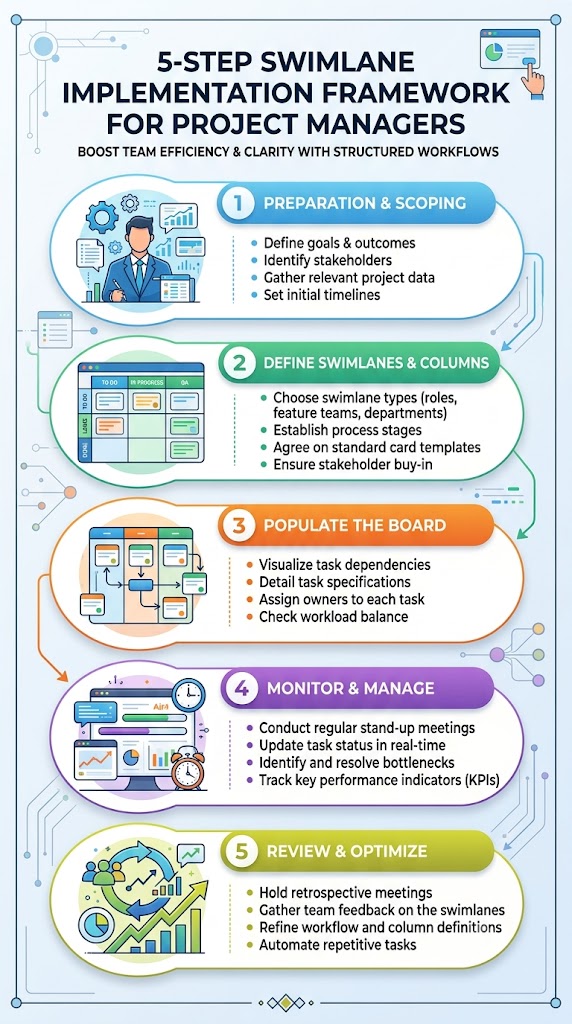
For project managers looking to implement swimlane process mapping immediately, follow this actionable, step-by-step blueprint:
Establish Clear Process Boundaries: Define the precise initiating trigger (e.g., “Customer submits custom feature request”) and the definitive end condition (e.g., “Feature live in production with billing updated”). Avoid scope creep by keeping the boundary fixed.
Identify Cross-Functional Actors: List every internal department, individual role, external third party, and automated tool involved in the lifecycle. Create a dedicated lane for each entity.
Map the “As-Is” Reality (Not the “To-Be” Fantasy): Facilitate a collaborative workshop with actual operational execution staff, not just high-level executives. Document how work is currently done, complete with informal workarounds, hidden approvals, and manual rework loops.
Audit Handoffs, Wait Times, and Bottlenecks: Trace every cross-lane arrow. Ask the team critical questions: How long does work sit in an inbox before being picked up? Who verifies quality at the boundary? Where do decision diamonds cause infinite rework loops?
Shift to Active Impediment Removal: Use the mapped visual flow to identify structural friction points. Re-architect board column policies, automate manual handoffs, and mentor team members through systemic blockers.
From Firefighting Chaos to High-Velocity Delivery
Imagine stepping into your office on a Monday morning without an inbox full of frantic escalation emails. Imagine status meetings where you no longer need to interrogate team members about task updates because the board architecture visually communicates the precise state, owner, and velocity of every epic in real time.
When you master process mapping and swimlane architecture, your daily reality transforms dramatically:
Scope Creep Eradication: Decision gateways enforce clear criteria before work crosses into execution lanes, preventing unvetted feature creep.
Predictable Throughput: By enforcing WIP limits across lanes, team overburden is eliminated, resulting in consistent, sustainable delivery velocity.
Elimination of Inter-Departmental Friction: Blame culture evaporates when handoff policies and lane responsibilities are transparently documented and agreed upon.
The Career Trajectory of the Servant-Leader PM
Beyond operational wins, mastering this domain fundamentally alters your career trajectory. Mediocre project managers act as administrative status aggregators: they push task lists, send reminder emails, and manage top-down through pressure. Executive leadership views them as overhead.
Elite project managers act as systems architects and servant leaders. They use swimlanes to mentor team members, identify root-cause impediments, and smooth out operational pathways. When you demonstrate the ability to enter a chaotic, cross-departmental environment, map complex handoffs, eliminate 30% of non-value-added lag time, and foster a collaborative team culture, executive leaders notice. You transition from an operational coordinator to an indispensable strategic leader.
Elevate Your Project Leadership with Skillsetify
Mastering swimlane process mapping and board architecture is not just about drawing better flowcharts: it is about taking control of your team’s operational environment and actively removing the structural roadblocks that hold exceptional talent back. By replacing top-down management with visual transparency, mentorship, and proactive impediment removal, you turn chaotic cross-functional initiatives into predictable, high-performing delivery engines.
If you are ready to stop guessing, move up the corporate ladder, and learn project management the right way, reach out to Skillsetify. We do not just teach frameworks: we show you your exact career growth trajectory. Through our hands-on mentoring and real-world executive curriculum, Skillsetify equips ambitious professionals with the exact tools needed to master complex enterprise delivery, build high-trust teams, and land top-tier project leadership roles. Contact Skillsetify today and transform your project management career.