How Pull System Mechanics Eliminate Chaos and Restore Predictable Delivery
Picture a scenario played out every Monday morning in corporate boardrooms worldwide. A project manager stands in front of a bloated work management board, surrounded by stressed engineers, anxious leads, and an executive asking why a critical release is three weeks late. The response from management is predictably flawed: “We need to push harder. Let us assign these ten critical feature requests to the developers immediately so they can get started.”
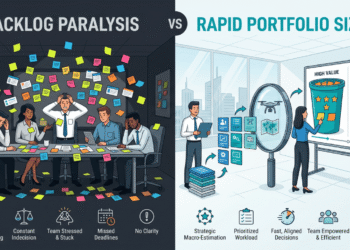
By Friday, forty distinct tasks are sitting in active development across a seven-person engineering team. Context switching reaches toxic levels. Daily standups turn into defensive debates about why tasks remain incomplete for weeks. High-priority items languish while engineers spend twenty-three minutes after every interruption trying to regain focus. The delivery date slips again, morale plunges, and leadership demands higher personal utilization rates.
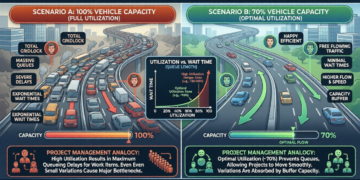
This organizational failure stems from a fundamental misunderstanding of flow dynamics. The underlying myth destroying team productivity is the belief that 100% resource utilization equates to high output, and that pushing work onto people as soon as a request arrives speeds up delivery. In physical and digital systems alike, pushing work into an already saturated pipeline does not increase output. It merely expands queues, bloats work-in-progress, and balloons lead time. Real operational efficiency requires flipping this dynamic entirely through the discipline of Pull System Mechanics.
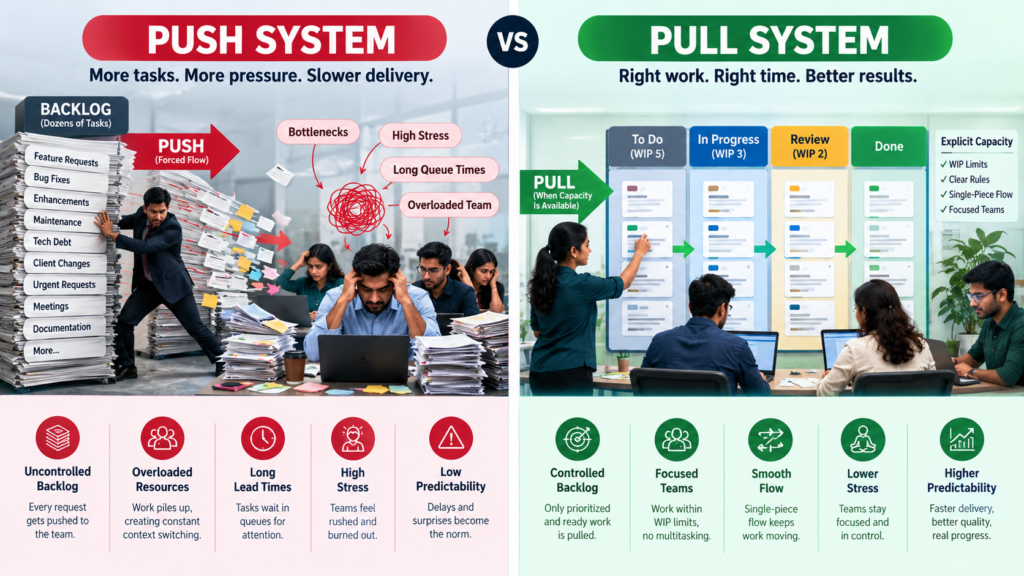
The Core Mechanics: Push vs. Pull Explained
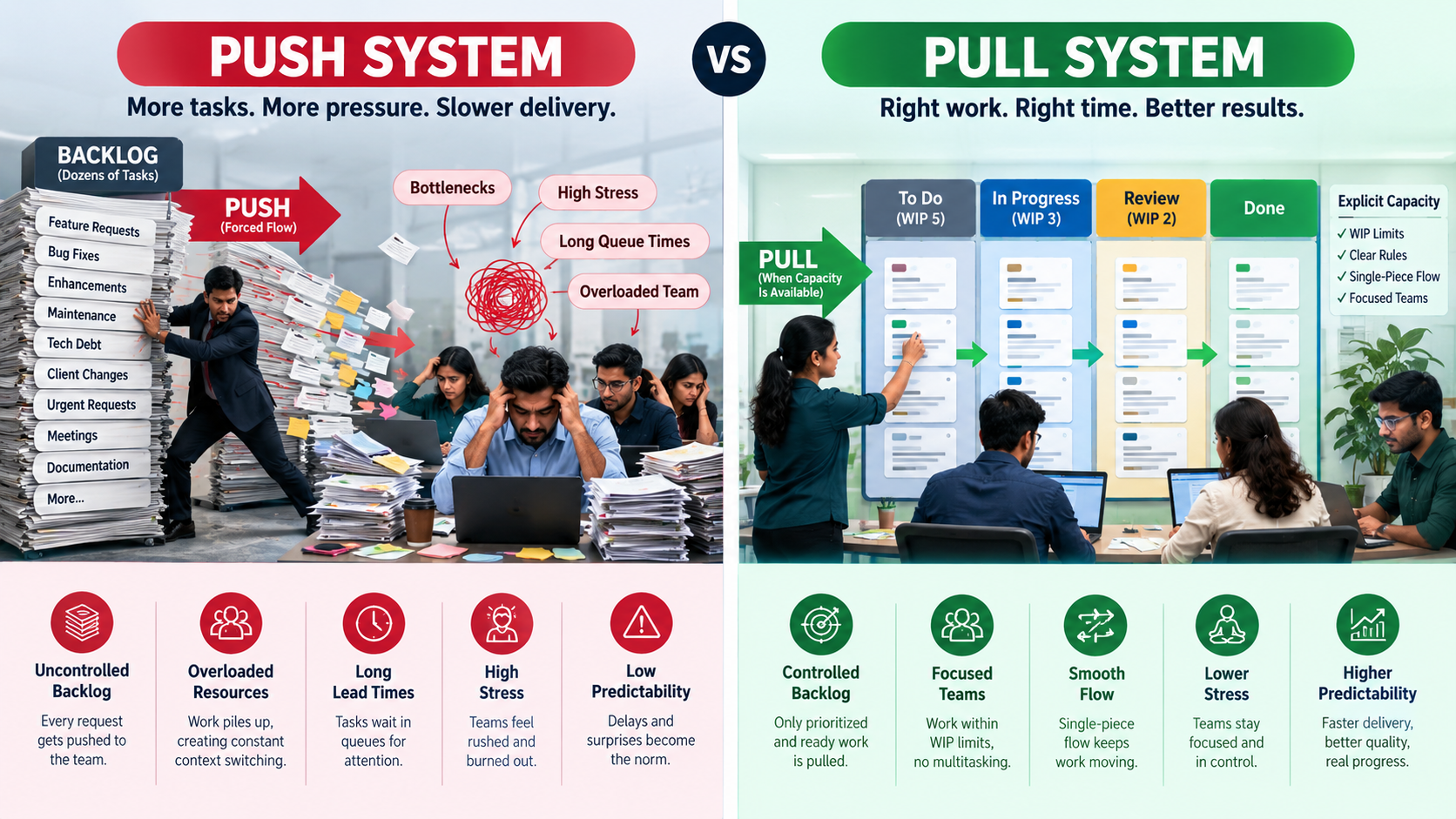
In a traditional push system, work allocation is governed by forecasts, schedules, or immediate management demands. Tasks are pushed into execution phases regardless of whether the downstream team has available bandwidth. The outcome is predictable: local bottlenecks form, cognitive load explodes, and work sits idle in hidden buffers waiting for attention.
A pull system operates on an entirely opposite premise, rooted in Lean manufacturing and refined within Kanban foundations. Work is pulled into an active work-in-progress state only when clear, demonstrable capacity becomes available. Rather than overloading individuals, the system acts as a controlled pipeline. A team member finishes a current work item, moves it to the next completed stage, and only then pulls a single new high-priority item from the prioritized queue.
The Mathematical Engine: Little's Law
The pull system is not merely a team preference: it is anchored in queueing theory. The mathematical engine governing workflow predictability is Little’s Law, formulated by mathematician John D. C. Little. In project management contexts, Little’s Law demonstrates the direct relationship between three core flow variables:
Where:
Work In Progress (WIP) represents the total number of active tasks currently being worked on within the system boundary.
Throughput represents the average rate at which completed work items exit the system per unit of time (for example, items per week).
Lead Time represents the total elapsed time from the moment a work request enters the system to the moment it is delivered to the customer.
The operational takeaway of Little’s Law is profound. If you increase WIP without a proportional increase in team capacity or throughput, your lead time skyrockets automatically. Conversely, by enforcing strict WIP limits and reducing the volume of concurrent work, you dramatically decrease lead time while maintaining or even increasing throughput.
Key Flow Metrics Demystified
To manage a pull system effectively, project leaders must distinguish between key metrics that reveal true delivery performance.
Lead Time vs. Cycle Time:
Lead Time: The total wall-clock time from the initial creation of a request in the backlog to its final release. Lead time measures customer experience.
Cycle Time: The active duration spent working on an item, measured from the moment a team member pulls it into work-in-progress to the moment it reaches completion.
In unmanaged push systems, cycle time might be two days, but lead time stretches to forty days because tasks sit idle in queues. A pull system targets wait time reduction, bringing lead time down toward actual cycle time.
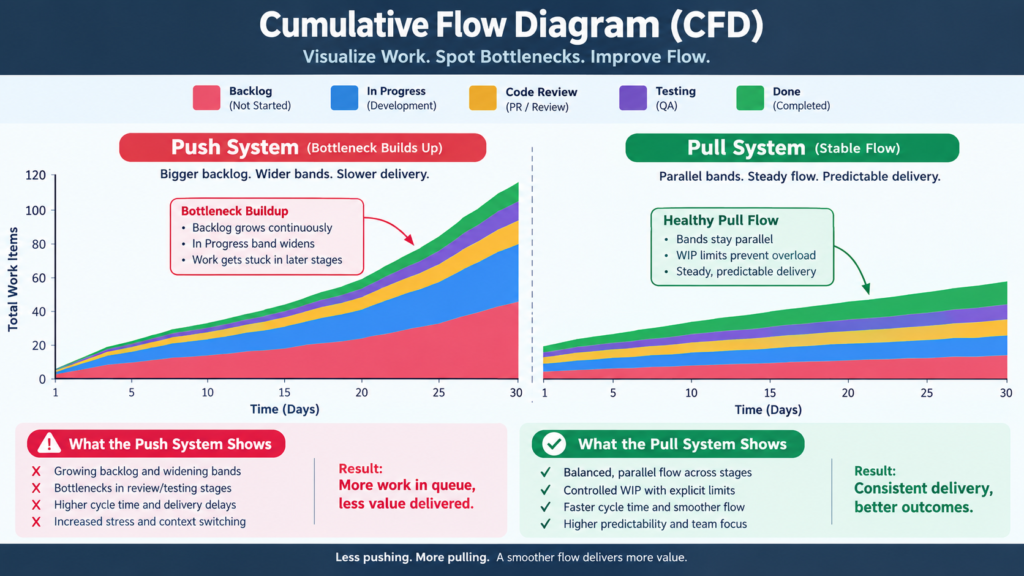
Cumulative Flow Diagrams (CFDs):
A Cumulative Flow Diagram tracks the cumulative distribution of work cards across every workflow stage over time.
Stable Flow: Parallel bands indicate a balanced pull system where work enters and exits at equal rates.
Widening Bands: An expanding band in a WIP column signals a bottleneck where tasks are being pushed in faster than downstream stages can pull them.
Flat Lines: A horizontal band across completed stages signals blocked progress, where downstream work has halted.
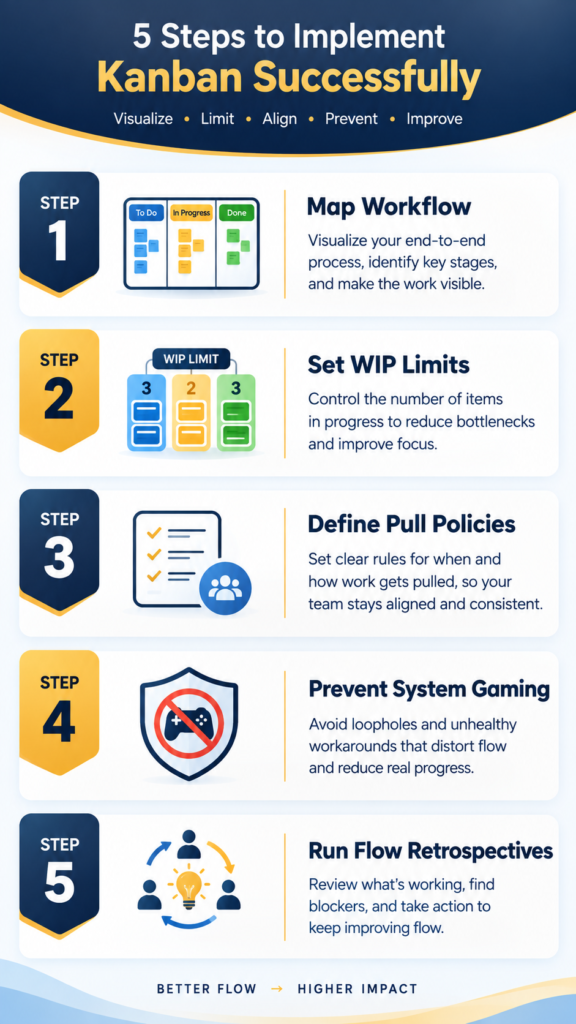
Step-by-Step Implementation Framework for Project Managers
Transforming a chaotic push environment into a high-performing pull system requires a structured, multi-phase operational blueprint.
Step 1: Map the True End-to-End Workflow
Begin by visualising the actual workflow on a Kanban board rather than an idealized process. Create explicit columns for every state a task moves through, such as Analysis, In Development, Peer Review, Testing, and Deployment. Use horizontal swimlanes to categorize service classes (for example, Expedite, Standard, and Maintenance) or distinct product modules.
Step 2: Establish Explicit WIP Limits
Set quantitative bounds on the maximum number of items allowed in active columns simultaneously. For teams transitioning to pull mechanics, use proven baseline formulas:
Alternatively, measure your team’s current active task count and apply an immediate 25% reduction to expose process constraints gently.
Step 3: Implement Explicit Pull Policies
Define explicit exit criteria for every board column. Create a golden rule: “Stop Starting, Start Finishing.” When an active column hits its WIP limit, no team member may pull a new card from the left. If a worker becomes free, they must look rightward to assist with code reviews, unblock stuck cards, or swarm on testing before pulling new work.
Step 4: Guard Against System Gaming
A common failure mode occurs when teams game pull mechanics by artificially breaking tasks into tiny subtasks to simulate rapid movement, or by hiding active work outside official board columns. Counter this by establishing standard definition of done criteria and sizing cards based on real deliverable value rather than micro-activity logs.
Step 5: Establish Continuous Feedback Loops
Integrate regular cadence meetings, such as daily flow syncs and bi-weekly replenishment meetings. Use throughput data and CFD analysis to review blockages, adjust WIP limits dynamically, and refine team capacity forecasts.
The Professional Transformation
When you successfully transition your team from push mechanics to a disciplined pull system, the immediate operational shift is transformative. The perpetual firefighting, frantic status updates, and late-night release rescues disappear. In their place emerges a predictable, sustainable cadence of execution characterized by low friction, high team morale, and crystal-clear visibility.
Instead of presenting executive sponsors with vague percentage completion estimates, you deliver precise lead time distributions backed by empirical queueing data. Scope creep is constrained naturally by capacity limits, and bottlenecks become visible operational targets rather than hidden sources of frustration.
Mastering flow mechanics elevates your professional trajectory. The corporate world does not short-change leaders who consistently deliver complex initiatives predictably without burning out teams. By moving beyond basic task management into sophisticated flow architecture, you shift your standing from a tactical administrator to a strategic business leader who controls operational outcomes through data, systems, and disciplined execution.
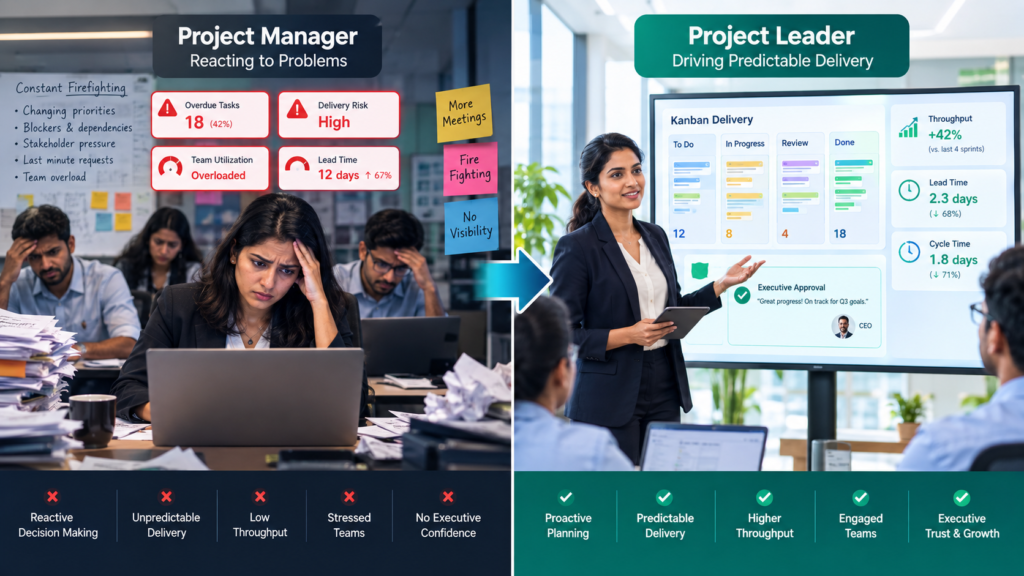
The pull system is more than a board setup: it is an operational mindset that separates reactive managers from elite project leaders. By enforcing WIP limits, leveraging Little’s Law, and optimizing end-to-end flow, you eliminate over-utilization waste and unlock predictable delivery across your entire portfolio.
If you are ready to stop guessing, move up the corporate ladder, and learn project management the right way, reach out to Skillsetify. We do not just teach frameworks: we show you your exact career growth trajectory.