The Facilitator’s Blueprint for Agile Mastery and Active Impediment Removal
A critical enterprise product release is bleeding past its deadline. Sprint velocity has dropped 40 percent over three consecutive iterations, key developers are visibly burned out, and the Jira board is clogged with stale tickets. Standing over the team, a traditional project manager barks orders: “Why isn’t this code merged? Who was assigned to this API dependency? Push it through immediately!”
The response? Silence. The launch fails catastrophically because developers hid critical technical debt and unaddressed cross-departmental blockers out of fear.
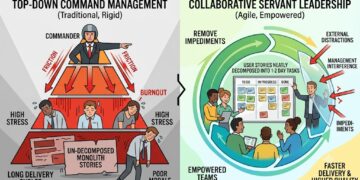
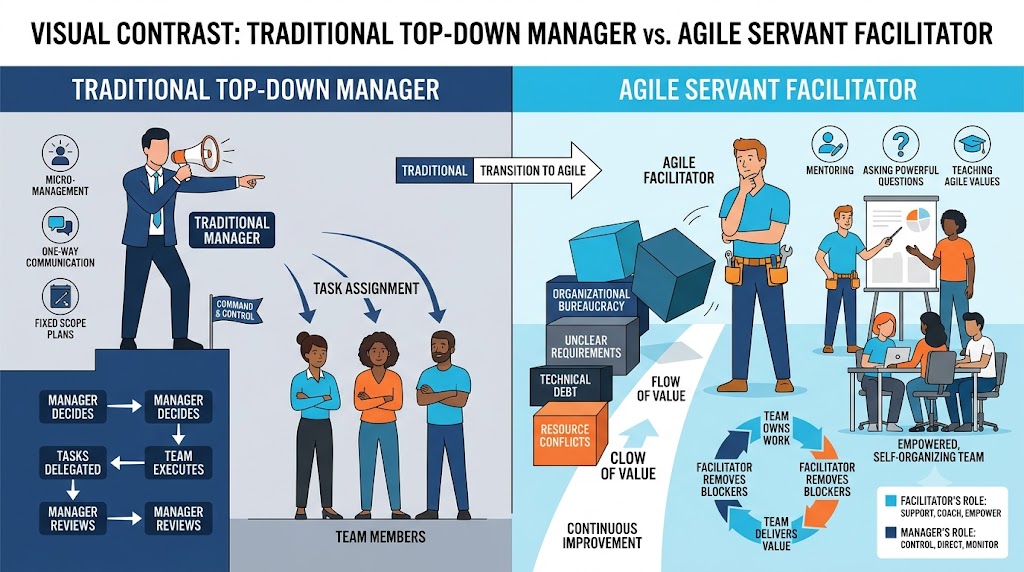
This crisis highlights a fundamental flaw in modern corporate project management. The most destructive myth circulating in enterprise tech is that Agile transformation simply means converting traditional command-and-control managers into Scrum Masters or Kanban leads while keeping top-down behaviors intact. True Agile maturity does not swap Gantt charts for sticky notes while retaining rigid authority. It demands a complete shift in leadership posture: moving away from top-down direction and toward active facilitation, team mentoring, and relentless impediment removal.
Decoupling Agile Variations: How Facilitation Adapts Across Frameworks
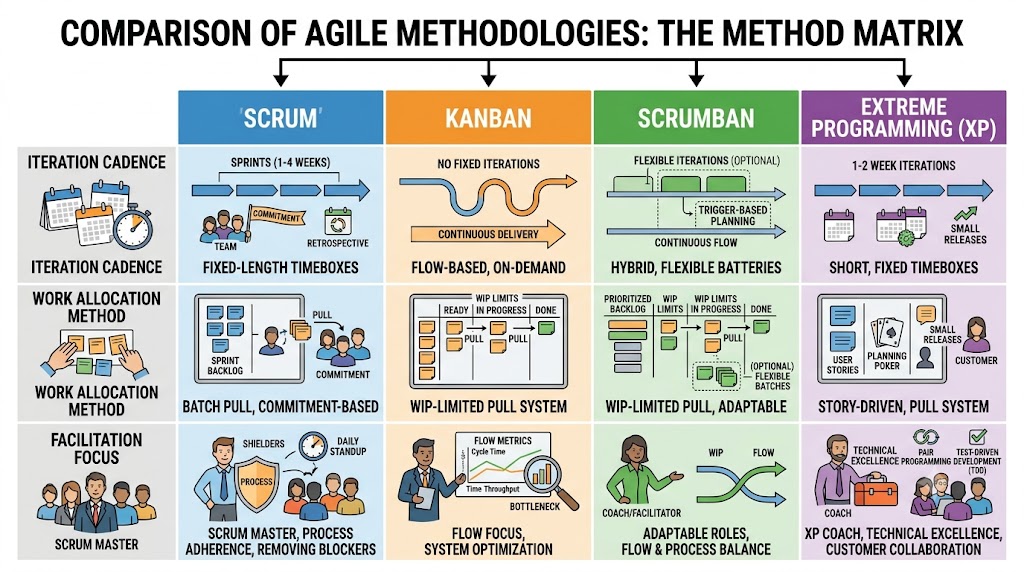
Agile is not a single, monolithic rulebook. It is a spectrum of frameworks designed for varying degrees of uncertainty, operational stability, and team structures. Choosing the right variation requires understanding how leadership stance shifts across each framework.
Scrum: Timeboxed Structure and Role Clarity
Scrum relies on structured timeboxes called Sprints, typically lasting two to four weeks. It relies on three clearly defined roles: the Product Owner, the Scrum Team, and the Scrum Master.
The Facilitation Stance: In Scrum, facilitation focuses on structured ceremonies including Sprint Planning, Daily Standups, Sprint Reviews, and Retrospectives. The leader does not assign tasks. Instead, they facilitate self-organization, ensuring the team commits to a feasible Sprint Goal based on historical capacity.
The Leadership Role: The leader acts as a protective shield, shielding developers from external scope creep and executive distractions during the active Sprint.
Kanban: Flow Optimization and Continuous Delivery
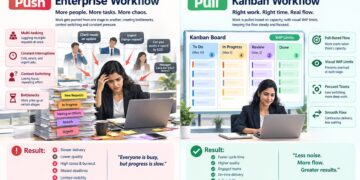
Unlike Scrum, Kanban operates without rigid timeboxes. It focuses on continuous delivery, visual workflow mapping, and strict limits on Work-In-Progress (WIP).
The Facilitation Stance: Facilitation shifts from ceremony moderation to continuous flow diagnosis. The leader monitors metrics like Cycle Time, Lead Time, and Throughput to spot workflow bottlenecks.
The Leadership Role: The leader facilitates pull-based work distribution. Rather than pushing tasks onto overburdened engineers, the leader ensures team members pull new work from the backlog only when capacity opens up under explicit WIP limits.
Scrumban and Extreme Programming (XP): Hybrid Agility
Scrumban: Combines the structure of Scrum events with the continuous flow and WIP discipline of Kanban. It is ideal for teams balancing feature development with unpredictable operational support.
Extreme Programming (XP): Focuses heavily on engineering practices like Pair Programming, Test-Driven Development (TDD), and Continuous Integration. Facilitation here centers on mentoring developers in technical excellence and facilitating immediate feedback loops between coders and business stakeholders.
Regardless of whether a team implements Scrum, Kanban, or a hybrid variation, the underlying core mechanism remains constant: success hinges on facilitating collaboration rather than demanding compliance.
The Four Stances of Elite Agile Leadership
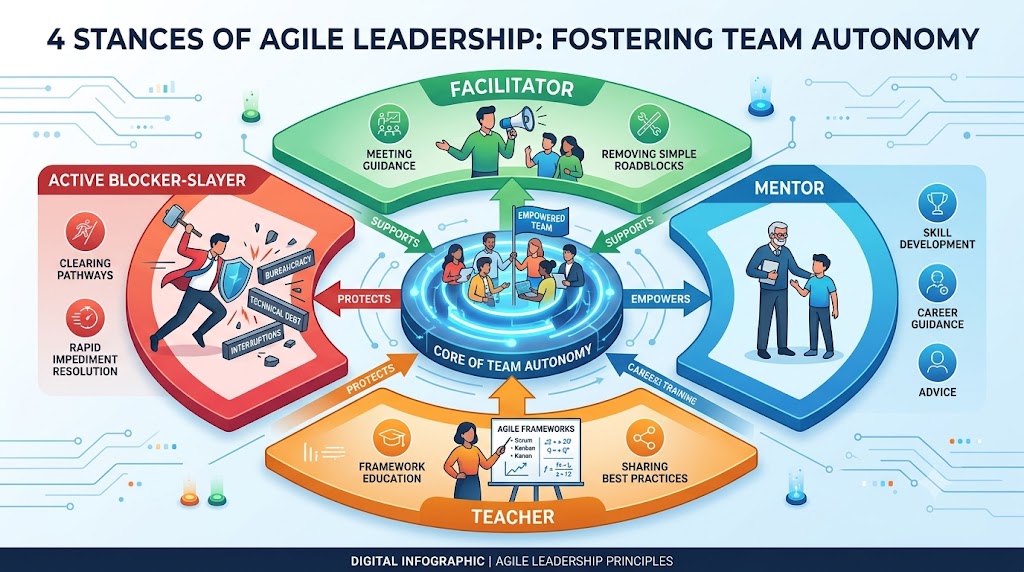
To lead high-performing teams without relying on top-down authority, project leaders must master four distinct operational stances. Knowing when to switch between these stances separates novice coordinators from elite project leaders.
1. The Neutral Facilitator
The leader acts as an unbiased guide during team discussions, planning sessions, and conflict resolutions. They design structured environments where every voice is heard, using techniques like silent brainstorming and dot-voting to build genuine consensus without imposing personal bias.
2. The Developmental Mentor
Rather than dictating solutions when a team member faces a complex technical or operational challenge, the leader asks guiding, open-ended questions. Mentoring builds long-term problem-solving capability within the team, transforming passive order-takers into autonomous decision-makers.
3. The Lean-Agile Teacher
The leader continuously educates the team and broader organization on core Agile principles, such as iterative value delivery, WIP limits, and continuous improvement. They explain the functional reasoning behind Agile practices so team members understand the purpose behind every workflow standard.
4. The Active Blocker-Slayer
Impediment removal is where Agile leadership moves from theoretical philosophy to concrete execution. An impediment is any barrier that exceeds the team’s direct authority or capacity to resolve. Elite leaders do not simply log blockers in a weekly status report: they actively engage outside departments, clear administrative roadblocks, and fight corporate bureaucracy on behalf of the team.
The Active Impediment Removal Protocol: A 5-Step Execution Framework
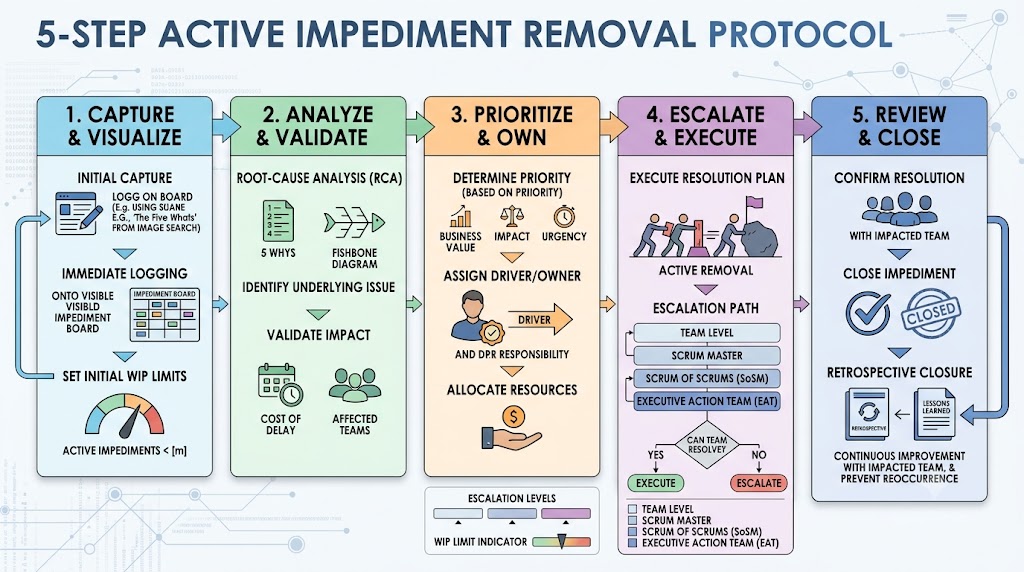
Project managers need a systematic execution protocol to clear blockers and maintain continuous delivery flow. This step-by-step framework can be integrated directly into any team’s daily operational rhythm.
Step 1: Capture and Categorize Blockers Immediately
Capture obstacles the moment they surface during daily standups or Kanban board reviews. Categorize each blocker immediately:
Internal Blockers: Code reviews, technical debt, or localized resource constraints within the team’s immediate control.
External Blockers: Pending API access, delayed vendor deliveries, cross-departmental security sign-offs, or shifting compliance requirements.
Step 2: Establish Explicit WIP Limits to Expose Bottlenecks
Impediments often stay hidden under stack-ranked task lists. Enforce strict WIP limits on active workflow columns (such as “In Development” or “In Testing”). When a column hits its limit, forbid the team from pulling new work. This operational halt forces hidden blockers to the surface immediately, compelling the entire team to clear the obstruction before resuming normal flow.
Step 3: Conduct Facilitated Root-Cause Analysis
When systemic blockers recur, lead the team through a structured 5-Whys analysis or Fishbone Diagram exercise. Focus team energy strictly on process breakdowns rather than individual fault:
Problem: The deployment failed security compliance testing.
Why? Security requirements were reviewed on the final day of the iteration.
Why? The security team was not looped into backlog refining.
Why? Security reviews are structured as external gatekeeping rather than integrated backlog criteria.
Root Cause: Lack of shift-left security integration in the initial definition of done.
Step 4: Enforce Cross-Departmental Service Level Agreements (SLAs)
Negotiate concrete escalation paths and turnaround SLAs with external department heads (Legal, IT Infrastructure, InfoSec, Finance). When an external blocker occurs, leverage executive sponsorship to resolve issues within agreed timeframes rather than letting tickets languish in administrative queues.
Step 5: Close the Loop in Retrospectives
Transform cleared impediments into permanent operational standards. During iteration retrospectives, evaluate how blockers were handled and update team working agreements, acceptance criteria, or definition of done standards to prevent identical blockers from recurring.
From Project Chaos to Predictable Elite Delivery
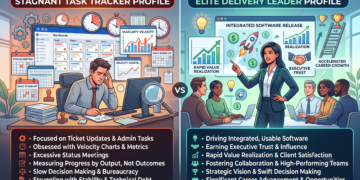
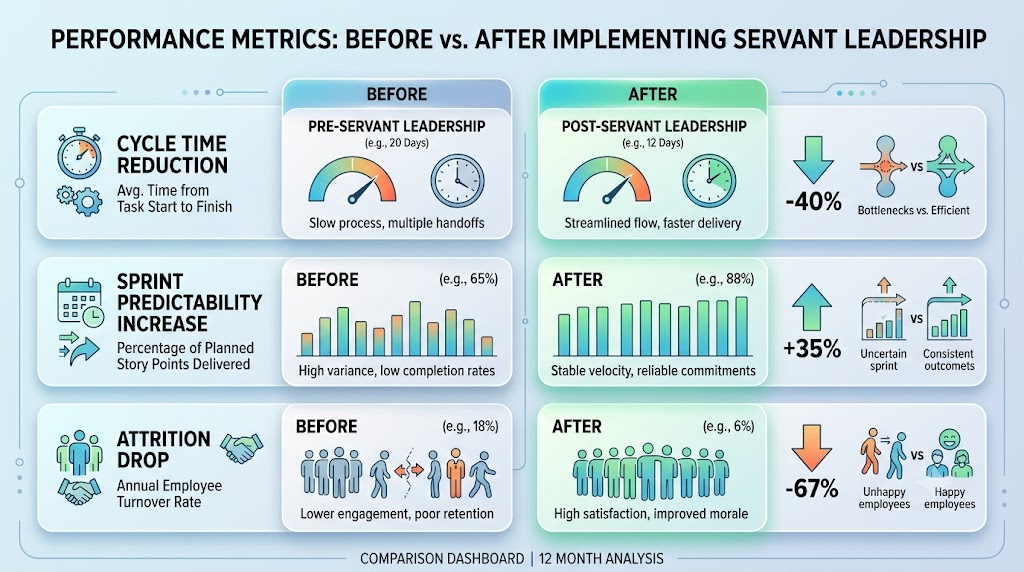
Transitioning from top-down management to active facilitation and servant leadership completely transforms project dynamics and team performance.
Life Before Active Facilitation
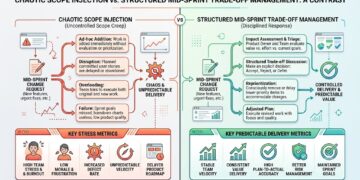
Pervasive Scope Creep: Unvetted stakeholder demands derail sprint goals mid-iteration.
Hidden Impediments: Engineers stay silent about technical roadblocks out of fear of executive reprimand, causing sudden delivery failures.
Severe Team Burnout: Chronic overtime and continuous context-switching lead to high turnover among senior engineering talent.
Unpredictable Velocity: Delivery schedules fluctuate wildly, eroding executive trust and customer satisfaction.
Life After Active Facilitation
Predictable Throughput: Strict WIP limits and optimized flow yield consistent, reliable release dates.
High Psychological Safety: Team members surface risks, errors, and blockers early when issues are cheap and simple to fix.
Autonomous Problem-Solving: Engineers proactively resolve localized challenges through peer collaboration, freeing project leaders to focus on strategic alignment.
Accelerated Career Progression: Organizations do not promote taskmasters who simply relay status updates. Senior leadership promotes strategic project leaders who build resilient, self-sustaining delivery engines.
Mastering these Agile facilitation variations elevates your professional standing. It establishes you as an indispensable leader capable of orchestrating complex cross-functional initiatives amidst shifting corporate priorities.
Stopping the cycle of project chaos requires moving beyond basic frameworks to master the exact leadership behaviors that drive elite enterprise delivery.
If you are ready to stop guessing, move up the corporate ladder, and learn project management the right way, reach out to Skillsetify. We do not just teach frameworks: we show you your exact career growth trajectory.