Why Your "Completed" Sprints Are Killing Product Quality (and How the Product Increment Fixes It)
The executive steering committee gathers in a glass-walled conference room for the quarterly product review. On paper, the project metrics look stellar. The Jira burndown chart reflects a clean slope, the team reported a peak velocity of 48 story points, and every ticket in the sprint backlog carries a green “Done” status.
Then, the Vice President of Product asks a simple question: “Can we click through the new automated checkout flow live on the staging environment?”
Silence fills the room. The engineering lead clears his throat and explains that while the backend microservices are finished and the frontend components are built, they haven’t been fully integrated or tested in a unified environment. “The code is 95% complete,” he offers. “We just need a dedicated hardening sprint next month to merge the branches, run end-to-end regression, and deploy.”
In that single moment, the illusion of progress shatters.
This scenario plays out daily in enterprise organizations worldwide. Teams mistake task completion for value delivery, confusing activity with real output. The fundamental root cause is a widespread corporate myth: the belief that a Scrum Increment is merely a collection of closed tasks that will eventually be integrated into a release candidate down the road.
The reality is far more rigorous. In modern Agile product delivery, if an output is not functional, fully integrated, thoroughly tested, and potentially releasable at the exact moment the sprint ends, it is not a Product Increment. It is technical debt disguised as progress.
Deconstructing the Product Increment: Mechanics, Anatomy, and Purpose
To understand why the Product Increment is the heartbeat of Agile delivery, one must evaluate its position within the broader Scrum framework. Scrum defines three primary artifacts: the Product Backlog, the Sprint Backlog, and the Product Increment. Each artifact represents a distinct phase of value evolution, moving from abstract strategic intent to concrete functional reality.
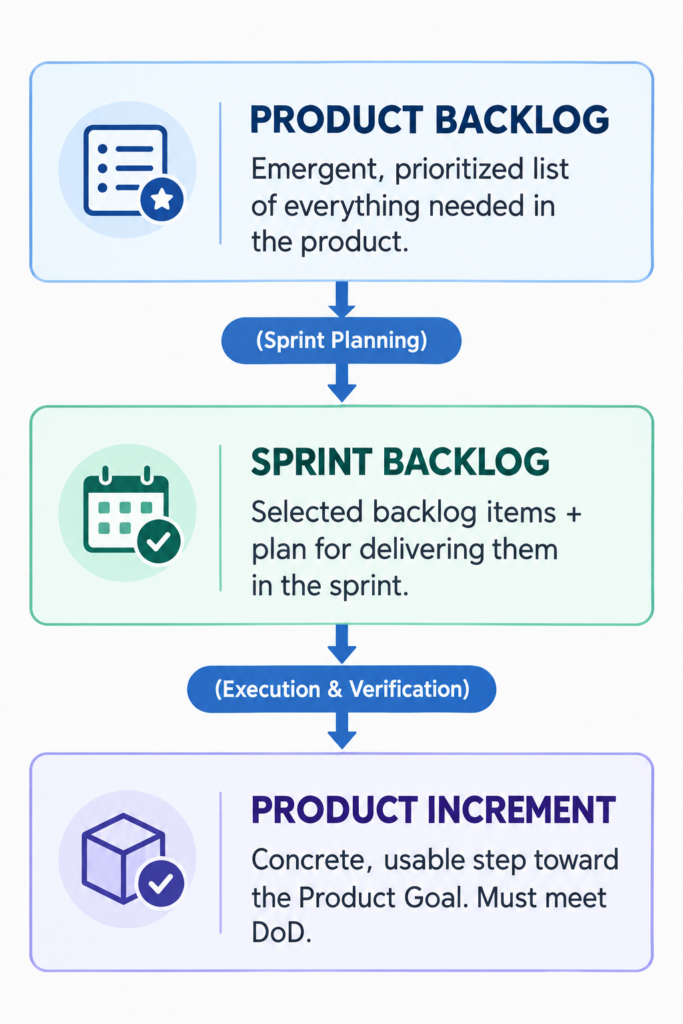
The Product Backlog captures the overarching vision, containing user stories, technical debt items, and feature requests. During Sprint Planning, the team extracts a high-priority subset into the Sprint Backlog, committing to deliver specific functional outcomes within a fixed timebox.
The Product Increment is the tangible result of that timebox. It is not a standalone feature fragment. It is the cumulative sum of all completed Product Backlog items from the current sprint, seamlessly unified with every Increment delivered in prior sprints.
The Core Mechanics of Incremental Delivery
The mechanics of an authentic Product Increment rest on three non-negotiable principles:
Additive Integration: Every new piece of functionality must integrate cleanly into the existing code base or system architecture without breaking previously delivered features.
Absolute Usability: The increment must be in a usable state. Even if the Product Owner chooses not to deploy it immediately to end customers due to strategic release timing, the software must be capable of surviving a real-world deployment without requiring additional bug fixes or code refactoring.
Empirical Inspection: The increment provides the only valid baseline for Empirical Process Control. Stakeholders cannot inspect velocity numbers, architecture diagrams, or Gantt charts; they can only inspect working software to make informed business decisions about the future product roadmap.
The Definition of Done (DoD): The Uncompromising Gatekeeper
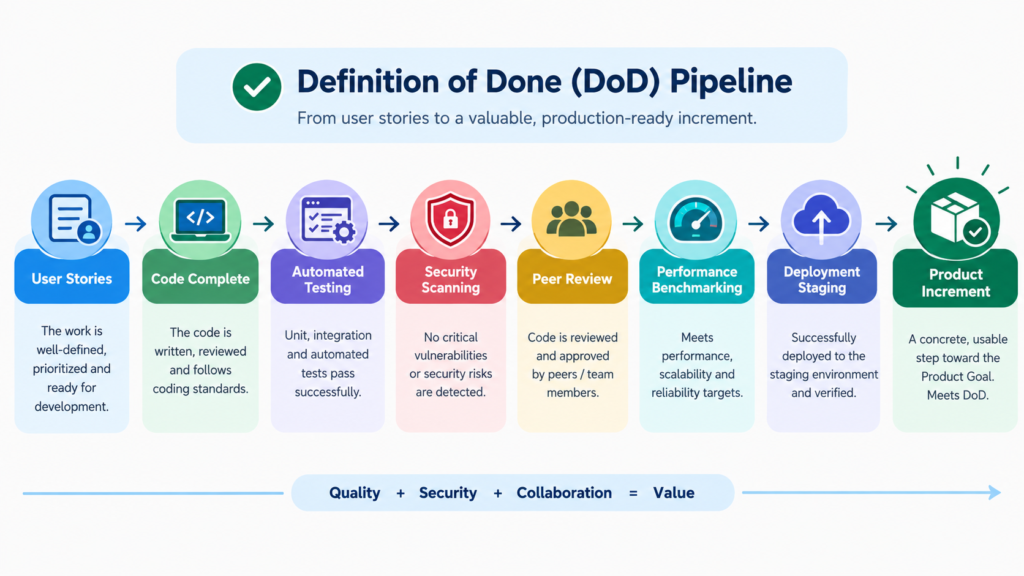
An increment cannot exist without a clear, enforced Definition of Done (DoD). The DoD is a formal quality agreement shared across the organization that specifies the exact technical and non-functional standards every backlog item must satisfy before it joins the Increment.
Without a rigorous DoD, teams fall into the trap of “Fake Completion,” where features pass visual inspection but carry hidden architectural vulnerabilities and unexploded quality risks.
| Organizational Dimension | Fake Completion (Task-Focused) | True Product Increment (DoD-Governed) |
| Code Integration | Isolated feature branches; manual merging reserved for release week. | Continuous Integration; code merged and validated daily. |
| Quality Assurance | Manual testing performed post-sprint by a siloed QA team. | Automated unit, integration, and end-to-end tests executed in-sprint. |
| Documentation & Compliance | Deferred to technical writers after project sign-off. | User documentation, API specs, and compliance checks completed in-sprint. |
| Deployability | Requires a 2-week “hardening sprint” or stability freeze. | Instantly deployable to production at the push of a button. |
| Business Impact | Value is locked in staging environments; high release risk. | Value is unlocked continuously; low release risk. |
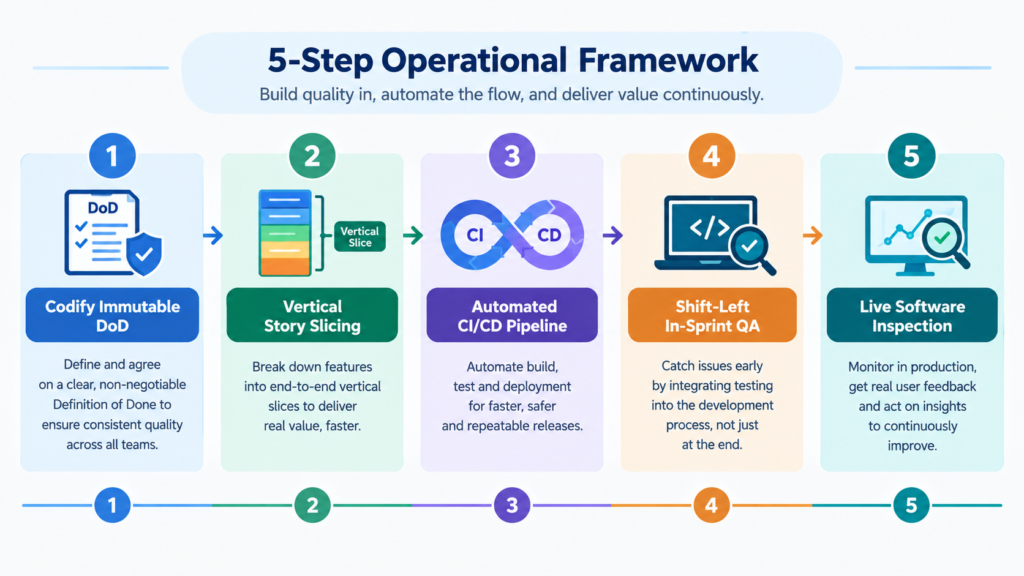
The 5-Step Operational Framework for Delivering True Product Increments
Transitioning an enterprise delivery team from shipping half-baked code to producing clean, functional Increments requires a structured operational model. Project Managers, Scrum Masters, and Delivery Leads can execute the following five-step framework to establish true incremental delivery across their engineering teams.
Step 1: Establish an Immutable Definition of Done
Gather the cross-functional delivery team, principal architects, operations leads, and quality engineering managers to define an explicit, non-negotiable DoD. The DoD must encompass every level of product verification:
Static Code Quality: Zero high-severity security vulnerabilities identified via automated static analysis tools; strict adherence to organizational style guides.
Test Automation Coverage: 100% pass rate on unit tests with a minimum code coverage threshold (e.g., 85%); automated regression suites executed without failures.
Environment Validation: Successful automated deployment to a production-like staging environment.
Non-Functional Requirements: Performance benchmarks verified (e.g., page load under 1.2 seconds); accessibility standards met (e.g., WCAG 2.1 AA compliance).
Ensure this DoD is visible, audited during every Sprint Review, and updated as the team’s engineering capabilities mature.
Step 2: Enforce Vertical Story Slicing
Horizontal story slicing is the single primary reason teams fail to deliver an Increment. When a Product Owner creates separate user stories for “Database Schema Design,” “Backend API Development,” and “Frontend UI Layout,” no single story produces a working, end-to-end piece of software.
Enforce vertical story slicing. Every backlog item must represent a thin, fully integrated slice of functionality that cuts through all architectural layers:
Horizontal Slicing (Incorrect): “Build the User Management API endpoints.” (Result: Data exists, but users cannot see or interact with it).
Vertical Slicing (Correct): “Enable a user to update their email address in their account profile.” (Result: Frontend form, backend API validation, database update, and confirmation email fully built, integrated, and verifiable).
By keeping user stories small and vertically sliced, the team can complete, integrate, and verify multiple functional pieces within a single sprint iteration.
Step 3: Align Modern CI/CD Pipelines with Sprint Execution
You cannot achieve a true Product Increment using manual testing routines and quarterly deployment workflows. The engineering architecture must support continuous integration and continuous deployment (CI/CD).
Establish automated build and test triggers within your delivery pipeline. Every time a developer merges code into the primary repository branch, the system should automatically execute the following sequence:
Compile the integrated build.
Run full static security analysis and dependency checks.
Execute the unit and integration test suites.
Deploy the built artifact into an ephemeral, production-equivalent staging environment.
Execute automated UI and end-to-end acceptance tests.
If any stage of this pipeline fails, the build breaks, and fixing the break becomes the highest-priority task for the team. This guarantees that the primary code branch remains in a deployable state at all times.
Step 4: Shift-Left Quality Assurance into In-Sprint Verification
Quality Assurance cannot operate as a downstream phase that occurs after developers mark code as complete. When QA testing happens outside the sprint boundary, bugs accumulate in hidden queues, destroying the integrity of the Increment.
Shift QA left by integrating quality engineers directly into the daily development cycle:
Write acceptance tests before code development begins, utilizing Frameworks like Behavior-Driven Development (BDD) with Given-When-Then syntax.
Pair developers with QA engineers during the sprint to run exploratory testing on completed feature slices immediately after code reviews pass.
Treat bug fixes discovered within the sprint as part of the original story’s completion scope, rather than deferring them as separate backlog items.
Step 5: Pivot the Sprint Review from Presentations to Live Software Inspection
Re-engineer the Sprint Review event around a strict policy: slide presentations, static mockups, and verbal status reports are prohibited. The review must consist entirely of live interaction with the functional Product Increment within a production or staging environment.
Structure the review around working user scenarios:
Demonstrate real data moving through integrated system boundaries.
Allow stakeholders and real business users to test the application directly during the session.
Gather immediate, empirical feedback on user experience, system performance, and business value fit.
If a feature cannot be demonstrated live in a fully integrated state, it cannot be showcased at the Sprint Review, and it cannot be claimed as part of the Product Increment.
The Enterprise Transformation: From Project Chaos to Elite Delivery
When an enterprise commits to delivering a true, functional Product Increment at the end of every sprint cycle, the entire operational culture undergoes a profound positive transformation.
Eliminating the "Dark Debt" Compound Interest
In traditional, pseudo-Agile environments where integration and testing are delayed until release windows, technical debt accumulates compound interest. Teams spend up to 40% of their total capacity running late-stage bug hunts, managing complex git branch conflicts, and performing emergency hotfixes.
When every sprint yields a verified, clean Increment, technical debt is exposed and remediated instantly. Development teams reclaim lost engineering capacity, redirecting creative talent toward building high-impact business features rather than patching systemic decay.
Restoring Executive Trust and Business Agility
Corporate leadership frequently views software delivery with skepticism due to missed release deadlines, cost overruns, and unexpected post-launch outages. Functional Increments eliminate this friction by replacing vague estimates with indisputable physical proof.
When business executives see working software deployed at the end of every two-week cycle, executive trust soars. Organizational leaders gain genuine business agility, securing the power to pivot market strategies, launch new product lines early, or adjust feature priorities dynamically based on real-world feedback rather than speculative plans.
Accelerating Professional Leadership Trajectory
For Project Managers, Scrum Masters, and Product Owners, mastering the mechanics of the Product Increment is the catalyst for executive career progression.
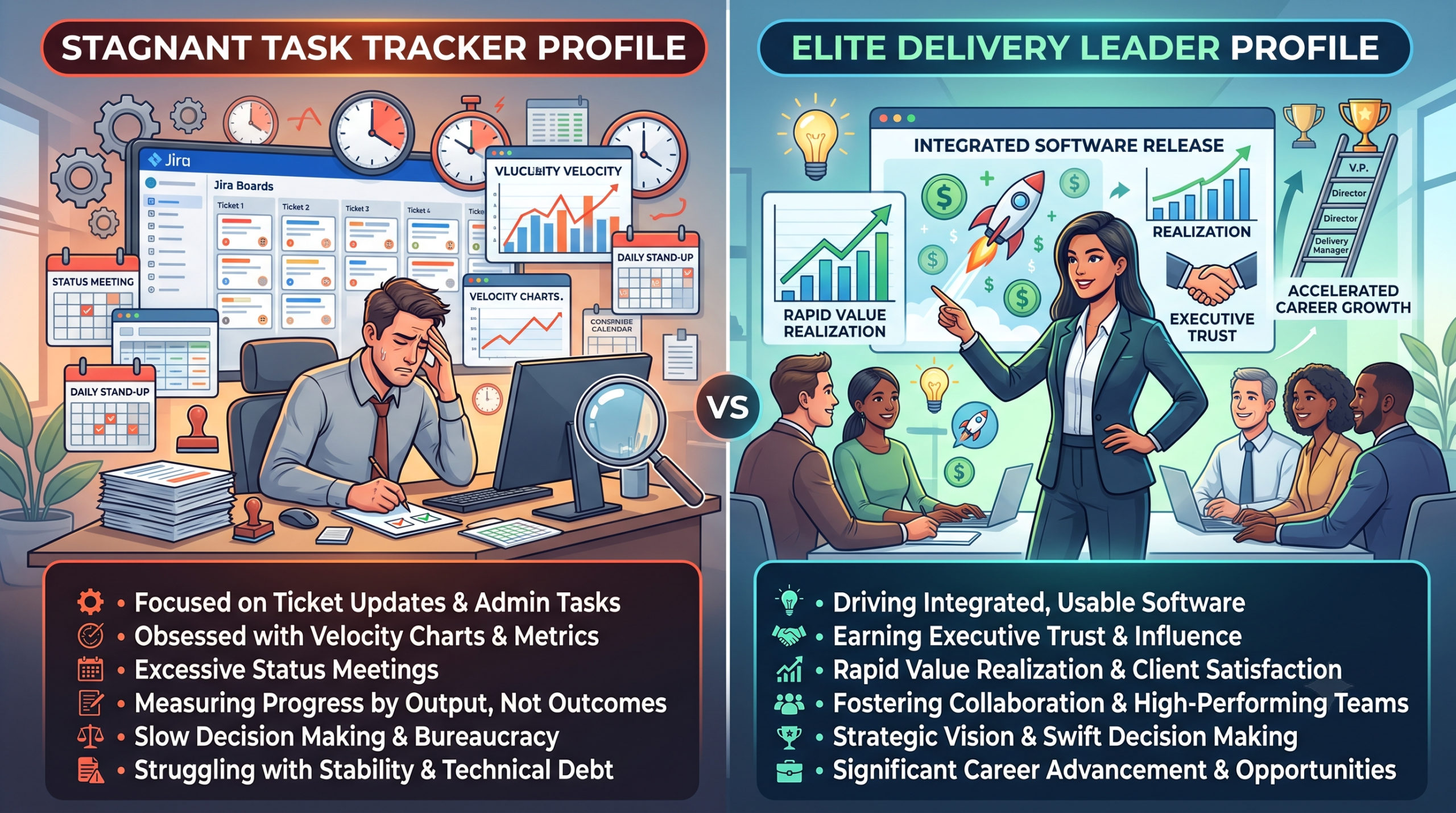
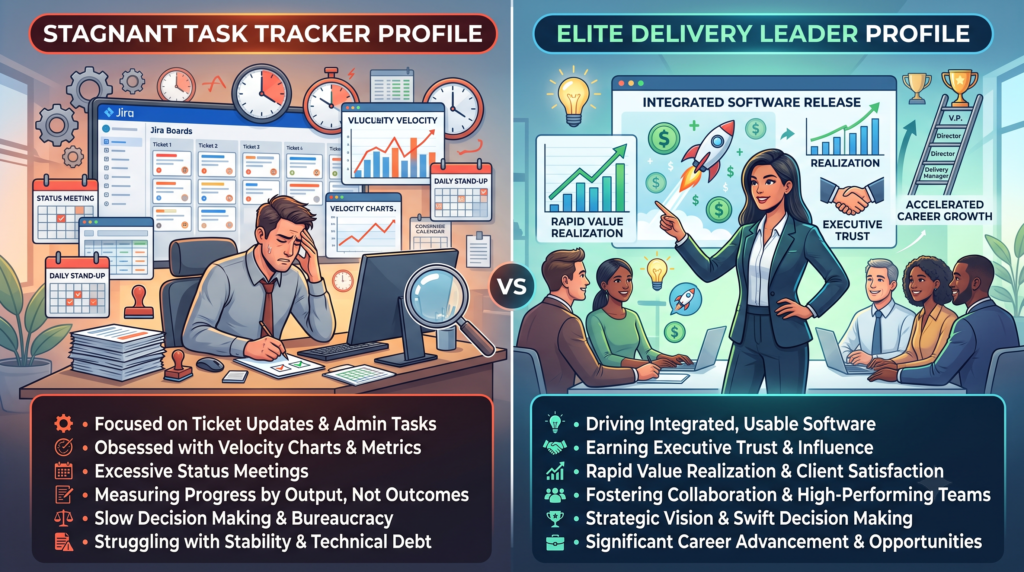
Organization leaders do not reward professionals who simply track tasks, update Jira boards, and report high team velocity while delivery dates slip. Executives elevate leaders who consistently drive tangible business outcomes, eliminate systemic execution risks, and deliver pristine, market-ready software assets on a predictable cadence.
By shifting your focus from managing task completion to governing high-potency Product Increments, you position yourself as a strategic delivery leader, an indispensable expert capable of transforming complex enterprise goals into reliable, revenue-generating reality.
Master Elite Delivery with Skillsetify
The difference between mediocre project tracking and elite, high-value enterprise delivery comes down to mastering foundational execution frameworks like the Product Increment. Delivering a fully integrated, functional, and deployable output at the close of every sprint cycle transforms chaotic project environments into predictable engine rooms of corporate innovation.
If you are ready to stop guessing, move up the corporate ladder, and learn project management the right way, reach out to Skillsetify. We do not just teach frameworks: we show you your exact career growth trajectory.