The Elite Framework for Managing Mid-Sprint Scope Changes
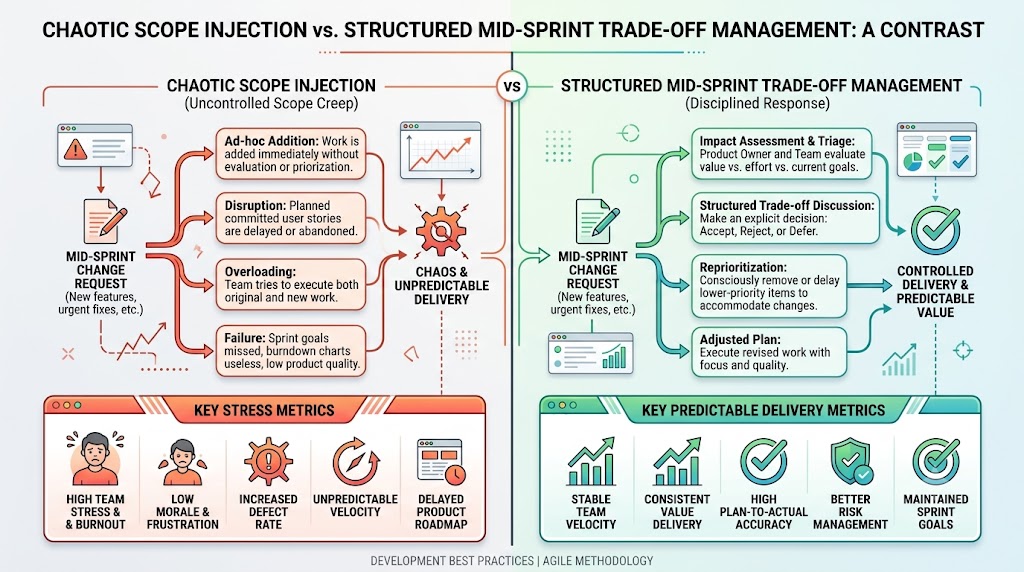
Your cross-functional delivery team is nearing the end of a high-stakes two-week Sprint. The burndown chart displays a beautiful downward slope, automated tests are passing cleanly, and your engineers are polishing core user stories. Suddenly, a high-priority Slack notification pings. It is a frantic Vice President of Sales: an enterprise prospect will walk away from a million-dollar contract unless a new custom reporting dashboard is promised and delivered immediately.
Panic sets in. The Product Owner yields to executive pressure, quietly drops thirteen story points of unrefined requirements into the active Sprint Backlog, and instructs the team to make it happen.
Chaos quickly takes over. Velocity collapses. Senior developers are furious about working late into the weekend. Quality assurance engineers are forced to test half-baked code without clear acceptance criteria. Production defects spike, morale plummets, and the Sprint ends in catastrophic failure with zero completed increments shipped to production.
This scenario plays out every single week across corporate enterprises. The fundamental root cause is not the unexpected customer request itself, but rather a structural breakdown in Agile governance.
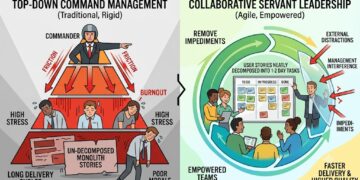
To master backlog management, you must dispel two toxic corporate myths right away. First, Agile does not mean saying yes to every incoming stakeholder demand instantly without friction or cost. Second, a Sprint Backlog is not a rigid stone tablet locked in an impenetrable vault where zero adaptation can ever occur. Real Agile backlog management lies directly in the middle: facilitating collaborative trade-offs, actively removing impediments, and leading your team with clarity rather than top-down command.
The Mechanics of Mid-Sprint Scope Changes: Process vs. Flexibility
To manage mid-sprint scope changes effectively, project leaders must first understand what a Sprint Backlog represents. It is not an arbitrary wish list or a flexible task pool. It is a committed forecast constructed by the development team during Sprint Planning, backed by real capacity calculations, historical velocity trends, and a strict Definition of Ready (DoR).
When stakeholders force new work into an active Sprint, they destroy the team’s cognitive focus, force expensive context-switching, and disrupt established delivery momentum. However, rigid dogmatism is equally dangerous to a business. Markets shift rapidly, critical security vulnerabilities emerge, and strategic business imperatives occasionally demand real-time alignment.
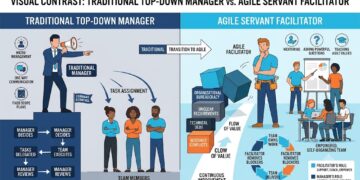
The solution requires a fundamental shift from top-down taskmaster management to servant leadership and active coaching. As a Scrum Master, Project Manager, or Agile delivery leader, your role is not to act as a dictator who brutally shuts down business requests, nor an order-taker who passively accepts scope creep. Your job is to facilitate transparent trade-off conversations, mentor team members on maintaining professional boundaries, and remove impediments before they burn out your team.
Why Mid-Sprint Changes Occur
Understanding the root cause of scope disruption is the first step toward managing it effectively. Mid-sprint scope requests generally stem from four distinct operational drivers:
Emergent Business Opportunities: Urgent competitive market shifts or high-value customer acquisitions that require immediate feature delivery.
Production Blockers and Critical Bugs: Unexpected system outages or high-severity defects that demand immediate engineering response over planned feature work.
Flawed Backlog Refinement: Incomplete acceptance criteria discovered mid-flight, forcing user stories to expand significantly in technical complexity.
Stakeholder Misalignment: Product Owners failing to engage executive sponsors during backlog prioritization, leading to last-minute directional pivots.
The 5-Step Tactical Framework for Managing Mid-Sprint Scope
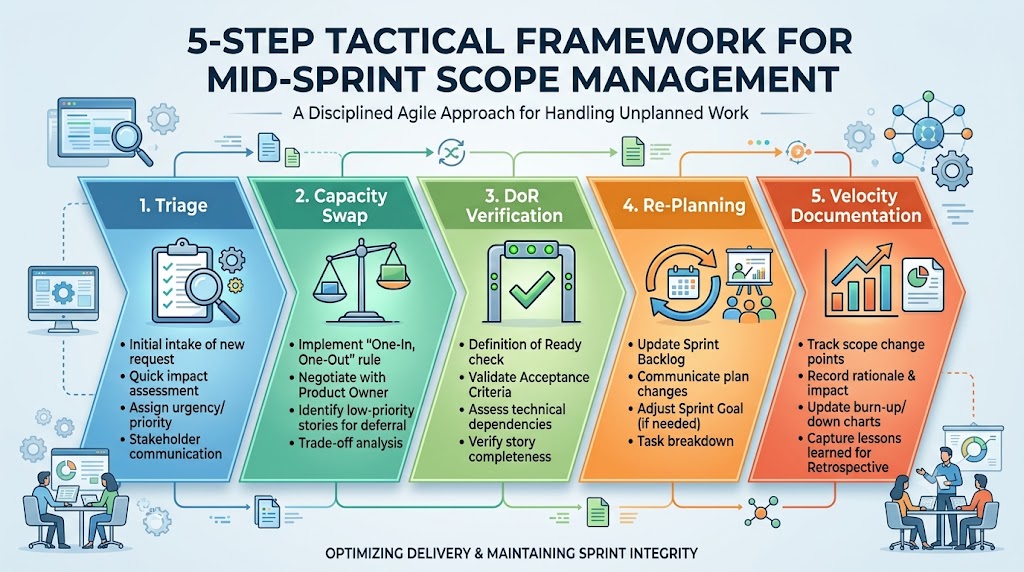
When a mid-sprint change request inevitably arrives, elite project managers do not react emotionally. They execute a repeatable, objective five-step evaluation framework designed to protect sprint integrity while remaining responsive to business realities.
Step 1: Triage and Filter the Request
The moment a new requirement surfaces, separate genuine business emergencies from emergent preferences. Convene a rapid alignment conversation with the Product Owner and ask a simple, clarifying question: “Does this specific change need to be delivered in the active iteration, or can it be prioritized at the very top of the Product Backlog for the upcoming Sprint Planning session?”
If the request can wait until the next iteration without causing direct financial or operational damage to the company, it belongs in the Product Backlog for proper refinement. It does not belong in the active Sprint.
Step 2: Enforce the Equal Capacity Swap Rule
If the business request is truly critical and cannot wait until the next iteration, enforce the foundational law of Agile capacity: work in equals work out.
If the Product Owner injects eight story points of new work into the active Sprint, eight story points of equivalent, unstarted work must be removed from the Sprint Backlog and returned to the Product Backlog. Total Sprint capacity must remain neutral. The development team, not the executives or the Product Owner, retains sole authority over deciding which unstarted items are removed based on technical dependencies and effort estimates.
Step 3: Audit the Definition of Ready (DoR)
Never allow raw, unrefined ideas to enter an active Sprint mid-flight. Before any new story is swapped into the active iteration, it must pass a rigorous Definition of Ready audit.
The incoming item must possess fully documented user stories, unambiguous acceptance criteria, clear UX wireframes if applicable, and explicit technical dependencies. Injecting half-baked user stories into an active Sprint guarantees technical debt, team frustration, and missed commitments.
Step 4: Facilitate a Mini Re-Planning Session
Avoid managing scope changes through private, offline side conversations between managers and individual developers. Call a concise, fifteen-minute re-planning session with the entire cross-functional team.
During this meeting:
The Product Owner clearly explains the business urgency driving the change.
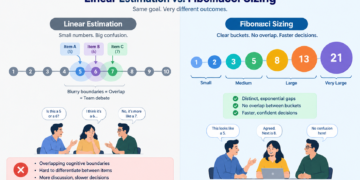
The engineering team reviews the incoming story and provides an immediate, relative point estimation using Fibonacci sequencing.
The team identifies which unstarted stories will be removed to offset the new points.
The team collectively evaluates and re-commits to a modified Sprint Goal.
Step 5: Document and Protect Team Velocity
ecord every scope swap meticulously in your project management tracking software, such as Jira or Azure DevOps. Tag the added items explicitly as mid-sprint additions.
When conducting the Sprint Retrospective, analyze the burndown chart and velocity impact with the team. Use this empirical data during executive reviews to demonstrate the exact cost of mid-sprint disruptions. Presenting hard data regarding defect rates and delivery delays transforms subjective scope arguments into objective business discussions.
From Chaos Firefighter to Strategic Delivery Leader
Mastering the delicate art of mid-sprint scope management does far more than keep software projects on schedule: it transforms your entire career trajectory as a delivery leader.
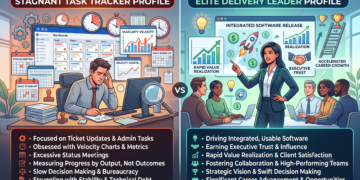
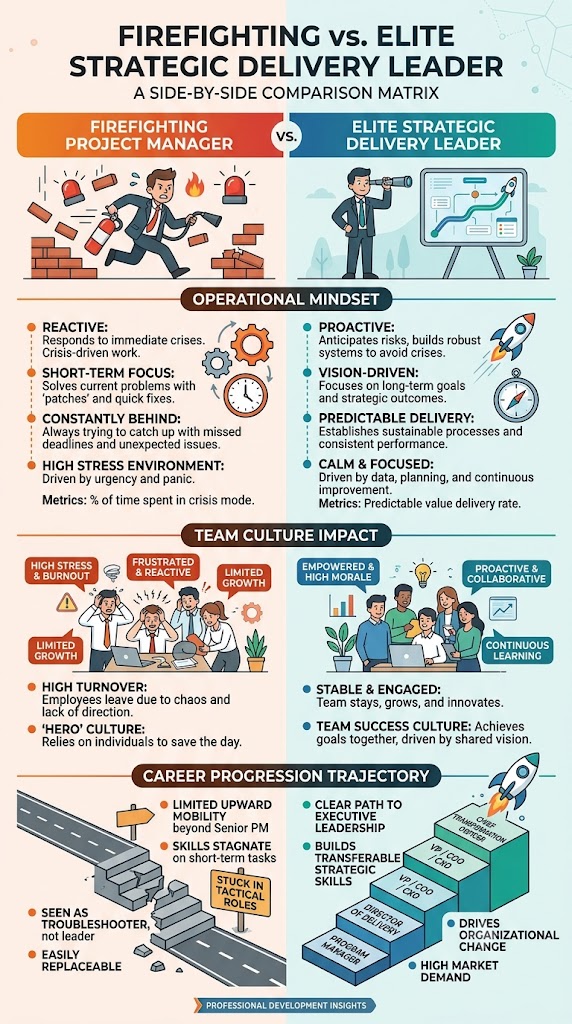
Consider the daily existence of a reactive, traditional project manager. You spend your workdays reacting to panic-driven emails, appeasing noisy executives, forcing developers into toxic weekend overtime, and constantly writing post-mortem emails for missed deadlines. You are viewed across the organization as a passive administrative taskmaster, constantly fighting fires and burning out elite engineering talent.
Now picture life as an elite, strategic delivery leader. Your Sprints run with predictable, repeatable precision. Your engineering team trusts you implicitly because you actively guard their bandwidth, mentor them through technical roadblocks, and protect them from organizational noise. Executive leadership respects your authority because you communicate using the language of business trade-offs, ROI, and empirical velocity rather than making empty promises.
When you facilitate mid-sprint changes using structured frameworks, clear professional boundaries, and collaborative trade-offs, you elevate your status from an operational task coordinator to an indispensable strategic partner. You become the rare professional capable of translating messy corporate ambiguity into reliable, high-impact product execution. This exact strategic capability is what separates mid-level coordinators from high-earning PMO directors and enterprise Agile transformation leaders.
Master the Art of Elite Project Delivery
Mid-sprint scope changes are an inevitable reality of modern business, but project failure is not. By replacing emotional reactions with structured triage frameworks, servant leadership, and uncompromising capacity trade-offs, you turn scope volatility into a sustainable competitive advantage.
If you are ready to stop guessing, move up the corporate ladder, and learn project management the right way, reach out to Skillsetify. We do not just teach frameworks: we show you your exact career growth trajectory.