The executive team is watching the Jira board with mounting anxiety. A high-priority epic titled “Implement Customer Payment Gateway” is parked under the “In Progress” column. It has been sitting there since Monday morning. It is a massive 13-point behemoth of a user story assigned to a senior developer who is currently bogged down, frustrated, and silently blocked by an unconfigured staging environment.
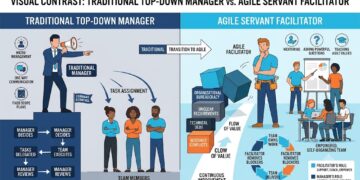
The traditional project manager reacts in panic: calling urgent status check-in calls, micro-managing hourly updates, and demanding to know why the ticket isn’t moving to QA. The result? Escalating team friction, developer defensive posturing, hidden impediments, and ultimately, an embarrassing sprint commitment failure during the Friday review.
Here lies the most prevalent corporate myth in modern software delivery: Task decomposition is an administrative burden, and managing sprint execution requires top-down supervision.
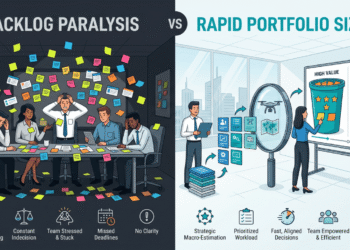
In reality, top-down assignment destroys velocity. When project leaders attempt to dictate how tasks are executed or force teams to accept mega-sized user stories without granular breakdown, they create dark matter in the backlog: hidden work, unvoiced dependencies, and mounting technical debt. True Agile excellence requires replacing top-down control with servant leadership: facilitating collaboration, mentoring team members through structured task decomposition, and aggressively insulating the team from external impediments.
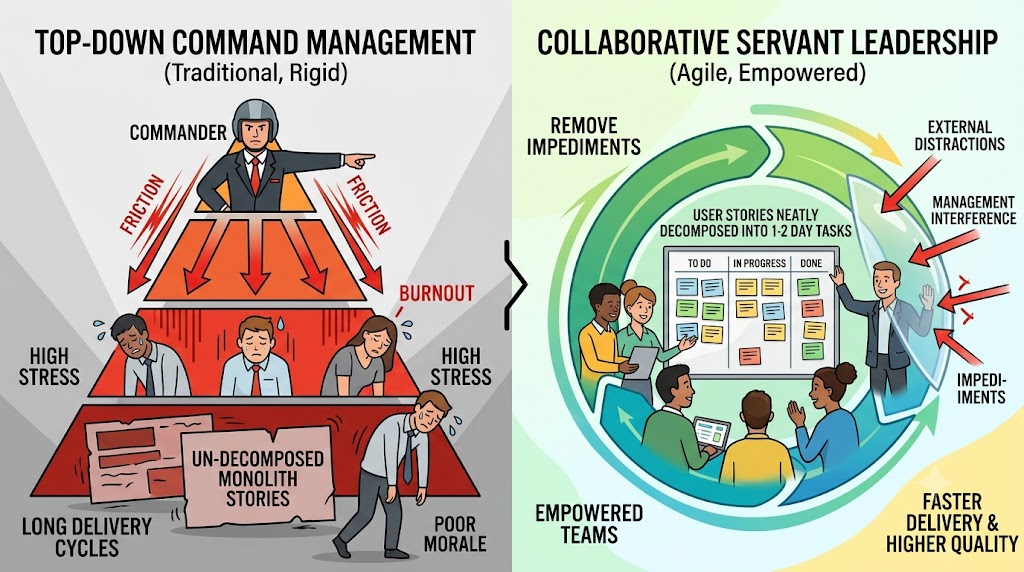
The Anatomy of a High-Velocity Sprint Backlog
To understand why sprints collapse, we must first analyze the fundamental difference between the Product Backlog and the Sprint Backlog.
While the Product Backlog represents the ultimate, dynamic to-do list for a product, managed through the DEEP framework (Detailed appropriately, Emergent, Estimated, and Prioritized), the Sprint Backlog is a precision delivery plan. Owned entirely by the cross-functional development team, the Sprint Backlog is a carefully curated subset of user stories chosen during Sprint Planning to achieve a single, unambiguous Sprint Goal.
However, selecting user stories is only half the battle. A user story written from the customer’s perspective (for example, “As a user, I want to filter products by price so that I can shop within my budget”) describes what business value is needed, not how it will be built.
If a team commits to user stories without decomposing them into concrete technical tasks, they are operating on hope rather than engineering rigor.
The Mechanics of Granular Task Decomposition
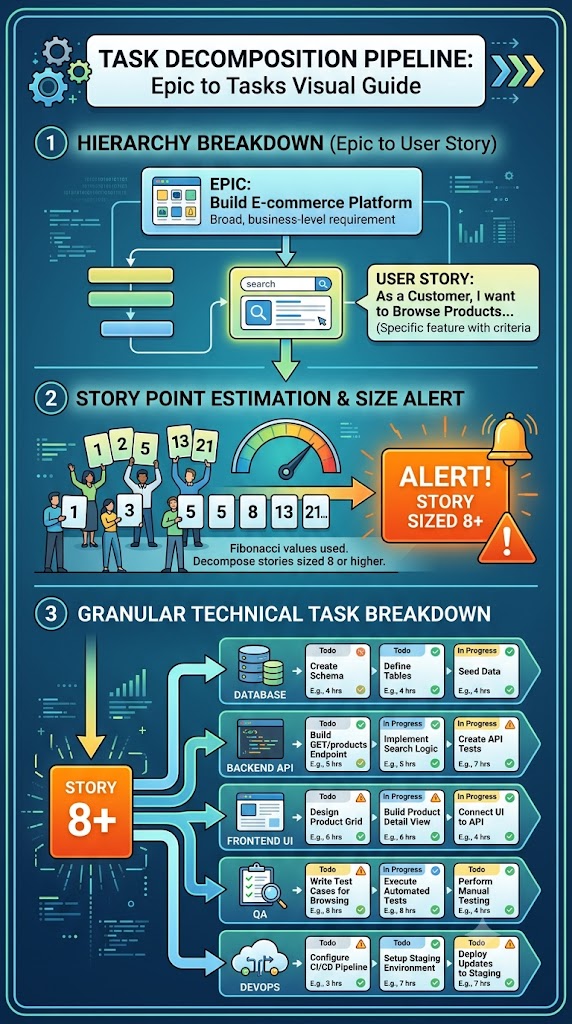
Decomposition is the process of breaking down high-level user stories into small, actionable work units that can be completed within 1 to 2 days (or ideally, under 8 hours of focused effort). This structural transformation converts abstract end-user desires into practical execution steps.
When teams decompose stories collaboratively during or immediately following Sprint Planning, they uncover hidden complexities early. Consider how a single user story transforms through proper vertical and horizontal decomposition:
Monolithic Story (Before Decomposition): “Implement Automated Invoicing System” (13 Story Points / 80 Estimated Hours).
Decomposed Sprint Backlog (After Decomposition):
Task 1 (Database): Schema migration for invoice tables and index creation (Estimate: 4 hours).
Task 2 (Backend API): Build REST endpoints for invoice generation logic (Estimate: 6 hours).
Task 3 (Third-Party Integration): Integrate PDF generator service and write mock unit tests (Estimate: 5 hours).
Task 4 (Frontend UI): Build customer-facing invoice review modal component (Estimate: 6 hours).
Task 5 (Quality Assurance): Write automated end-to-end integration test suite (Estimate: 4 hours).
Task 6 (DevOps): Configure feature flag and verify staging deployment pipeline (Estimate: 2 hours).
Notice the shift: what was once an unmanageable block of uncertainty is now a series of visible, achievable micro-deliverables. Team members can self-assign tasks, track progress transparently on the kanban board, and identify bottlenecks within hours rather than days.
Why Relative Sizing Eliminates Estimation Fatigue
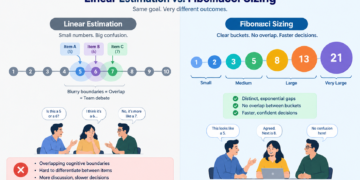
A core element of effective backlog management is adopting relative estimation using the Fibonacci sequence (1, 2, 3, 5, 8, 13, 21). Human cognition struggles to differentiate between 6 hours of effort versus 7 hours. However, the exponential spacing of Fibonacci numbers forces the human brain to perceive distinct cognitive leaps in complexity and risk.
If a story jumps from a 5 to an 8, or an 8 to a 13, the team is signaled that uncertainty is compounding exponentially. Anything estimated at an 8 or 13 should immediately trigger a mandatory decomposition exercise, breaking the story into smaller, 2-point or 3-point components before work commences.
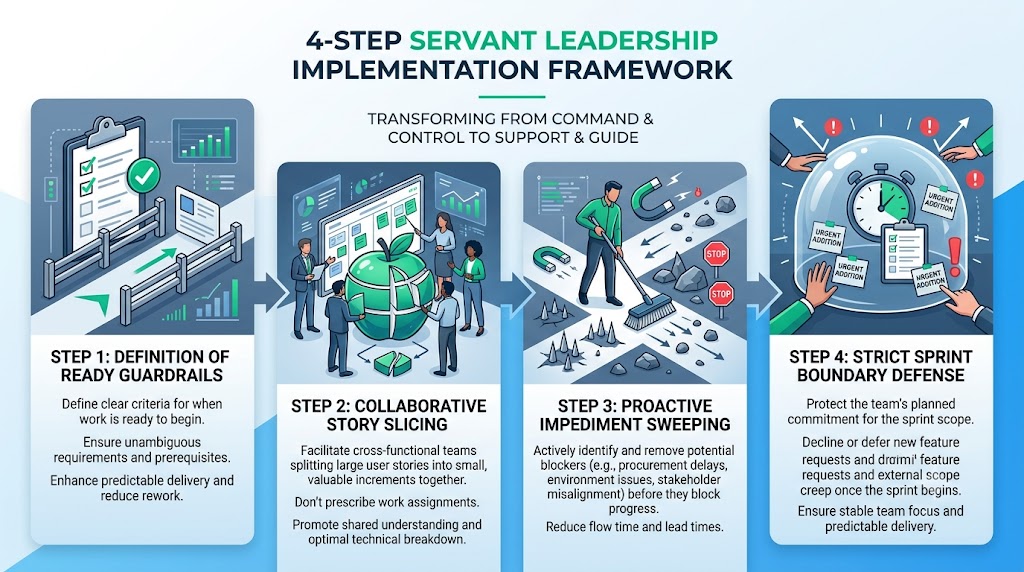
The Servant Leader's 4-Step Implementation Framework
How do you ensure task decomposition happens without becoming a micromanager?
The answer lies in servant leadership. Your job is not to write the technical tasks or assign them to developers. Your job is to facilitate the framework, mentor team members on decomposition techniques, and relentlessly clear the path so they can execute effortlessly.
Here is the step-by-step blueprint for project managers and Scrum leaders:
Step 1: Establish Strict Guardrails and the Definition of Ready (DoR)
Before a story enters the Sprint Backlog, enforce a clear Definition of Ready. Require that every story has:
Clear, testable Acceptance Criteria.
Up-to-date UI/UX mockups or API contracts attached.
A defined business value rationale from the Product Owner.
An agreed relative complexity estimate below your team’s decomposition threshold (for instance, a maximum size of 5 story points).
If a story lacks these elements, empower the development team to push back and decline adding it to the active sprint.
Step 2: Facilitate Collaborative Slicing Sessions
During Sprint Planning or dedicated refinement sessions, lead the team through structured user story slicing. Mentor developers to slice stories along natural technical boundaries:
Input Slicing: Separating standard user path functionality from edge-case validation.
Operations Slicing: Building basic CRUD (Create, Read, Update, Delete) capability before advanced reporting features.
Interface Slicing: Building backend API contracts ahead of frontend UI polishing.
Encourage cross-functional team members (frontend, backend, QA, database) to discuss task dependencies collaboratively on screen, fostering collective ownership rather than siloed handoffs.
Step 3: Implement Proactive Impediment Removal
A broken sprint backlog is often a symptom of unaddressed systemic blockers. The servant leader actively scans the board during Daily Standups for subtle signs of friction:
A task staying in “In Progress” for more than 24 hours.
A developer continuously switching between multiple tasks due to missing credentials or pending pull requests.
External dependencies such as waiting on security approval or third-party vendor documentation.
When impediments surface, do not ask the developer to resolve administrative roadblocks. Step in immediately to clear compliance red tape, secure staging resources, or coordinate cross-team alignment.
Step 4: Protect Sprint Boundaries Against Scope Creep
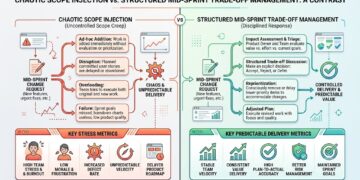
Mid-sprint scope changes destroy velocity. When stakeholders or Product Owners attempt to inject unplanned work into an active sprint, execute the standard Agile boundary protocol:
Educate the stakeholder on the risk to current sprint commitments.
If the change is non-negotiable and urgent, facilitate a trade-off discussion: for every new item introduced, an equivalent story point value must be removed from the Sprint Backlog and returned to the Product Backlog.
Re-convene the team to decompose the newly introduced story collaboratively before work begins.
The Professional Transformation: From Firefighter to Strategic Leader
When you transform your approach to sprint backlog management and task decomposition, the structural impact on your organization is immediate and profound.
Consider the operational shift:
| Performance Metric | Traditional Top-Down Management | Servant-Led Backlog Orchestration |
| Sprint Commitment Accuracy | Unpredictable (50-60% completion rates) | High Precision (85-95% predictable delivery) |
| Work Visibility | Opaque (monolithic stories obscure progress) | Crystal Clear (granular task boards show daily flow) |
| Impediment Resolution | Reactive (issues surfaced during sprint reviews) | Proactive (blockers cleared within hours of detection) |
| Team Morale | High burnout, micro-managed anxiety | High autonomy, collaborative ownership |
| Stakeholder Trust | Eroded by missed release dates | Strengthened by consistent increment delivery |
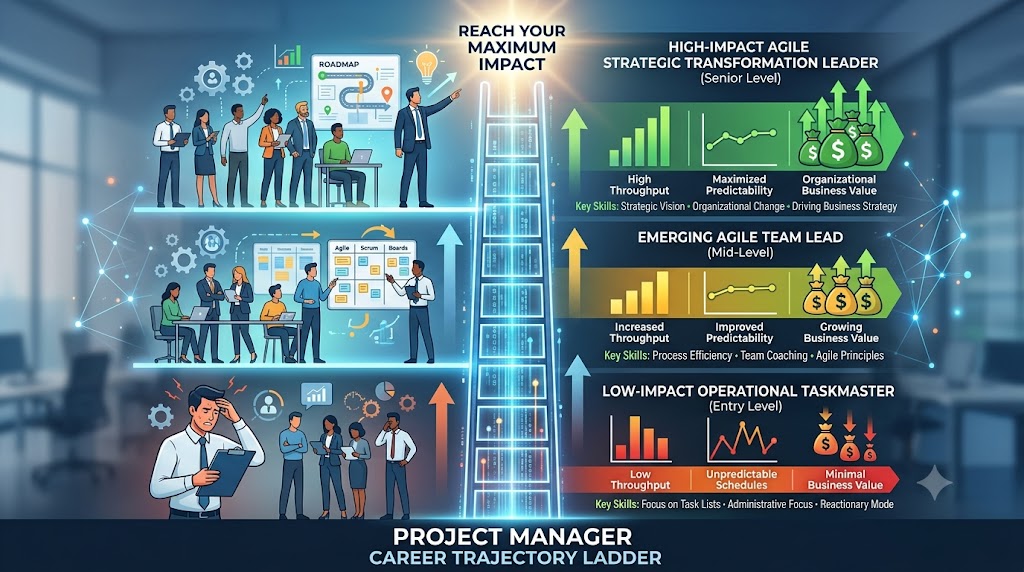
For your career, this transition represents the leap from operational firefighter to strategic enterprise leader. Executive teams do not promote project managers who spend their days chasing status updates and managing Gantt chart fires. They promote leaders who build self-organizing systems, foster cross-functional synergy, and deliver predictable revenue-generating outcomes.
Mastering the nuance of backlog decomposition, servant leadership, and agile governance marks the threshold where your resume evolves from tactical project coordinator to indispensable corporate transformation strategist.
Elevate Your Agile Leadership with Skillsetify
Mastering Sprint Backlogs and task decomposition is not about memorizing textbook definitions from an Agile guide. It is about acquiring the tactical leadership wisdom required to navigate complex enterprise politics, empower technical teams, and drive flawless execution in high-stakes environments.
If you are ready to stop guessing, move up the corporate ladder, and learn project management the right way, reach out to Skillsetify. We do not just teach frameworks: we show you your exact career growth trajectory.
Whether you are aiming to transition into a Senior Scrum Master, Lead Project Manager, or Agile Transformation Director, Skillsetify provides the mentorship, real-world case studies, and career roadmap required to turn methodology into market leadership. Take command of your professional trajectory today.