Why the Visionary Role is the Missing Catalyst in Agile Project Initiation
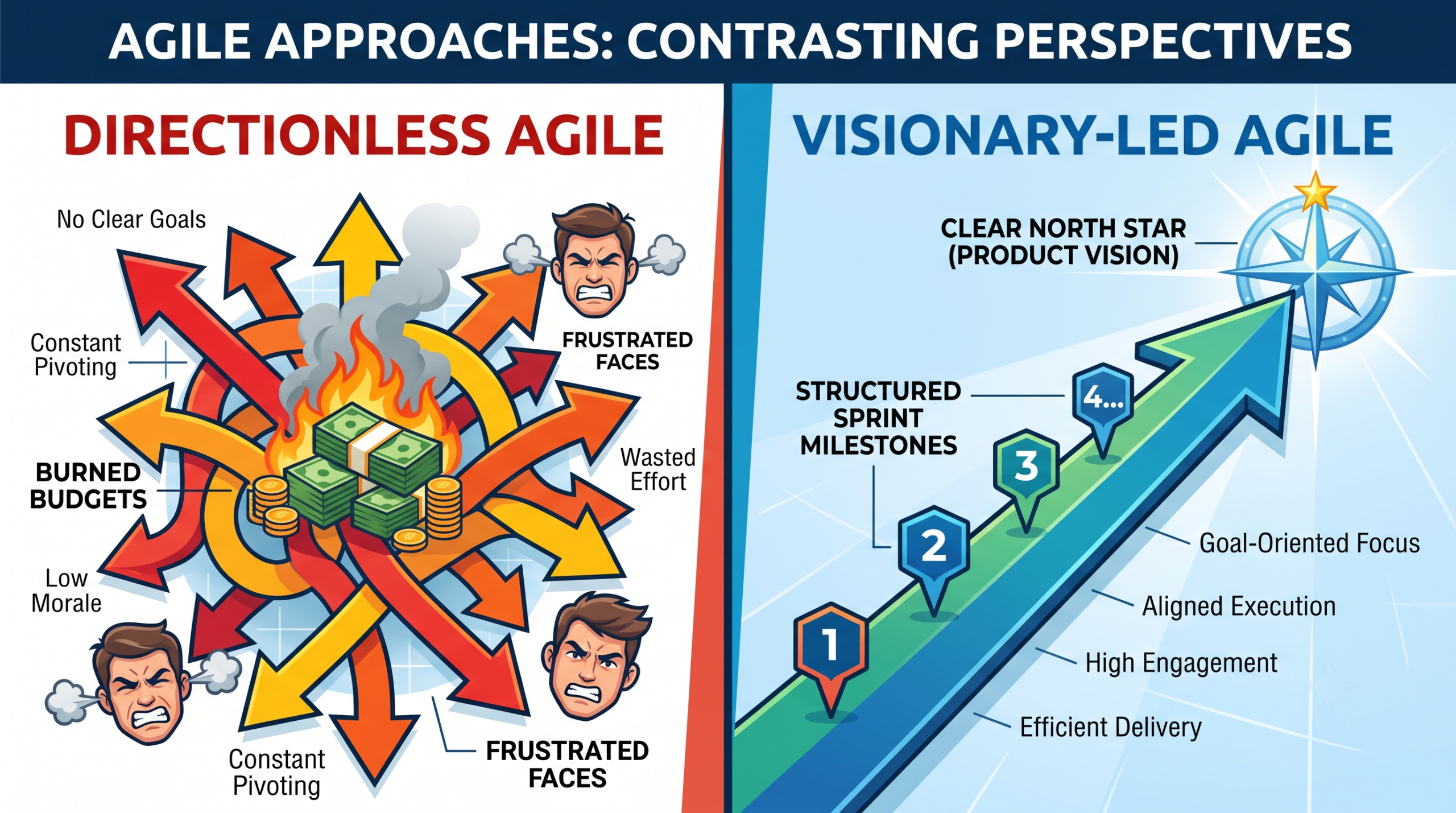
Picture this: It is Monday morning of Sprint 0. You have a cross-functional squad of top-tier software engineers, product designers, and QA leads ready to execute. Jira boards are prepped, Slack channels are populated, and velocity targets are set. Yet, six weeks later, the initiative is spiraling into chaos. Velocity metrics look high on paper, but the actual product is a fragmented mess of disjointed features. The engineering team is building enterprise-grade architectural redundancy for a capability the client never requested, while the design team is crafting slick onboarding flows for a user persona that does not exist.
Budget is burning at $50,000 a week, team morale is tanking, and executive stakeholders are demanding immediate answers.
What went wrong? You did not lack technical talent, project management software, or Agile rituals. You suffered from a fatal, all-too-common enterprise failure: launching an initiative without a Visionary Leader to anchor its initial phase.
Let us dispel a pervasive corporate myth right away: Agile does not mean launching into execution without direction and figuring out the destination along the way. Somewhere in the corporate shift toward iterative frameworks, management teams mistakenly conflated flexibility with directionlessness. True Agile maturity does not eliminate initial planning; it demands absolute clarity of purpose from Day 1.
Deconstructing the Visionary Role in Agile Leadership
Agile leadership is not a rigid, single-style discipline. Depending on the context and lifecycle stage of a initiative, effective managers must wear multiple hats, shifting fluidly between Servant Leader, Adaptive Manager, Coach, Facilitator, and Change Agent. However, during the critical initiation and chartering phases, the Visionary Role is paramount.
The Visionary Leader provides clear direction, overarching purpose, and genuine inspiration when project uncertainty is at its peak. While a Servant Leader focuses on clearing daily blockers and a Coach focuses on individual growth, a Visionary Leader focuses relentlessly on strategic outcomes. They answer the fundamental question that every project team silently asks: Why does this work matter, and what does success actually look like?
Why Initial Project Phases Require Vision Over Velocity
In modern project delivery, velocity without vector is just expensive friction. During initiation, project teams face maximum ambiguity. Business requirements are fluid, stakeholder demands are conflicting, and scope creep lurks around every corner. Without a Visionary Leader to establish clear boundaries and articulate a compelling narrative, teams default to two dangerous corporate behaviors:
Passive Order-Taking: Developers build backlog items mechanically without understanding business value, leading to severe technical debt and feature bloat.
Analysis Paralysis: Teams get bogged down in endless debate over edge cases because no core philosophy exists to guide rapid decision-making.
A Visionary Leader transforms high-level executive strategies into an inspiring, actionable narrative. Consider iconic product launches in tech history: breakthrough offerings rarely emerge from a bulleted list of 500 unvetted requirements. They stem from a clear, bold vision that gives every team member an intuitive filter for daily engineering and design decisions.
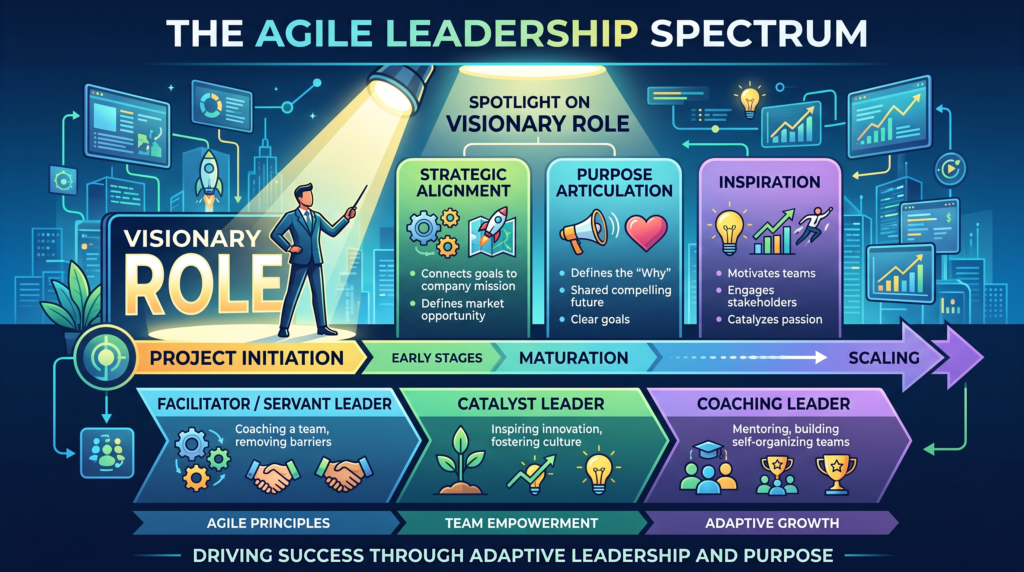
The Core Mechanics of Visionary Initiation
To lead effectively in the early phases of a project, a manager must align three core mechanics: Purpose Articulation, Guardrail Definition, and Strategic Context Setting
| Strategic Dimension | Without Visionary Leadership | With Visionary Leadership |
| Team Focus | Reactive task completion and ticket churning. | Proactive outcome delivery aligned with business goals. |
| Scope Management | Uncontrolled scope creep driven by noisy stakeholders. | Strict alignment against established strategic guardrails. |
| Decision Making | Escalated to management, causing delivery bottlenecks. | Decentralized and autonomous, guided by core project vision. |
| Stakeholder Trust | Low confidence due to shifting dates and unclear value. | High trust built on transparent, outcome-focused roadmaps. |
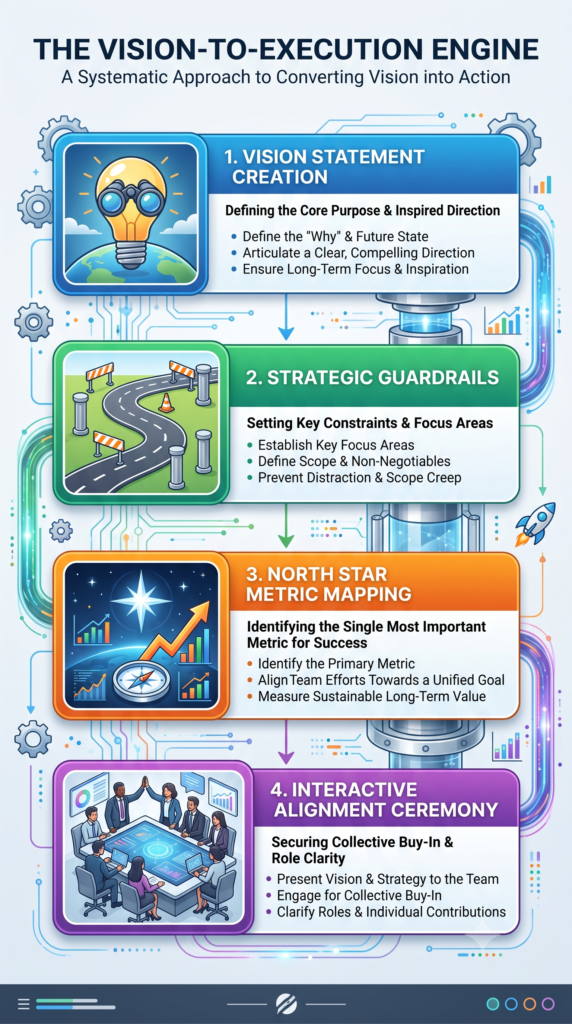
The Vision-to-Execution Engine: A Step-by-Step PM Framework
How do you operationalize visionary leadership as a Project Manager or Scrum Master? You do not need to rely on sheer charisma. You need a structured, repeatable framework that translates executive intent into tactical team alignment.
Step 1: Formulate the Core Vision Statement
Before building a single backlog item, construct a definitive Vision Statement using a structured positioning blueprint:
For [target user/customer persona]
Who [statement of the critical need or pain point]
The [project/product name] is a [solution category]
That [key benefit and compelling strategic outcome]
Unlike [current legacy system or manual workaround]
Our Project [primary competitive differentiator or business impact]
Step 2: Establish Strategic Guardrails
Vision is as much about deciding what not to build as it is about defining what to build. Establish explicit guardrails during project chartering:
Non-Negotiable Objectives: The 2-3 core business outcomes that define success.
Explicit Out-of-Scope Items: Features or requests that will be systematically deferred to prevent initial scope dilution.
Boundary Conditions: Firm financial, compliance, or technical constraints the team must honor.
Step 3: Connect Vision to the North Star Metric
Inspiration must tie directly to measurable business outcomes. Connect your Vision Statement to key Objectives and Key Results (OKRs), selecting a single North Star Metric.
For example, if your initiative involves an enterprise claims portal, your North Star Metric might be: “Reducing total claims processing turnaround time from 48 hours to 15 minutes.” Every sprint goal, architecture review, and user story can now be measured against this single metric.
Step 4: Execute the Vision Alignment Ceremony
Do not send out a long slide deck and call it a project kickoff. Conduct an interactive Vision Alignment Ceremony:
Present the Narrative: Frame the business problem and customer friction points with real operational data.
Run the Future Press Release Exercise: Have team members write a hypothetical internal announcement from two years in the future, detailing why this initiative transformed the business.
Calibrate Team Understanding: Verify that every engineer, designer, and tester can articulate in their own words how their daily work contributes to the high-level vision.
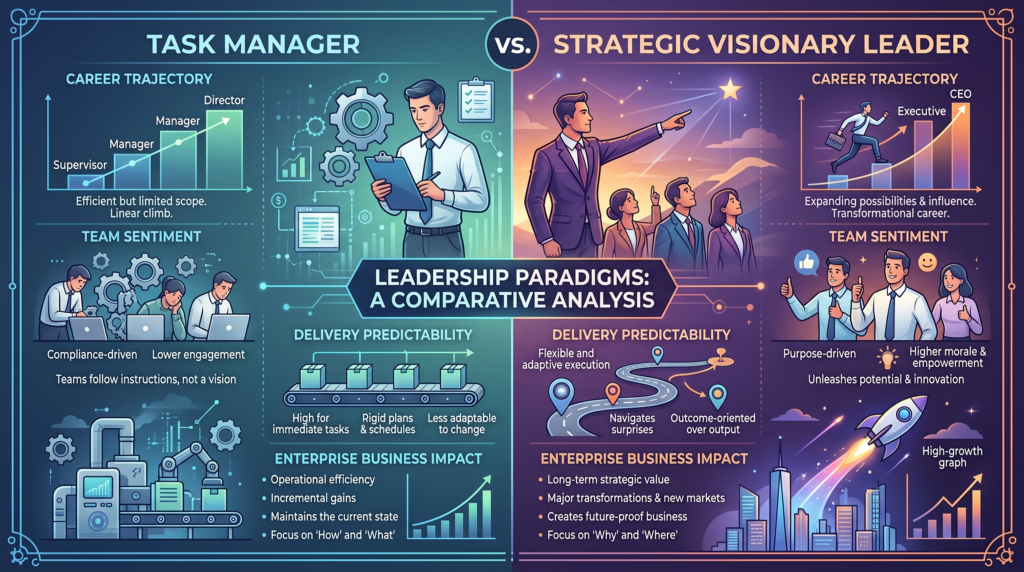
The Professional Transformation: From Task Manager to Strategic Leader
Imagine stepping into your next enterprise project with this framework fully deployed.
No longer are you trapped in a chaotic cycle of conflicting stakeholder requests, team burnout, and endless status tracking. Instead, your team operates with autonomy and strategic alignment. When scope creep threatens sprint goals, team members independently evaluate incoming requests against established vision guardrails, filtering out distractions before they reach the backlog. When technical blockers arise, engineers make intuitive, context-aware decisions because they deeply understand the project’s ultimate purpose.
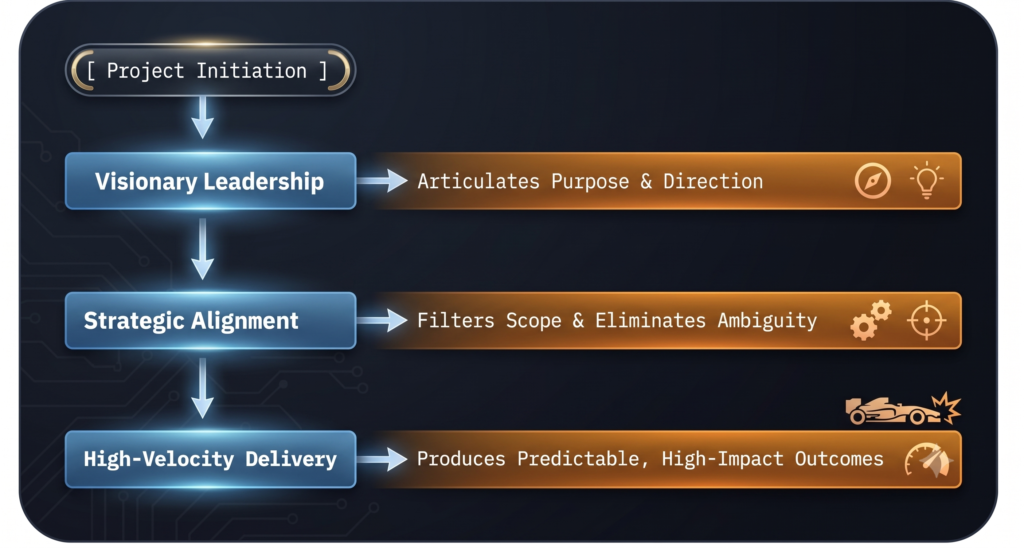
This is the fundamental shift from basic project administration to elite strategic leadership.
When you master the Visionary Role during initiation, you stop acting as a human ticket-router who simply pushes work across a kanban board. You position yourself as a high-leverage business leader capable of steering complex initiatives to success. Executive leaders notice when a manager consistently transforms ambiguous corporate mandates into predictable, high-impact delivery. This strategic capability is precisely what elevates ambitious professionals out of mid-level execution loops and into executive roles like Program Director, VP of Delivery, and Chief Product Officer.
Execution Without Vision is Just Expensive Noise
Great technical execution will never save a project headed in the wrong direction. As an Agile leader, your primary responsibility during initiation is to light the path, unite your team around a shared purpose, and establish the strategic momentum required for long-term execution.
If you are ready to stop guessing, move up the corporate ladder, and learn project management the right way, reach out to Skillsetify. We do not just teach frameworks: we show you your exact career growth trajectory. Take control of your career path and master enterprise leadership with Skillsetify today.