Why Rigid Management Styles Destroy High-Stakes Projects
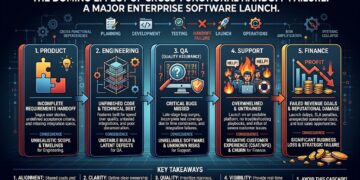
Just before a major multi-million dollar software release, a critical production defect surfaces in the final staging environment, threatening to delay deployment to over 500 enterprise clients. In the war room, the Project Manager sits back, nods supportively, and asks the engineering team, “How would you like to handle this, and what blockers can I clear for you?” Nobody takes charge. Deadlines slip, the client escalates to executive leadership, and the project descends into absolute operational panic.
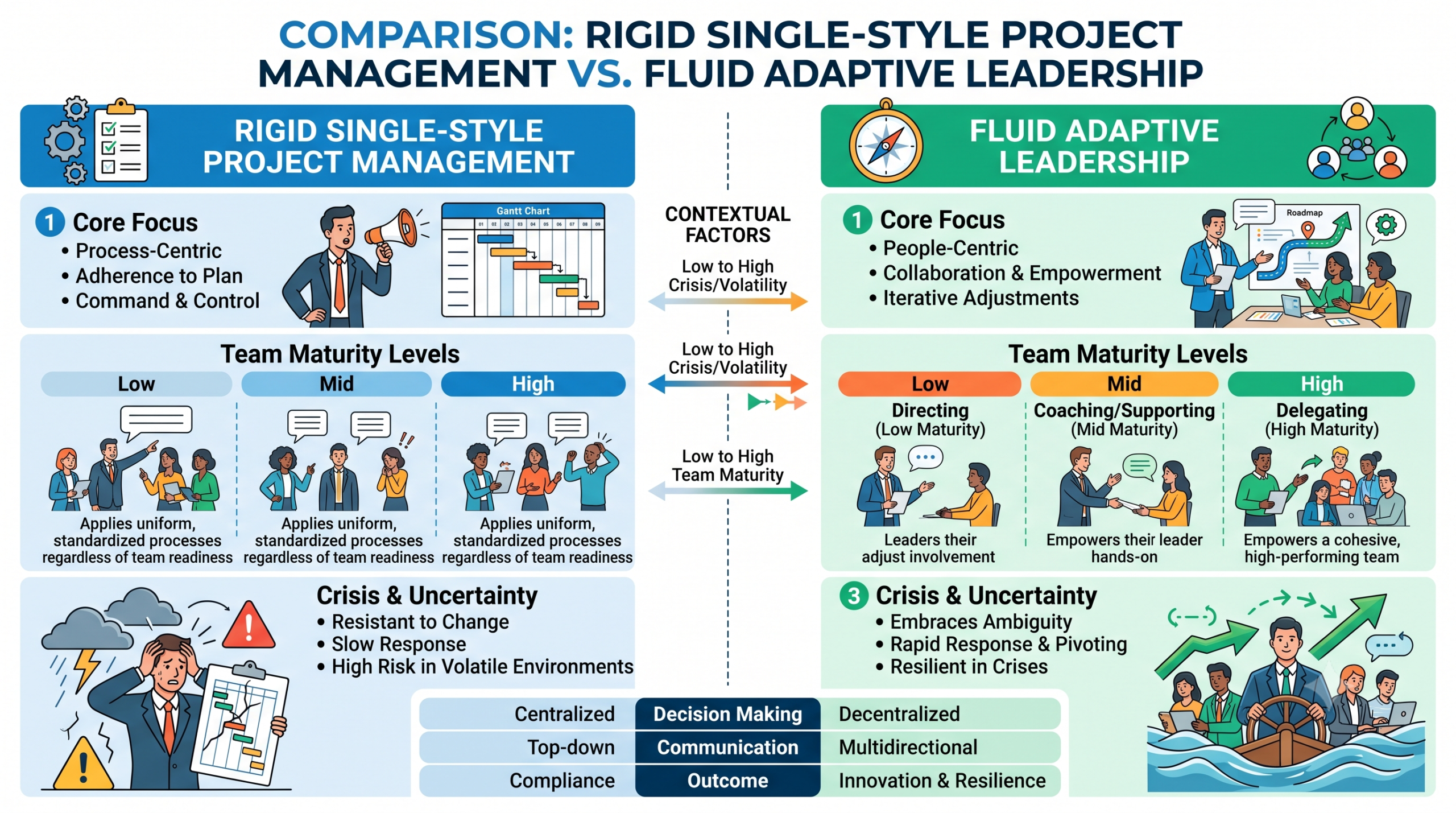
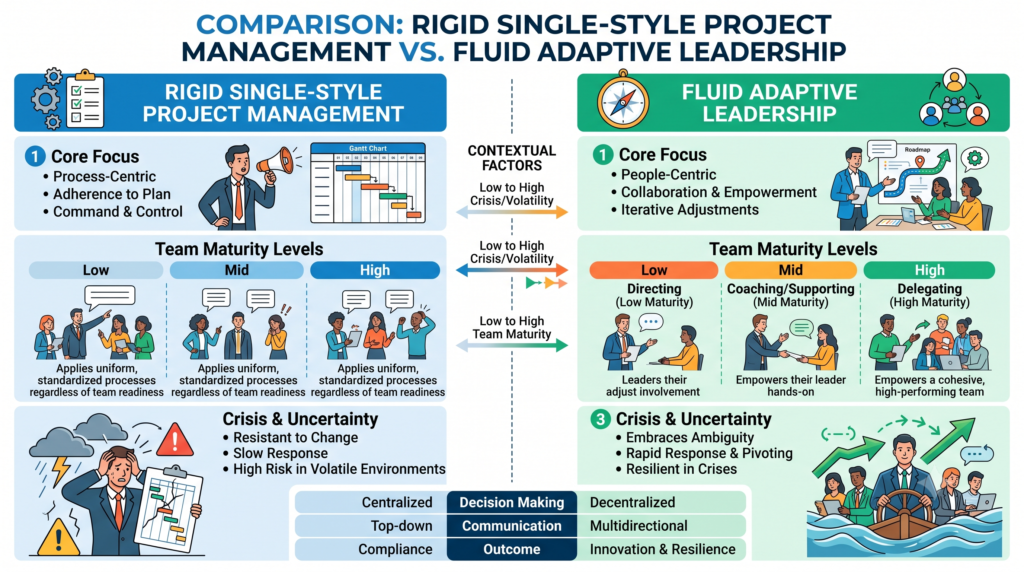
This scenario exposes a fatal flaw in modern project management: the blind, dogmatic application of a single leadership style. For the past decade, enterprise management circles have championed Servant Leadership as the single silver bullet for project execution. Corporate culture has fed managers a pervasive myth: true Agile leaders must always act as passive facilitators who simply clear blockers and step back.
The reality in modern enterprise delivery is starkly different. Dogmatically applying one leadership posture regardless of context is an express ticket to project failure. High-stakes delivery environments do not require static managers; they require Adaptive Leadership. Adaptive Leadership describes the ability to fluidly adjust management postures based on changing situational urgency, project complexity, and team dynamics.
Decoupling Leadership Dogma: The Mechanics of Adaptive Leadership
Agile methodology is fundamentally a philosophy of flexibility, yet many project managers treat leadership as a rigid set of fixed rules. True adaptive leaders recognize that project environments fluctuate daily. A technical crisis requires rapid direction, an innovative product discovery phase requires visionary alignment, and a mature team executing routine tasks requires hands-off facilitation.
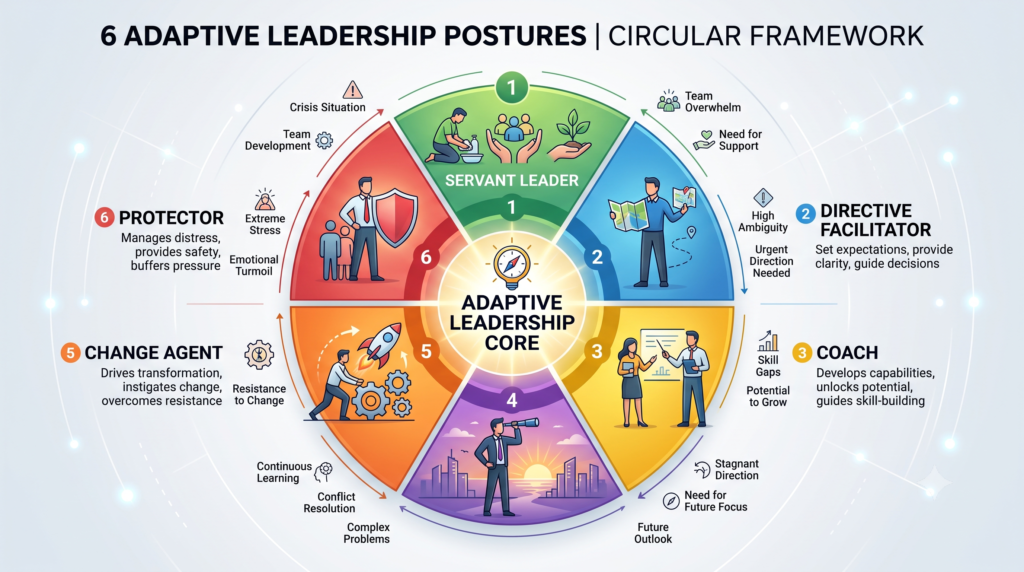
To navigate these changing dynamics, an adaptive leader must master six distinct operational postures and deploy them fluidly based on the immediate business context.
The 6 Core Postures of the Adaptive Project Leader
The Servant Leader: Focuses entirely on supporting team autonomy, removing operational friction, and putting team needs first. This posture is optimal for high-maturity teams executing well-defined backlogs where micro-direction hinders progress.
The Directive Facilitator: Takes immediate charge during high-stress operational crises or architectural deadlocks. When timelines are severely compressed or team alignment breaks down, the adaptive leader steps in to provide direct decision-making and firm boundaries.
The Organizational Coach: Concentrates on long-term skill development and individual career growth. Instead of handing out solutions, the leader guides team members through analytical questioning to help them discover answers and build autonomous problem-solving capabilities.
The Strategic Visionary: Articulates the overarching business purpose, key metrics, and strategic value behind project deliverables. This posture is essential during project initiation and scope realignments, ensuring every team member understands why the initiative matters to the organization.
The Transformation Change Agent: Drives structural, process, or cultural shifts across departments. Whether introducing digital transformation tools or replacing legacy workflows, the change agent conducts readiness assessments and aligns stakeholders to navigate enterprise friction.
The Team Protector: Cushions the team from external organizational politics, erratic executive demands, and context-switching distractions. By absorbing operational heat from upper management, the protector keeps the delivery engine focused and productive.
Navigating the Protector's Paradox
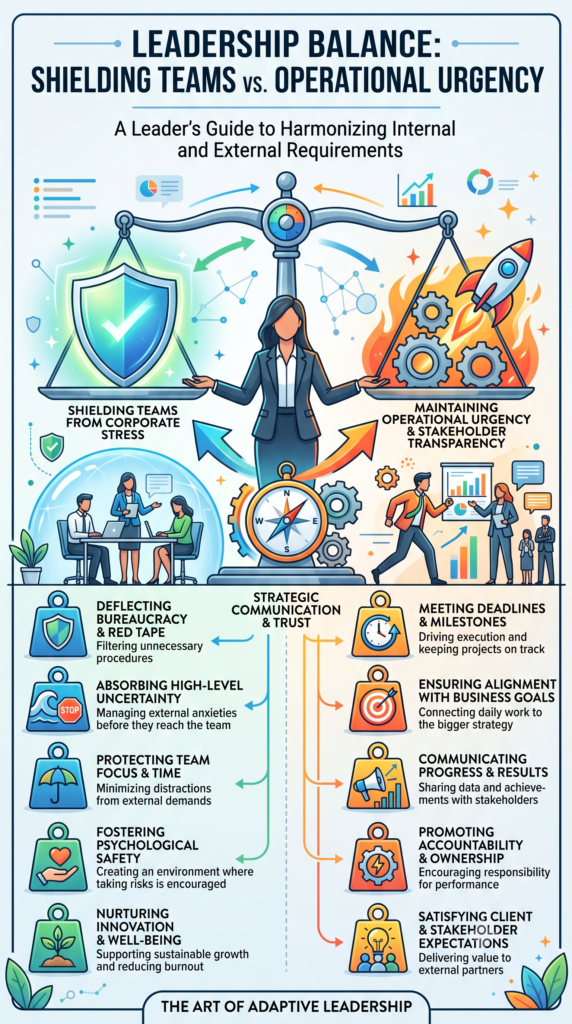
While shielding a team from executive pressure is vital, uncalibrated protection creates a dangerous failure mode known as the Protector’s Paradox.
When a project manager acts as an absolute buffer, absorbing all executive heat while hiding operational urgency from the development team, negative secondary effects emerge:
The team develops a false sense of security, failing to realize the severity of missed milestones.
Deliverables are intentionally or unintentionally delayed due to a lack of situational awareness.
Transparency collapses between the delivery layer and executive stakeholders.
To overcome this paradox, adaptive leaders adopt a posture of Soft and Firm Transparency. You must shield your team from toxic panic while maintaining radical transparency regarding business realities. Let the team understand stakeholder expectations, key milestone impacts, and project risks, while maintaining a safe environment where they can deliver solutions without fear.
The 5-Step Adaptive Leadership Execution Framework
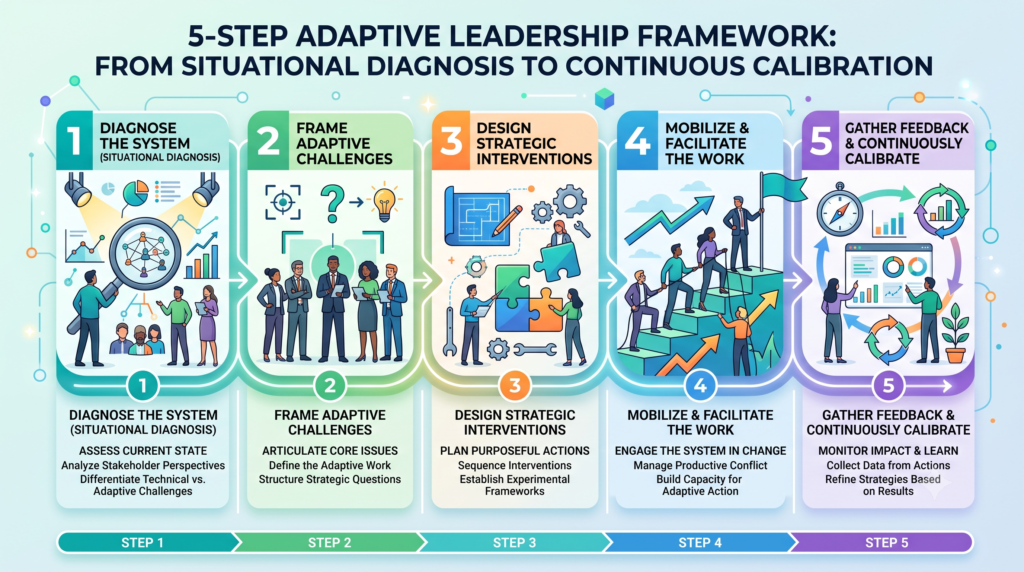
Transitioning from a rigid manager to an adaptive leader requires a systematic, repeatable framework. Project managers can apply this five-step methodology immediately across enterprise projects..
Step 1: Situational & Contextual Diagnosis
Before taking action, evaluate your immediate operational environment. Ask three diagnostic questions:
Is the project currently in a stable execution phase, an initiation phase, or an active crisis?
What is the technical and operational maturity level of the team?
What are the specific risk profiles and delivery constraints?
Step 2: Stakeholder & Influence Mapping
Identify key internal and external stakeholders, mapping their power, interest, and influence over project outcomes. Establishing clear stakeholder context allows you to communicate urgency accurately to your team without causing unnecessary panic.
Step 3: Posture Selection & Dynamic Matching
Match your leadership approach directly to your situational diagnosis using the Adaptive Leadership Matrix below.
| Project Context | Team Maturity Level | Optimal Leadership Posture | Primary Objective |
| Active Outage / Crisis | Low to High | Directive Facilitator | Rapid decision-making and emergency containment. |
| Project Initiation | Medium to High | Strategic Visionary | Aligning business purpose and securing stakeholder buy-in. |
| Process Overhaul | Low to Medium | Transformation Change Agent | Managing resistance and establishing modern workflows. |
| Routine Sprint Execution | High Maturity | Servant Leader | Eliminating blockers and enabling autonomous execution. |
| Capability Gaps | Low to Medium | Organizational Coach | Building individual technical competence and confidence. |
Step 4: Transparent Execution & Soft-Firm Boundary Setting
Lorem ipsum dolor sit amet, consectetur adipiscing elit. Ut elit tellus, luctus nec ullamcorper mattis, pulvinarExecute your selected posture with clear, transparent communication. When performance timelines slip or team members procrastinate, establish firm boundaries while remaining supportive. Emphasize team accountability: the project succeeds or fails as a collective unit, but individual ownership drives the engine. dapibus leo.
Step 5: Continuous Calibration & Feedback Loops
Leadership is not static. Evaluate team momentum, velocity, and psychological safety during retrospective cycles. Re-diagnose your environment and adjust your leadership posture as project phases evolve.
From Delivery Chaos to Elite Executive Trajectory
Picture the alternative project reality: No more late-night production panics driven by uncommunicated risks. No more disengaged teams coasting on vague expectations while executives fume over missed deadlines.
When you implement Adaptive Leadership, project chaos transforms into predictable, elite delivery. Your engineering teams operate with autonomy during routine execution because they trust you to step in decisively when a real crisis strikes. Stakeholders gain confidence because delivery milestones become reliable and transparent.
Mastering this situational fluidity is what separates tactical project managers from strategic business leaders. Executive leadership does not promote project managers simply because they know how to run a daily meeting or update a project board. They promote leaders who can read complex corporate dynamics, manage high-stakes risk, and fluidly guide teams through ambiguity to deliver bottom-line results.
Learning project management the right way means moving past rigid textbook dogmas and developing true operational agility. It is the single fastest catalyst to elevate your career from managing tasks to driving enterprise strategy.
Take Command of Your Project Leadership Trajectory
Navigating modern corporate complexity requires more than memorizing static frameworks: it demands master-level situational awareness, leadership agility, and real-world execution skills.
If you are ready to stop guessing, move up the corporate ladder, and learn project management the right way, reach out to Skillsetify. We do not just teach frameworks: we show you your exact career growth trajectory. Connect with our expert advisors today and transform your project leadership potential into executive reality.