It Is Your Greatest Strategic Asset
Approaching the scheduled launch of a $12 million cloud modernization initiative for an enterprise financial client, your Lead Systems Architect and your Head of Data Engineering are locked in a heated standoff in a packed conference room. The architect demands a rigid microservices redesign to satisfy long-term scalability standards, while the engineering lead insists on a monolithic patch to meet the immediate, board-mandated go-live target. Voices elevate, project scope drifts into unknown territory, and team morale plummets. Standing in the middle, the project manager attempts to smooth over the conversation, offering vague platitudes about teamwork and suggesting everyone take space to cool off.
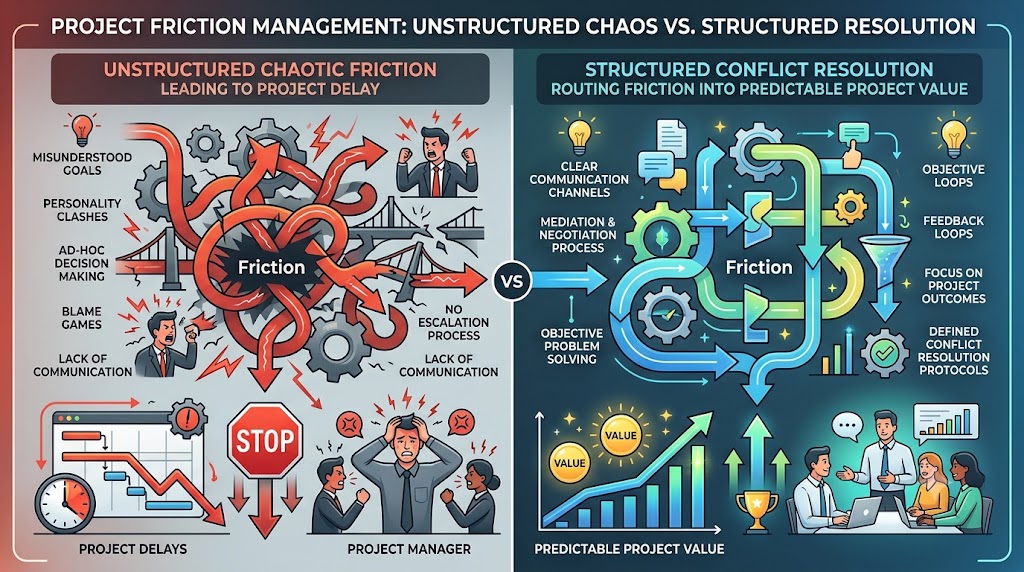
Shortly after, the situation degrades into complete gridlock. The data engineering team has quietly slowed work in protest, key API deliverables are officially delayed, and the enterprise project sponsor is demanding an emergency C-suite briefing to explain potential SLA penalties. This scenario plays out in corporate boardrooms and engineering centers globally. The underlying disaster in this scenario is not the technical disagreement itself, but the project manager’s reliance on passive mediation rather than a structured conflict resolution architecture.
In modern B2B culture, one persistent myth ruins project velocity faster than bad code, flawed estimates, or tight budgets: the myth that a healthy project team is a peaceful team. Organizations frequently mistake polite silence for cross-functional alignment, viewing team friction as an inherent management failure. In reality, conflict is an inevitable, necessary byproduct of bringing diverse, high-performing specialists together under constrained environmental conditions. High-performing organizations do not attempt to eliminate conflict: they build rigorous, repeatable systems to diagnose, contextualize, and resolve it.
Decoupling Friction Through Core Frameworks and PMBOK Architecture
To transform interpersonal and operational friction into project momentum, project leaders must move away from emotional, ad-hoc responses and ground their approach in systemic methodologies. The Project Management Body of Knowledge (PMBOK) provides an architectural blueprint for understanding where friction originates, how it evolves, and how to apply the precise technical strategy required to resolve it cleanly.
The 7 Root Sources of Project Conflict
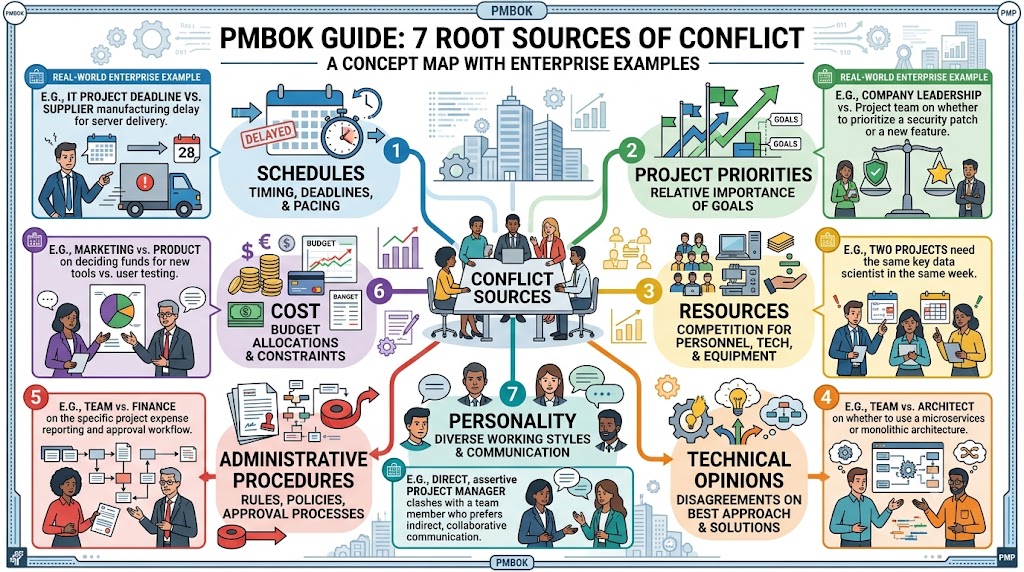
Conflict in complex enterprise environments rarely stems from personal hostility or malicious intent. Instead, it originates from systemic tensions embedded within competing organizational constraints. Effective project managers must diagnose the underlying mechanics before attempting any form of remediation. PMBOK highlights seven primary root sources of project conflict, ranked by operational frequency:
Schedules: Disagreements regarding milestone timelines, task sequencing, dependency handoffs, and deliverable deadlines. This represents the single most frequent cause of friction in project management.
Project Priorities: Misalignment between key stakeholders regarding which project outcomes yield the highest strategic business value or must be prioritized during resource allocation.
Scarce Resources: Competition over limited specialized talent, engineering hardware, cloud infrastructure, external vendor budgets, or cross-functional team bandwidth in matrixed organizations.
Technical Opinions: Contrasting views on engineering methodologies, architectural standards, technology stacks, software design patterns, or quality assurance criteria.
Administrative Procedures: Friction caused by organizational governance models, reporting protocols, decision-making channels, sign-off hierarchies, and workflow approvals.
Cost Constraints: Disputes over budget allocation, cost estimates, financial variance tolerance, vendor pricing models, and ongoing expense tracking mechanisms.
Personality Workstyles: Interpersonal friction arising from differing communication habits, professional values, cultural norms, or individual work preferences.
By isolating the exact root source, project leaders prevent superficial treatments. Attempting to solve a schedule compression conflict with interpersonal soft-skills coaching, for instance, completely fails to resolve the underlying timeline constraint and only increases team frustration.
The 5 PMBOK Conflict Resolution Techniques
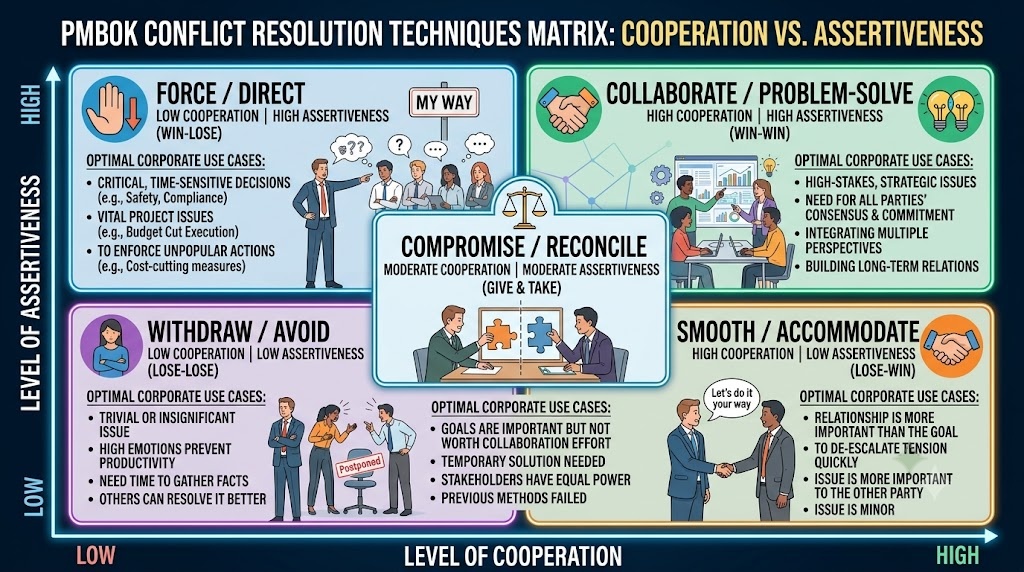
Once the root source is isolated, project leaders must deploy the appropriate structural resolution technique. PMBOK establishes five distinct conflict resolution strategies, each engineered for specific operational contexts:
Collaborate / Problem-Solve: Multiple viewpoints are synthesized to forge a consensus, win-win outcome. This approach digs beneath surface-level demands to address true underlying business needs. It builds long-term commitment and shared accountability, making it ideal for complex, high-stakes scenarios involving influential stakeholders where consensus is vital.
Compromise / Reconcile: Both parties make concessions to identify a mutually acceptable, middle-ground solution that temporarily or permanently resolves the issue. This technique is optimal when time is constrained, equal-authority stakeholders are involved, and a quick, pragmatic outcome is required without derailing project velocity.
Smooth / Accommodate: Differences are downplayed, while areas of agreement are emphasized to preserve harmony and maintain relationships. This approach is most effective when the issue is minor, when you need to build goodwill for future leverage, or when preserving team stability outweighs the immediate deliverable outcome.
Withdraw / Avoid: The project leader retreats from the active disagreement, postponing the issue to allow parties time to cool down or gather additional facts. This tactic should be reserved for low-stakes disputes, temporary cooling-off periods, or situations where you lack sufficient authority or information to act immediately.
Force / Direct: A dominant position is asserted, enforcing one party’s perspective at the expense of another. This creates a win-lose outcome and carries a high risk of team demoralization. It is strictly reserved for high-stakes emergencies, critical safety or compliance mandates, or rapid decision-making when consensus cannot be reached.
The Step-by-Step Implementation Framework
Translating PMBOK conflict architecture into daily project execution requires a repeatable operational playbook. When friction threatens project health, execute this four-step diagnostic and resolution protocol:
Conduct Root Cause Isolation: Immediately isolate the dispute from personal emotion. Convene separate one-on-one discovery sessions with involved parties within 24 hours of the conflict surfacing. Map the friction directly back to one of the seven PMBOK sources, distinguishing between surface-level positions (what stakeholders say they want) and underlying interests (what stakeholders actually need).
Execute Contextual and Power Mapping: Assess the surrounding organizational environment. Evaluate stakeholder influence using a Power-Interest grid, review contractual obligations, calculate schedule urgency, and determine financial impact. Assess whether the conflict threatens core baseline constraints (scope, time, cost) or merely impacts preferred implementation preferences.
Select and Execute the Optimal Strategy: Match the diagnosed root cause and contextual power dynamic to one of the five resolution techniques. If two senior engineers disagree on database architecture during early phase planning, leverage Collaboration to build a unified design. If a vendor dispute threatens an immediate sprint goal, apply Compromise or Force depending on contractual authority and timeline urgency.
Institutionalize Agreements and Monitor Outcomes: Document the agreed-upon solution in official project governance artifacts, updating the issue log, team charter, risk register, and communication management plan. Schedule a formal follow-up review within five business days to verify that the resolution is holding, operational efficiency is restored, and no secondary resentment is impacting delivery velocity.
![4-step conflict resolution implementation framework from Root Cause Isolation to Governance Institutionalization.]](https://skillsetify.com/blog/wp-content/uploads/2026/08/watermark-removed-fcb13d8f-2282-4c34-8912-5cdfef6c5972.jpg)
The Strategic Shift: Elevating from Delivery to Leadership
Mastering structured conflict resolution fundamentally transforms your daily reality as a project professional. When you replace emotional firefighting with methodical framework execution, project chaos turns into predictable, high-value delivery. Scope creep is caught before it compromises budgets, cross-functional teams operate with psychological safety, and team burnout drops significantly because disagreements are handled transparently, fairly, and systematically.
Beyond immediate project health, mastering these architecture-level skills alters your long-term career trajectory. The corporate landscape is saturated with tactical project managers who manage schedules, track tickets, and report status updates. However, enterprise executives do not promote individuals merely for updating task tracking tools. They promote leaders who can navigate high-stakes organizational friction, align conflicting executive priorities, and maintain delivery governance under severe pressure.
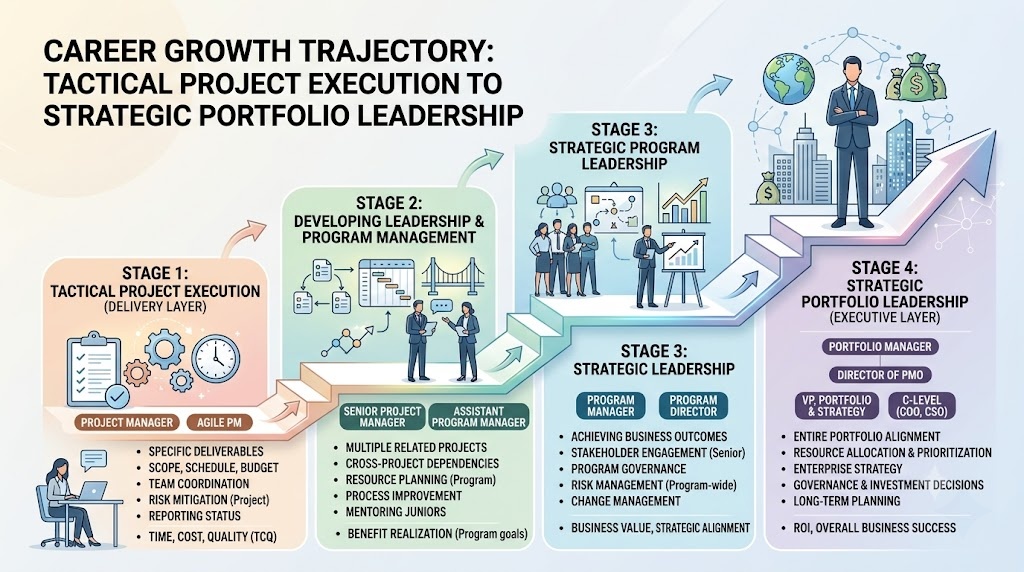
In enterprise corporate structures, career progression requires transitioning across three distinct layers:
The Delivery Layer: Focused on tactical task execution, hands-on technical tracking, and localized issue resolution.
The Program Layer: Focused on managing interdependencies, driving cross-functional business value, and orchestrating multi-project governance.
The Strategic Layer: Focused on portfolio optimization, C-suite alignment, enterprise resource modeling, and strategic value realization.
To advance from the tactical delivery layer to the program and strategic management layers, you must speak the language of enterprise leadership. Demonstrating mastery over PMBOK frameworks, organizational dynamics, and systematic conflict resolution signals to senior executives that you possess the executive presence and strategic acumen required to oversee complex portfolios and drive business growth.
Master the Frameworks That Drive High-Stakes Delivery
Navigating complex enterprise environments requires far more than intuitive guessing or passive management. It demands deep framework fluency, structural rigor, and the ability to turn workplace friction into strategic alignment. By mastering root cause analysis, PMBOK conflict resolution techniques, and structured governance execution, you establish yourself as an indispensable project leader capable of driving enterprise success under any circumstances.
If you are ready to stop guessing, move up the corporate ladder, and learn project management the right way, reach out to Skillsetify. We do not just teach frameworks: we show you your exact career growth trajectory.