Why Elite Project Leaders Use Governance as an Accelerator
It is a Tuesday, and a high-visibility digital transformation project is bleeding momentum. Three functional leads are locked in a contentious debate over architectural scope changes, engineers have paused code deployments while waiting for a sign-off from an inactive Steering Committee, and the primary client sponsor is demanding immediate delivery milestones.
The project manager spends the entire morning frantically formatting a 45-slide status deck, chasing down three disconnected department heads for approval signatures, and drafting defensive emails to mitigate executive anxiety. Meanwhile, the actual project work sits completely frozen.
Every ambitious professional has witnessed this administrative paralysis.
Somewhere along the evolution of enterprise management, organizations adopted a toxic myth: that rigorous project governance means building bureaucratic checkpoints, demanding excessive documentation, and policing delivery teams.
When governance functions as an operational roadblock, it does not mitigate risk; it actively creates risk by crippling velocity and obscuring reality. High-performing organizations view governance through an entirely different lens.
True governance is not a gatekeeper. It is a strategic enabler designed to clear obstacles, align stakeholder perception, protect delivery flow, and accelerate career trajectories.
Deconstructing Governance
From Bureaucratic Tax to Strategic Enabler
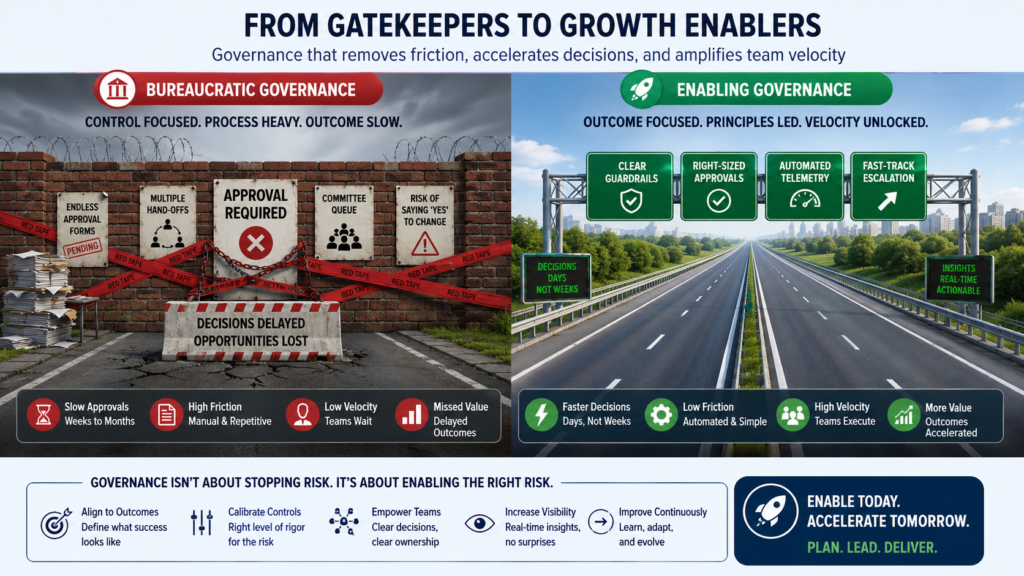
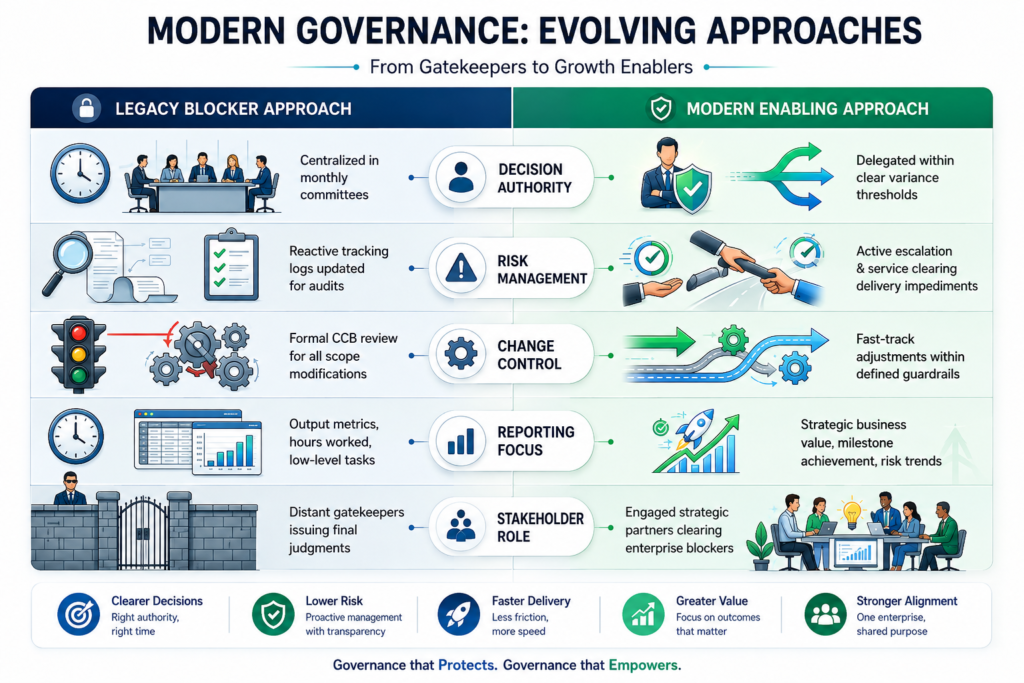
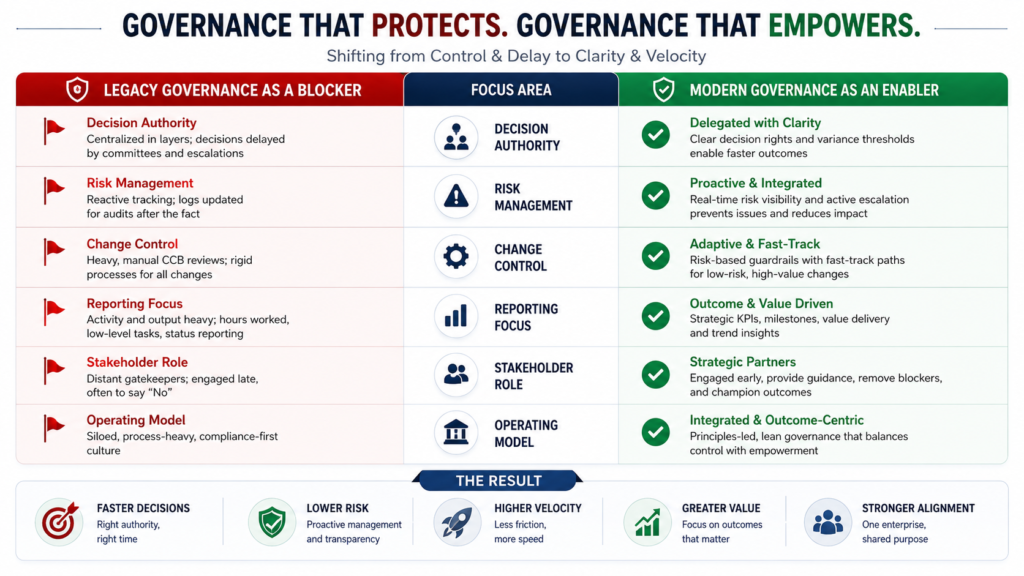
To transform governance from a delivery tax into an operational engine, leaders must first understand where traditional models break down. Traditional oversight often operates on control-based friction: requiring exhaustive sign-offs, rigid change-control boards (CCBs) that meet once a month, and lagging indicators that report failure long after the damage is done.
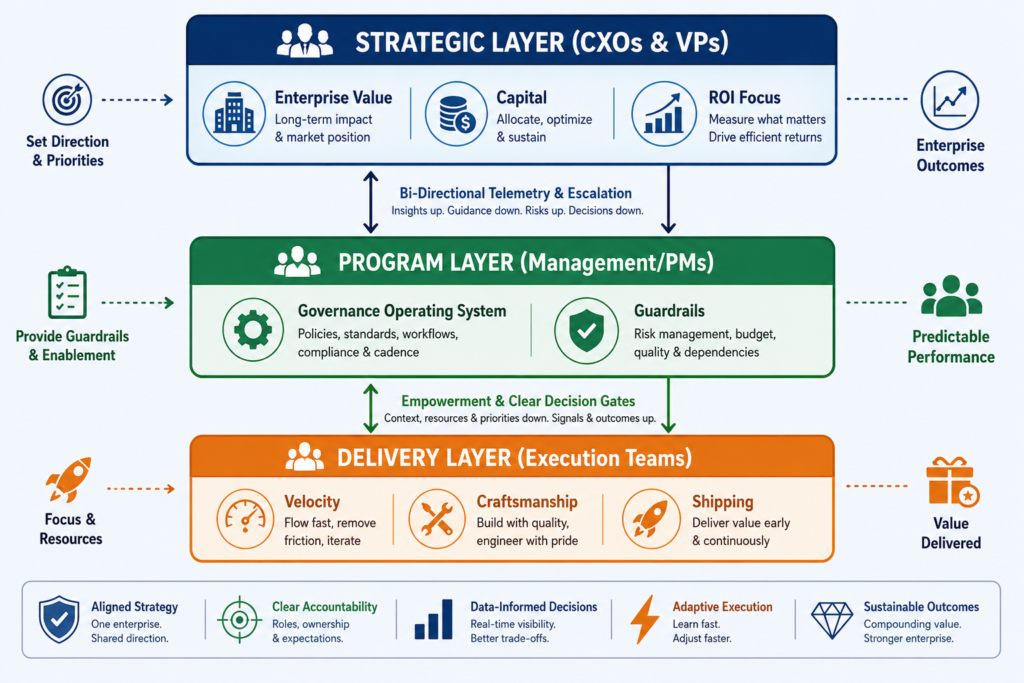
Enabling governance flips this paradigm entirely. It treats governance as the structured operating system that removes ambiguity, provides immediate air cover, and creates seamless alignment across the three critical layers of an enterprise:
The Strategic Layer (Executive Leadership & CXOs): Focused on enterprise value, revenue generation, market positioning, and capital allocation.
The Program Layer (Management & Senior Delivery Leaders): Focused on cross-project synergies, resource optimization, risk management, and outcome governance.
The Delivery Layer (Technical Teams & Functional Leads): Focused on iterative execution, quality standards, and technical velocity.
Why Dysfunctional Governance Breaks Teams
When governance structures become blockers, projects fail in predictable patterns:
Perception-Delivery Disconnect: Delivery teams work overtime shipping features, but because governance channels fail to manage executive perceptions, leadership views the initiative as a failure.
Analysis Paralysis: Teams hold back on critical technical decisions because the cost and friction of obtaining formal committee approval is too high.
Shadow Governance: Frustrated by slow processes, functional teams bypass formal channels entirely, creating blind spots that expose the business to severe legal, financial, and architectural risks.
The 5-Step Operational Framework
Building an Enabling Governance Model
Transforming project governance into an operational accelerator requires practical, repeatable mechanics. The following 5-step framework establishes enabling governance structures across predictive, agile, and hybrid delivery environments.
Step 1: Establish Delegated Authority and Decision Thresholds
Eliminate bureaucratic bottlenecks by defining pre-approved variance thresholds. Delivery teams should not need steering committee approval for routine decisions that do not impact strategic baselines.
Define a explicit budget variance limit (e.g., up to 5% or $15,000) within which the project lead can authorize changes without escalation.
Set schedule tolerance windows (e.g., up to 5 business days on non-critical path activities) allowing internal adjustments.
Implement a single-page Decision Matrix (DACI or RAPID) clarifying exactly who makes decisions, who provides input, and who is simply informed.
Step 2: Transition from Approval Checkpoints to Operational Guardrails
Shift focus from reactive inspection to proactive design parameters. Instead of reviewing every artifact at the end of a sprint or milestone, establish automated guardrails that allow teams to move fast safely.
Embed automated quality and compliance gates directly into deployment pipelines.
Publish explicit architectural boundaries, coding standards, and security playbooks upfront.
Grant delivery teams autonomy to execute within defined parameters without secondary sign-offs.
Step 3: Implement Lightweight, Cadence-Based Steering
Replace lengthy monthly governance meetings with crisp, high-frequency synchronization sessions focused entirely on blocker removal.
Restructure Steering Committee sessions around three core prompts: What strategic milestones did we hit? What trade-offs require leadership decisions? What organizational roadblocks must leadership clear today?
Enforce pre-reads and cap verbal governance briefings to 15 focused minutes.
Convert status reporting into dynamic dashboards showing live progress rather than manually assembled slide decks.
Step 4: Construct Fast-Track Escalation Pathways
Governance must serve as an active escalation service for delivery leads. When an initiative hits an cross-functional impasse, governance protocols should resolve it within hours, not weeks.
Establish service-level agreements (SLAs) for governance escalations (e.g., steering sponsors must resolve critical project dependencies within 24 hours).
Define objective trigger criteria that dictate when a risk automatically converts into an executive escalation.
Run monthly retrospective audits to identify and eliminate systemic organizational dependencies.
Step 5: Align Stakeholder Perceptions Through Strategic Telemetry
Project success is governed as much by stakeholder perception as it is by tangible output. A project delivered on budget and on schedule can still be considered a failure if stakeholder expectations are misaligned.
Map key project champions and skeptics across an Influence-Impact matrix.
Tailor governance communications to executive priorities: focus on ROI, risk exposure, and time-to-value rather than granular technical tasks.
Secure continuous stakeholder buy-in by validating incremental deliverables at regular intervals.
From Project Chaos to Strategic Authority
The Career Transformation
When a project professional masters the art of enabling governance, their day-to-day operational reality shifts dramatically.
No longer trapped in endless status updates or caught in the crossfire of conflicting stakeholder demands, delivery moves with predictability. Teams operate with autonomy within clear guardrails, scope changes are handled through objective trade-offs rather than emotional negotiations, and leadership receives the visibility it needs to support the project.
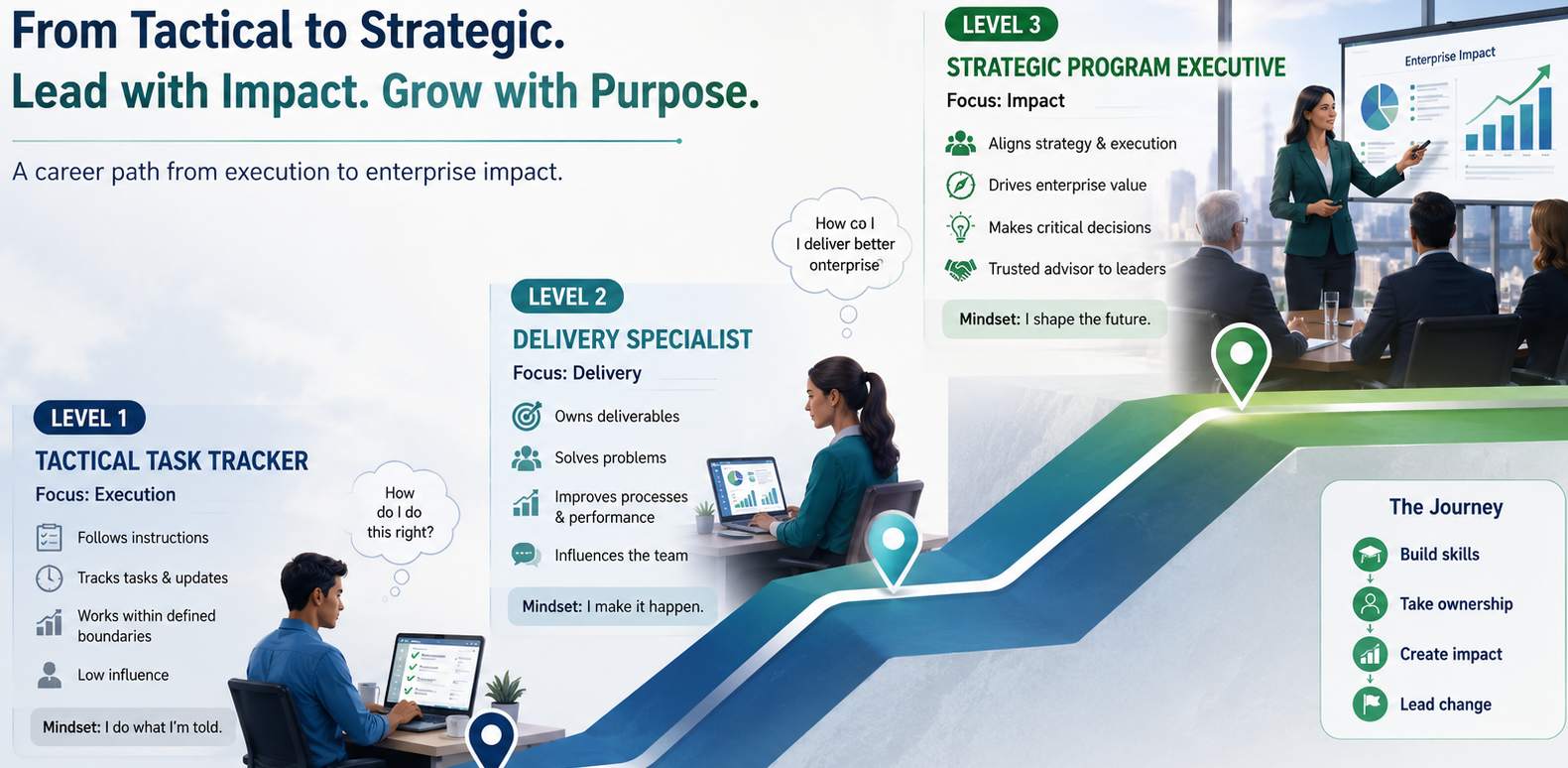
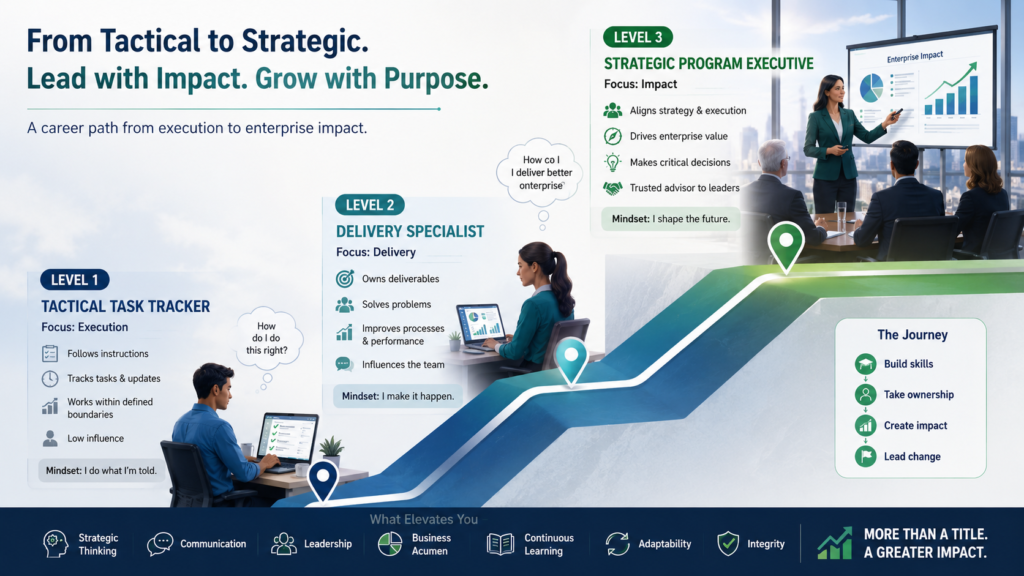
This operational shift directly mirrors the career progression from a tactical coordinator to a strategic project leader.
Ambition alone does not move professionals up the corporate ladder: executive capability does. Moving into leadership requires stepping out of the hands-on delivery weeds and mastering the strategic layer. When you demonstrate the ability to design governance systems that balance risk controls with team velocity, senior executives recognize you as a partner who can reliably convert strategic vision into bottom-line business value.
Mastering this distinction transforms project management from a source of professional burnout into the ultimate driver of strategic authority.
Master Elite Project Leadership with Skillsetify
Navigating enterprise politics, complex delivery models, and executive governance cannot be solved by memorizing rigid textbook theory. Real-world project excellence requires practical strategic frameworks, deep stakeholder management skills, and the confidence to lead high-stakes initiatives.
If you are ready to stop guessing, break through the delivery ceiling, move up the corporate ladder, and learn project management the right way, reach out to Skillsetify. We do not just teach frameworks: we show you your exact career growth trajectory.
Equip yourself with the tools, authority, and strategic mastery required to lead modern enterprise delivery. Connect with Skillsetify today to elevate your career.