Why You Do Not Need 'Project Manager' on Your Business Card to Earn Your PMP Certification
Imagine spending four years as a Senior Systems Analyst orchestrating cross-functional teams, managing six-figure software rollouts, mitigating operational risks, and keeping executive stakeholders aligned across three time zones. Then, a long-awaited Portfolio Lead position opens up at your company. You ask your director about stepping up, and they give you a polite smile: “We really need someone with a Project Management Professional (PMP) certification to handle this portfolio.”
Numb with disappointment, you open your laptop, pull up the Project Management Institute (PMI) eligibility criteria, and pause at the requirement: 4,500 hours of project leadership experience. You look down at your email signature. It says “Systems Analyst,” not “Project Manager.” Assuming you are automatically disqualified, you close the browser tab, convince yourself that certification is out of reach, and watch a peer with less hands-on experience walk into the office you spent four years working toward.
This scenario plays out in corporations every single day. Ambitious professionals routinely fall victim to the “Imposter Title Trap,” operating under the damaging assumption that corporate job titles dictate professional qualifications.
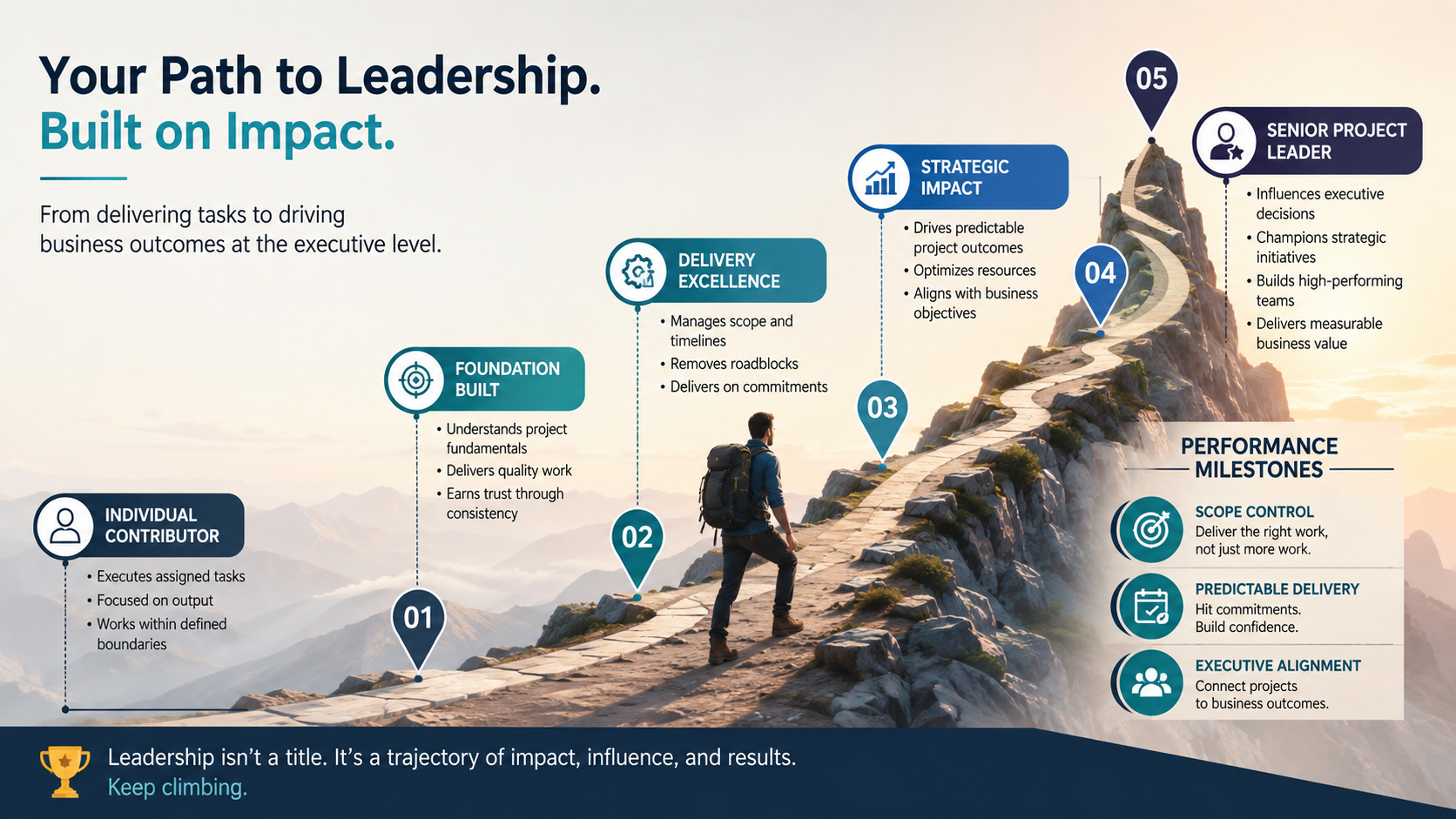
The reality is simple: PMI does not certify corporate titles. PMI certifies real-world project management responsibilities
Decoding the 4,500-Hour Benchmark: Mechanics, Rules, and Math
To qualify for the PMP exam, candidates must meet specific project experience thresholds set by PMI based on their highest level of education. For candidates holding a four-year degree (or global equivalent), the requirement is 4,500 hours of experience leading and directing project tasks over a minimum of 36 non-overlapping months within the last eight years. Candidates holding a high school diploma or associate’s degree must document 7,500 hours across 60 non-overlapping months.
Understanding the mechanics of how PMI measures these hours is critical to building an accurate, audit-proof application.
Roles That Regularly Qualify Without a "PM" Title:
Business Analysts: Facilitating requirements sessions (Planning), scope definition (Initiating), and user acceptance testing (Monitoring and Controlling).
Software Engineers / Tech Leads: Estimating work effort (Planning), coordinating developer sprints (Executing), and conducting code quality audits (Quality Control).
Scrum Masters & Agile Coaches: Facilitating team delivery (Executing), managing backlogs with product owners (Planning), and running retrospectives (Closing/Process Improvement).
Operations & Marketing Specialists: Leading product launches (Executing), managing agency contracts (Procurement), and tracking campaign spend (Cost Management).
Management Consultants: Onboarding client projects (Initiating), managing frameworks (Executing), and conducting formal handoffs (Closing).
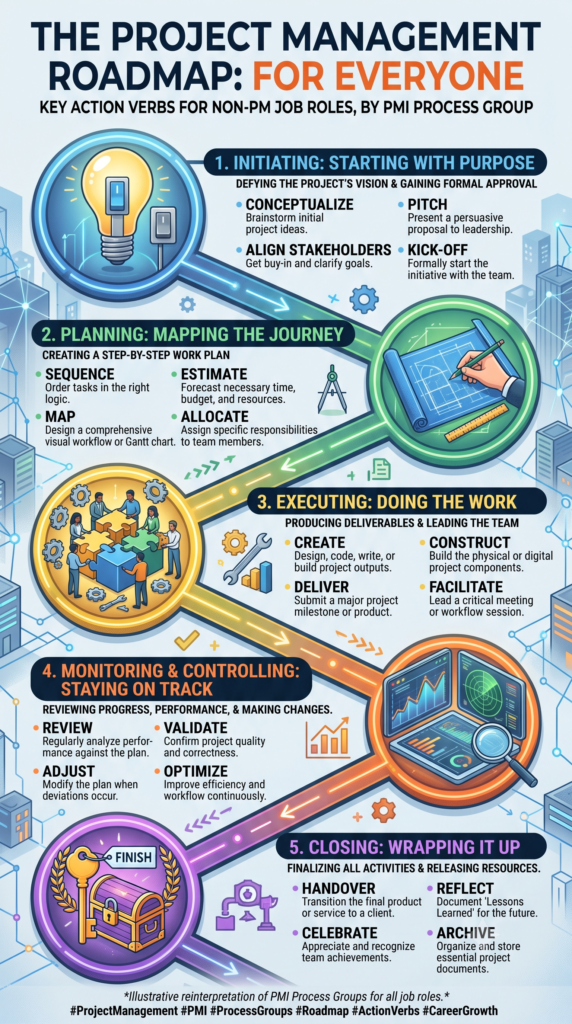
Mapping Non-PM Experience Across the 5 Process Groups
To transform daily work accomplishments into an application that PMI reviewers will approve, you must translate your tasks into the formal terminology of the five Project Management Process Groups. You do not need to have led all five process groups on every single project, but your overall application history must show demonstrated experience across them.
| Process Group | Non-PM Daily Work Context | PMI Application Translation |
| Initiating | Defining campaign objectives, writing kick-off briefs, securing stakeholder buy-in. | Identified project deliverables, defined key internal/external stakeholders, and assisted in developing the project charter. |
| Planning | Estimating sprint timelines, mapping resource dependencies, assigning team tasks. | Created the work breakdown structure (WBS), established schedule baselines, and defined risk response plans. |
| Executing | Directing technical tasks, leading cross-functional meetings, coordinating vendors. | Directed and managed project work, allocated human and material resources, and facilitated stakeholder communications. |
| Monitoring & Controlling | Reviewing sprint burn-down charts, managing scope changes, tracking budgets. | Monitored project schedule performance, controlled scope variances via change requests, and verified deliverable quality. |
| Closing | Handing off software builds, archiving project assets, running team retrospectives. | Obtained formal customer acceptance of final deliverables, archived project records, and documented lessons learned. |
Step-by-Step Framework: How to Audit and Document Your Hours
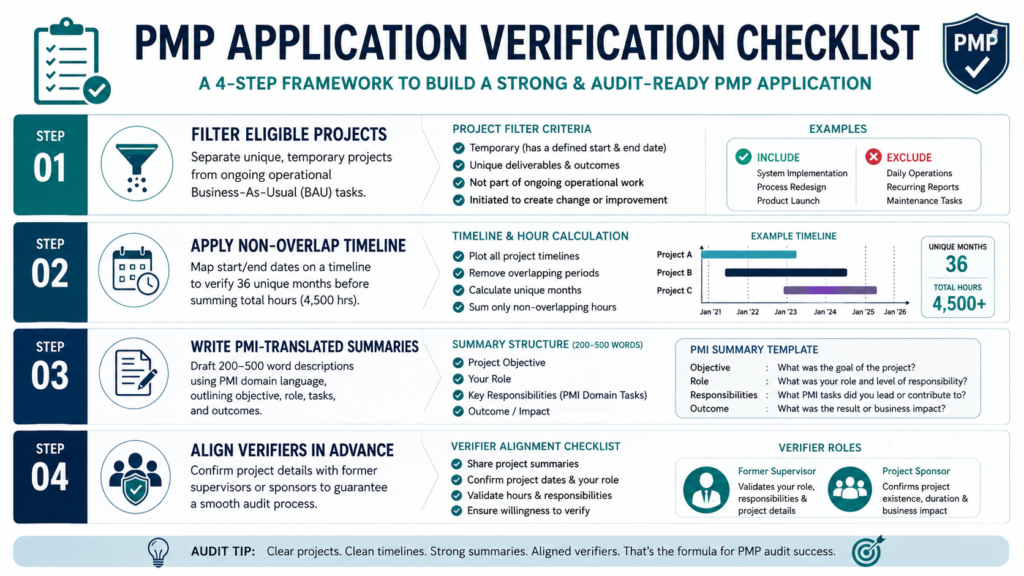
Follow this four-step framework to audit your career history, calculate your eligible experience, and assemble a compliant PMP application.
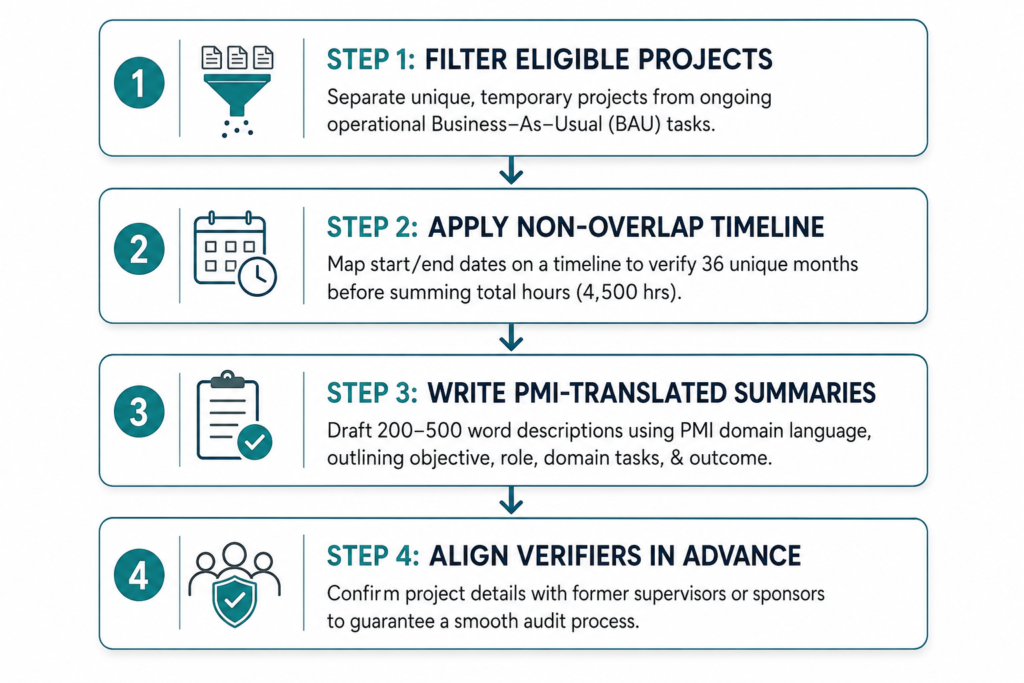
Step 1: Filter Eligible Projects from Operational Work
Review your past eight years of employment. Separate temporary projects from ongoing business-as-usual (BAU) operations.
Eligible Project: Re-architecting a database, launching a new marketing channel, migrating server infrastructure, organizing an industry summit.
Ineligible BAU Task: Maintaining daily ticket queues, writing routine weekly reports, managing standard monthly payroll processes.
Step 2: Build a Non-Overlapping Timeline
Plot your candidate projects on a spreadsheet with start and end dates. Identify overlapping ranges. Calculate your total unique months first to confirm you meet the 36-month threshold, then sum your total hours dedicated to project leadership activities across those initiatives.
Step 3: Write PMI-Compliant Project Summaries
For each project listed on your application, write a structured summary between 200 and 500 words. Format your text using these four core elements:
Objective: State the specific business goal of the initiative.
Your Role: State explicitly that you led and directed project activities.
Domain Actions: Outline specific tasks you performed across Initiating, Planning, Executing, Monitoring/Controlling, and Closing using PMI terminology.
Outcome: State the final result, deliverable handoff, and formal closeout.
Important Note on AI Assistance: While generative AI tools are excellent for brainstorming and structuring notes, avoid copying unedited AI templates into your PMI application. PMI uses automated detection systems to screen for generic submissions. Ensure your descriptions reflect your authentic, specific project experience.
Step 4: Confirm Your Verification Contacts Early
Should your application be randomly selected for a PMI audit, you will need a contact person (a former manager, supervisor, client, or sponsor) to verify your experience descriptions. Reach out to your verifiers before submitting your application, share your drafted summaries with them, and confirm they agree with how your project contributions have been structured.
The Professional Transformation: Unlocking Your Executive Potential
Translating your past work into the structured language of global project management does more than pass an application review: it changes how you see yourself as a professional.
When you step out of the narrow boundaries of corporate job titles, imposter syndrome disappears. You realize that you have already been doing the work of an elite project leader; you simply lacked the formal vocabulary to represent it.
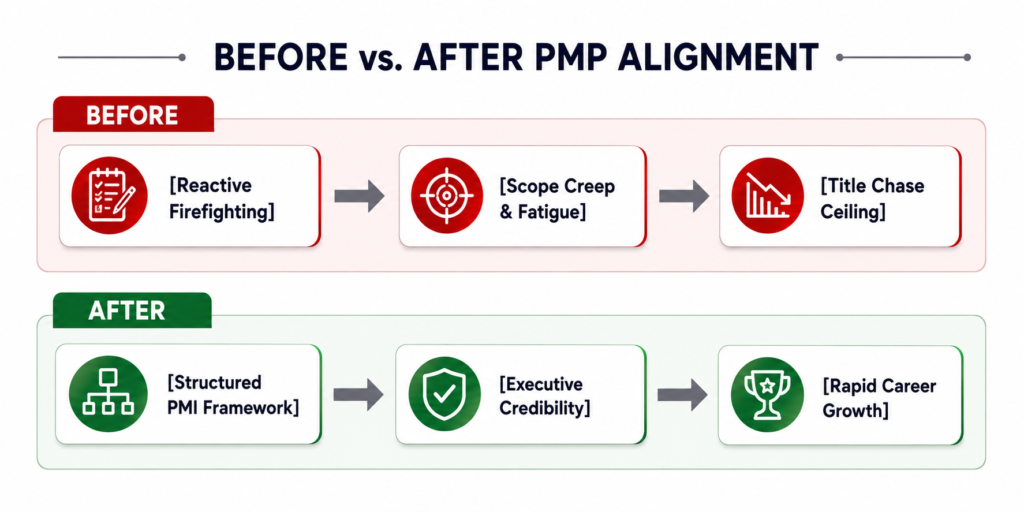
Life After Mastering Project Management the Right Way:
Predictable Delivery: Shift from reactive firefighting and team burnout to structured delivery using predictable, repeatable frameworks.
Executive Credibility: Speak the language of risk, scope, cost, and stakeholder engagement. You no longer ask for permission: you present clear business cases and structured risk matrices to decision-makers.
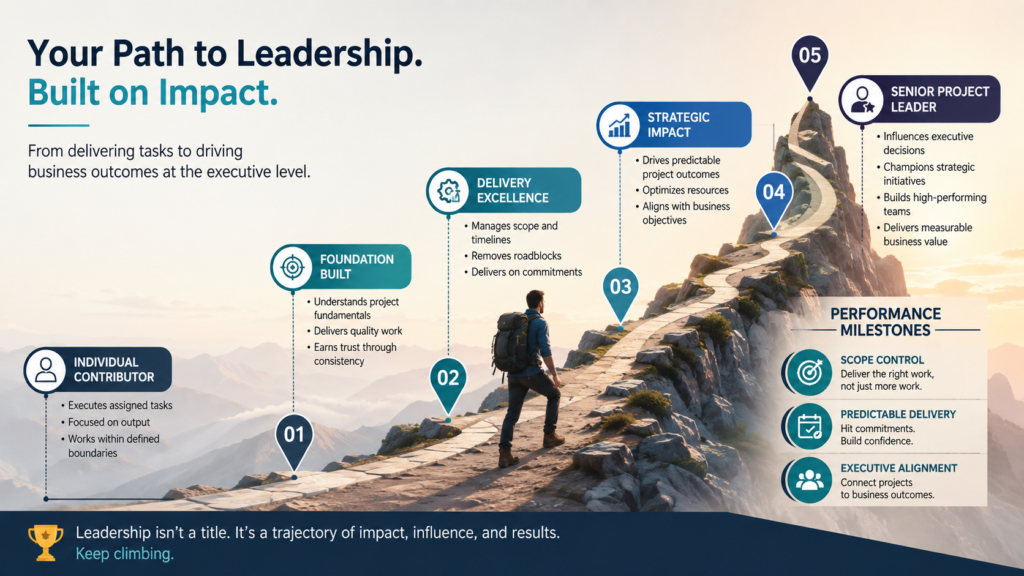
Accelerated Career Trajectory: Earn global recognition that opens doors to senior management, higher compensation tiers, and enterprise leadership roles without waiting for a title change.
Earning your PMP certification validates your real-world leadership and positions you as a capable driver of business outcomes.
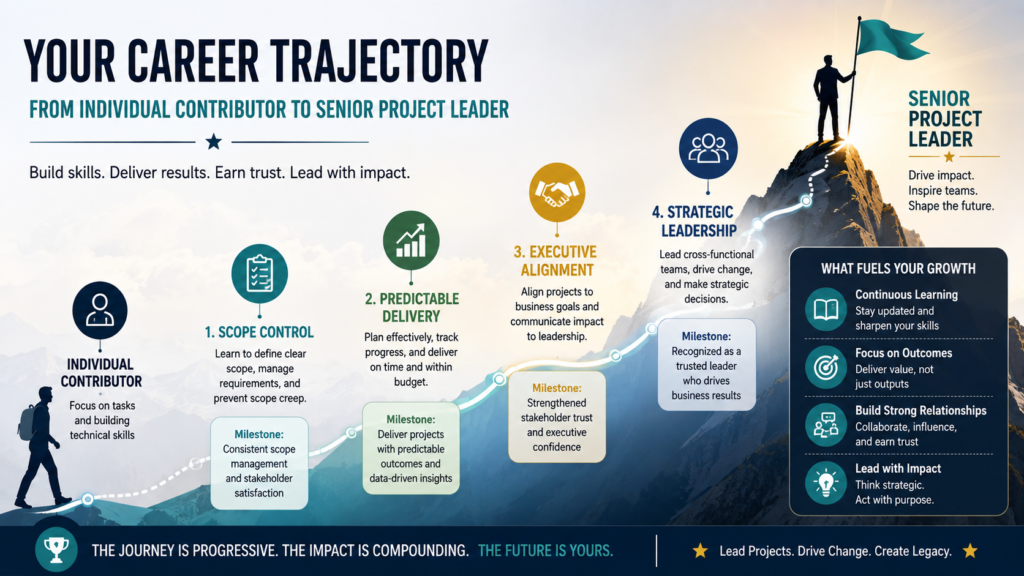
Take the Next Step with Skillsetify
Your career growth should not be stalled by administrative confusion or outdated myths about job titles. You have put in the work, managed the initiatives, and built real-world experience. What you need now is the strategic guidance to package that experience, master the exam concepts, and achieve your certification.
Ready to Accelerate Your Career?
If you are ready to stop guessing, move up the corporate ladder, and learn project management the right way, reach out to Skillsetify. We do not just teach frameworks: we show you your exact career growth trajectory.
Connect with our program team today for a personal experience assessment and start your path toward PMP certification.