The Case for Anonymous Point Distribution
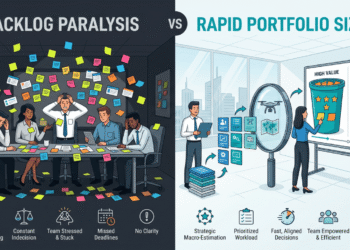
Picture this scenario. You are sitting in a critical sprint planning session. The stakes are incredibly high, the backlog is overflowing with forty complex user stories, and your cross-functional team is already feeling the pressure. You need to narrow this list down to the absolute most valuable deliverables. You open the floor for prioritization.
Almost instantly, the Senior System Architect leans forward and declares that refactoring the backend database structure is the undeniable top priority. The Vice President of Product chimes in, insisting that a shiny new user interface feature must take precedence.
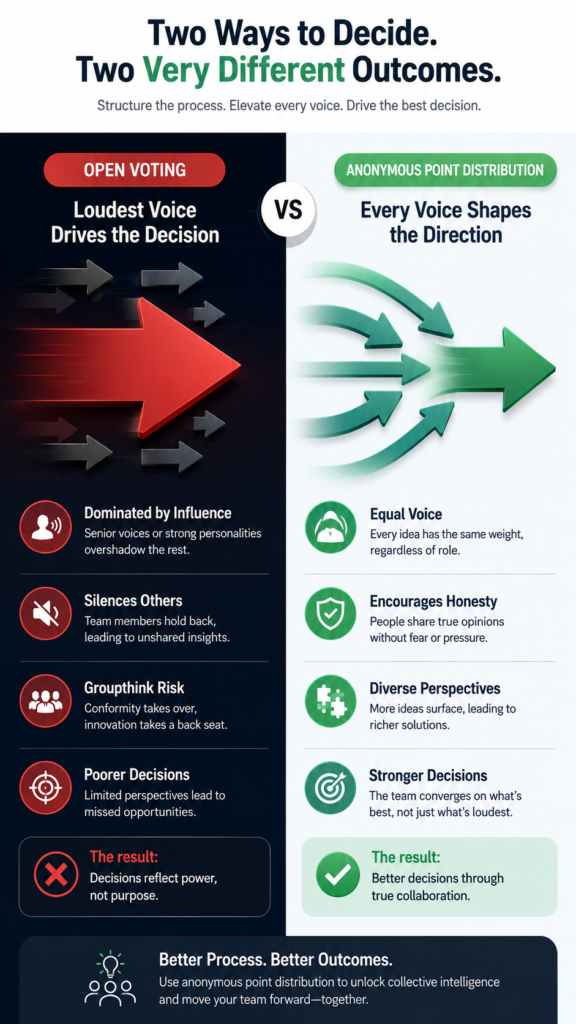
What happens next is a silent tragedy that occurs in meeting rooms across the globe. The junior developers, the quality assurance testers, and the quiet innovators in the room simply nod along. They might see a massive dependency risk. They might know that a completely different feature would deliver ten times the customer value. But they stay silent. The prioritization is hijacked not by data, but by dominance.
This brings us to a pervasive corporate myth. The myth states that if everyone in a room nods in agreement, you have achieved consensus. In reality, open agreement in a hierarchical environment rarely means genuine consensus. It usually just means the team has capitulated to the Highest Paid Person’s Opinion.
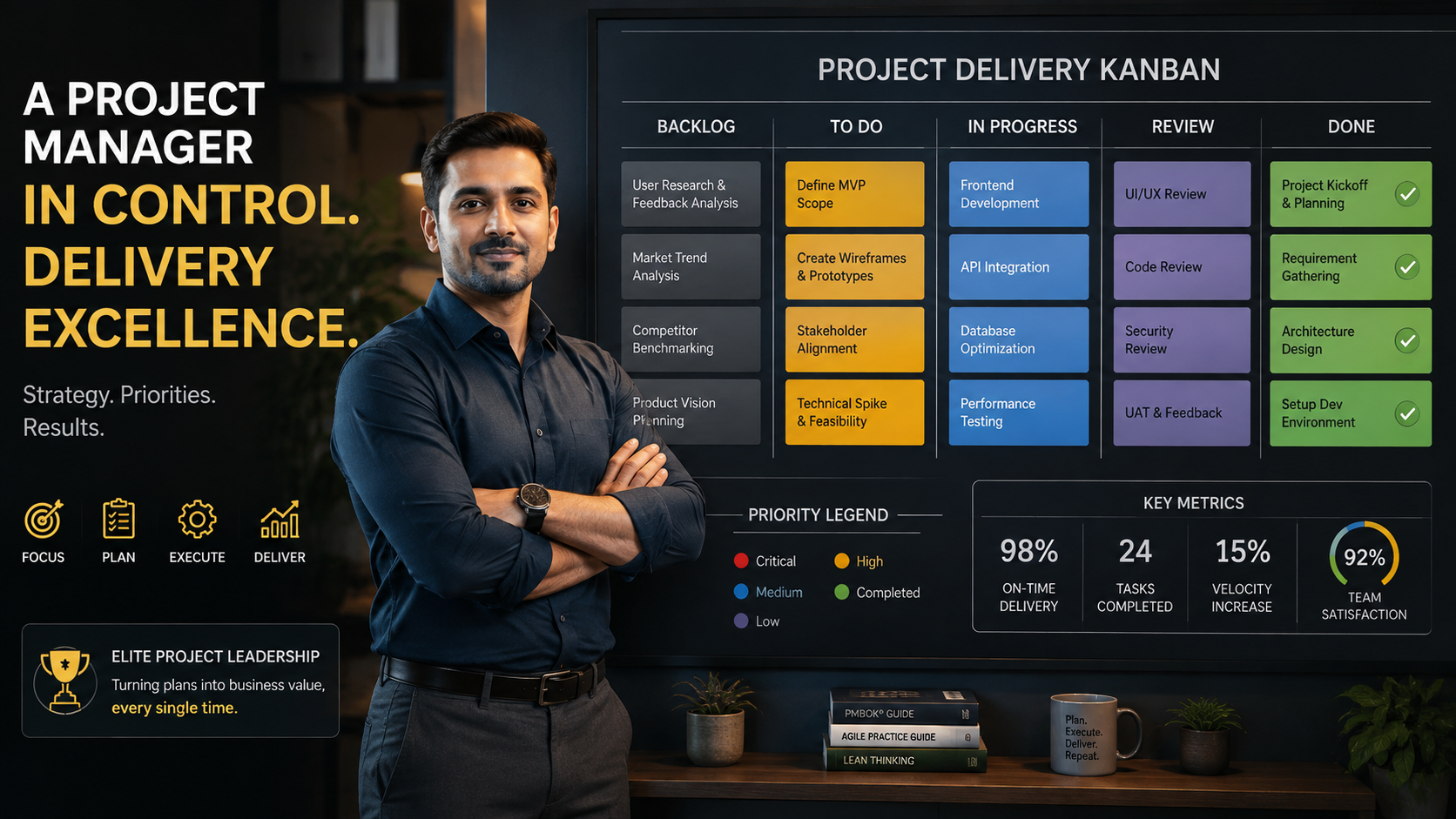
If you want to build truly elite, high-performing teams, you must remove the politics from prioritization. You must adopt Anonymous Point Distribution.


The Mechanics of Anonymous Point Distribution
Anonymous Point Distribution, often referred to as blind dot voting or secret allocation, is a dependency management and prioritization framework designed to uncover the absolute truth of team consensus.
Instead of asking team members to verbally debate which user stories or tasks are the most critical, you distribute a hidden currency to each participant. Participants then privately allocate this currency across the available options. Only when every single person has finalized their distribution are the results revealed to the group.
Why Secrecy is the Ultimate Equalizer
To understand why this works, we have to look at the cognitive biases that destroy standard project management. Authority bias compels individuals to defer to the opinions of authority figures, even when they suspect those opinions are flawed. The bandwagon effect causes people to align their votes with the majority simply to avoid conflict.
When you remove the public nature of voting, you neutralize these biases entirely. A title no longer carries weight. A loud voice is suddenly muted. The only thing that matters is the aggregate intelligence of the cross-functional team.
When participants vote anonymously, they vote based on their actual on-the-ground expertise. The database engineer votes to fix a critical flaw because they know the system will crash otherwise. The UI designer votes for a specific user story because they have seen the customer feedback. The resulting data provides a remarkably accurate map of what actually needs to happen next.
The Hard Versus Soft Dependency Rule
Before implementing this system, an elite Project Manager must clearly distinguish between hard dependencies and soft dependencies.
A hard dependency is a mandatory prerequisite. You cannot build the roof of a house before you pour the foundation. You cannot design a login page without first provisioning the server environment. Hard dependencies are non-negotiable and should never be put to a vote. They are simply facts of the project roadmap.
A soft dependency, however, is a matter of choice, best practice, or strategic sequencing. When you have a massive backlog of soft dependencies and parallel tasks, prioritization becomes subjective. This subjective space is exactly where Anonymous Point Distribution thrives. It takes the guesswork out of the choices and replaces it with collective, quantified team insight.
Step-by-Step Implementation Framework
Moving from theory to practice requires a rigid, well-facilitated structure. If you leave the rules open to interpretation, the process will fail. Here is the exact blueprint for facilitating an elite Anonymous Point Distribution session.
Step 1: Curate the Board
Start by removing all hard dependencies from the voting pool. Those items are already locked into the schedule. Take the remaining subjective items and present them clearly to the team. For this example, let us assume you have ten team members and forty potential user stories on the board.
Step 2: Define the Currency
Give every participant a fixed, equal amount of voting currency. A highly effective standard is to give each team member one hundred points. The rule is simple: they must distribute all one hundred points, but they are restricted in how broadly they can spread them.
Step 3: Establish the Constraints
Do not allow team members to put one point on one hundred different items. Force them to make hard choices. Instruct each person to select a maximum of four user stories from the board of forty. They must distribute their one hundred points exclusively among those four chosen items.
They can weight their distribution however they see fit. A participant might put fifty points on a massive critical feature, thirty on a secondary feature, and ten points each on two smaller tasks. This forced constraint ensures that only the truly critical items receive attention.
Step 4: The Silent Auction
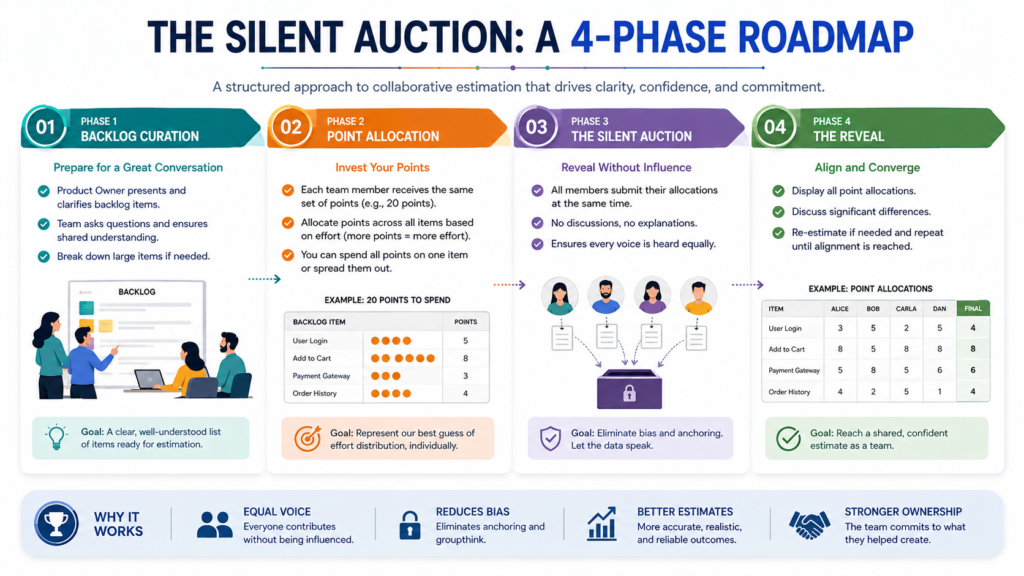
This phase must be done in absolute secrecy. Do not allow side conversations or open debates. If your team is remote, use a digital whiteboard tool that hides inputs until the facilitator unlocks the board. If you are in a physical room, use index cards or private digital forms. The silence is critical. It allows people to think deeply without being influenced by the body language or sighing of their peers.
Step 5: The Big Reveal and Alignment
Once all one thousand points (ten team members multiplied by one hundred points) are allocated, reveal the board simultaneously. Sort the user stories in descending order based on the total points received.
The results are often staggering. Items that leadership assumed were critical might sit empty. Quiet, unglamorous technical debt items might suddenly rise to the top, revealing a hidden consensus among the developers that the system requires maintenance.
Step 6: Targeted Discussion
You do not need to discuss all forty items. You only need to discuss the outliers. If one person put eighty points on an item that nobody else voted for, ask them to explain their reasoning. They might have a brilliant insight that the rest of the team missed, or they might simply have misunderstood the scope. Either way, your discussion is now laser-focused, data-driven, and devoid of ego.
The Professional Transformation
Implementing this methodology does much more than just organize a product backlog. It fundamentally transforms the culture of your project team and the trajectory of your career.
When you transition away from open, chaotic arguments and move toward Anonymous Point Distribution, you eliminate the constant threat of scope creep and team burnout. Developers stop feeling like they are merely taking orders from out-of-touch executives. They become active, invested stakeholders in the planning process. The psychological safety of the team skyrockets, resulting in more honest estimations, higher quality code, and highly predictable elite delivery.
For you, the Project Manager, the transformation is just as profound. You stop being a meeting referee and transition into a strategic facilitator. You protect the team from dominant personalities and shield choices from political influence. Leadership will quickly notice that your sprints actually deliver on time and your team operates with a level of harmony that other departments lack. Mastering these deep psychological frameworks is exactly how an ambitious professional accelerates their career from a standard coordinator to a highly sought-after strategic leader.
Stop Guessing and Start Leading
Relying on the loudest voice in the room is a recipe for disaster. Open voting breeds compliance, but anonymous point distribution uncovers the truth. By allocating hidden currency and forcing constrained choices, you strip away the ego, bypass the authority bias, and tap directly into the collective genius of your team. This is not just a meeting tactic. This is a foundational shift in how real project management is executed.
If you are ready to stop guessing, move up the corporate ladder, and learn project management the right way, reach out to Skillsetify. We do not just teach frameworks: we show you your exact career growth trajectory.