The Fist of Five Masterclass for Elite Project Delivery
We have all been there. It is the final hour of a grueling sprint planning meeting. The team is exhausted. The Product Owner slaps a complex user story onto the virtual board and asks for an estimate. A junior developer tentatively suggests a three. The senior architect rolls her eyes and counters with a thirteen. The room falls into an awkward, heavy silence. To end the misery, the Scrum Master splits the difference and logs an eight in the system.
Fast forward two weeks, and the sprint is a complete disaster. Scope creep has multiplied, technical debt has spiraled out of control, and the team is completely burned out.
Why did this happen? It happened because the team skipped the most crucial step in Agile estimation. They assigned a numerical value to a user story before confirming that everyone in the room actually understood the structural visibility of the work.
Let us dispel a toxic corporate myth right now. The biggest lie in modern Agile project management is that a unanimous story point estimate means total team alignment. In reality, forced consensus often hides deep, structural misunderstandings. When you rush to assign a Fibonacci number without verifying comprehension, silence merely hides operational fractures. If your team is estimating without a baseline gauge of understanding, you are not managing a project. You are simply rolling the dice and hoping for the best.

The Missing Link in Story Point Mechanics
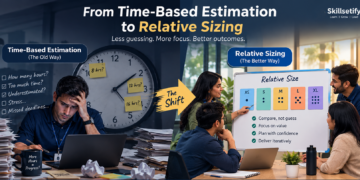
In elite B2B project management, story points are never measures of time. They are measures of relative effort, complexity, and risk. However, you absolutely cannot measure the relative complexity of a task if half your development team envisions a minor frontend UI tweak while the other half foresees a massive backend database migration.
This is where the concept of “structural visibility” becomes paramount. Before a team can confidently assign a three, a five, or an eight to a user story, they must share a crystal-clear vision of the work required. They need a shared reference baseline. If the structural visibility is cloudy, your relative estimates will be fundamentally flawed from the outset.
To bridge this massive communication gap, elite Scrum Masters and Project Managers deploy a technique called Fist of Five Voting. This methodology is not a replacement for Planning Poker or traditional Fibonacci estimation. Instead, it is a highly effective pre-estimation diagnostic tool. It is a rapid, visual method designed specifically for gauging understanding levels and confirming structural visibility before a single number is ever assigned to a ticket.
The Psychology of Consensus and Psychological Safety
Before diving into the mechanics, we must understand why this framework succeeds where traditional voting fails. Standard binary voting, like a simple yes or no, forces people into extreme corners. It ignores the nuance of hesitation. More importantly, in hierarchical corporate environments, junior team members often fear speaking up against senior architects.
Fist of Five Voting shatters this dynamic by creating psychological safety. It normalizes disagreement and transforms skepticism into a highly valued project asset. When a team member holds up a single finger, they are not acting as a detractor. They are acting as a risk manager. By utilizing a gradient scale of agreement, the methodology gives your team the psychological permission they need to surface hidden risks without feeling like they are derailing the entire meeting.
The What and Why of Fist of Five Voting
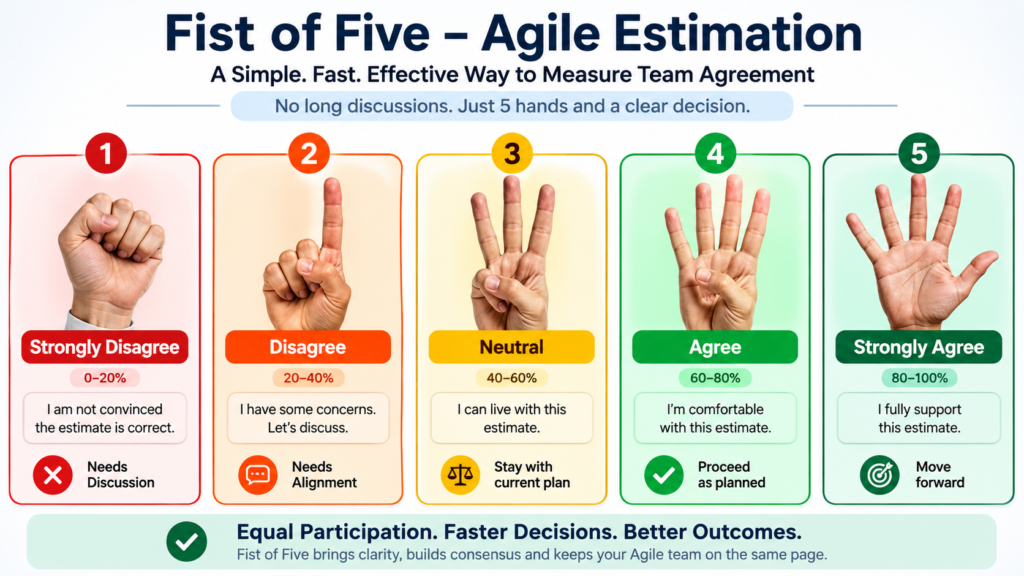
Fist of Five Voting is a real-time consensus-building mechanism. It forces every participant to physically or virtually show their hand, revealing their true level of comprehension and comfort with the proposed user story. Here is exactly what each vote means in a high-performance corporate environment:
A Closed Fist (0): This is a complete roadblock. A closed fist means “I do not understand this requirement at all” or “I see a massive, catastrophic flaw in this approach.” A fist halts the estimation process immediately.
One Finger: This indicates serious reservations. The team member understands the premise but believes there are critical missing details, unresolved dependencies, or major structural risks that must be addressed before moving forward.
Two Fingers: This signals minor concerns. The developer grasps the baseline but wants to clarify a few specific technical constraints or acceptance criteria before committing to a final estimate.
Three Fingers: This represents the baseline of neutral support. The team member understands the user story well enough to proceed, even if it is not their preferred technical approach. They are willing to fully commit and go along with the group consensus.
Four Fingers: This represents solid agreement and high structural visibility. The team member fully understands the requirements, sees no hidden traps, and is completely ready to assign an accurate story point estimate.
Five Fingers (Open Hand): This is enthusiastic championing. The participant has total clarity, loves the proposed solution, and feels highly confident in the team’s collective ability to deliver the work flawlessly.
Establishing the Ultimate Reference Baseline
When you utilize Fist of Five to confirm structural visibility, you are actually protecting your project’s reference baselines. In Agile estimation, teams always compare new user stories against a known reference story, often called a baseline story. For example, if building a login page is historically an eight-point story, building a password reset page might be a three-point story.
However, that entire comparative system collapses if the team misunderstood the original baseline story. By running a Fist of Five check before estimating your foundational reference stories, you ensure that the standard measuring stick used for your entire project is flawless. A well-calibrated reference baseline prevents point inflation and keeps your velocity metrics pure, accurate, and predictable.
The Step-by-Step Implementation Framework
Knowing the scale is only half the battle. Implementing this methodology seamlessly into your sprint planning requires absolute discipline. If you want to elevate your team from average to elite, you must weave Fist of Five directly into your story point mechanics. Here is the exact, step-by-step framework you can copy and use immediately in your organization.
1. The Requirement Walkthrough The Product Owner presents the user story, the acceptance criteria, and the definition of done. The goal here is purely informational. No one is allowed to talk about story points, hours, or complexity yet. The focus remains entirely on what needs to be built, not how difficult it will be to execute.
2. The Pre-Estimate Fist of Five Once the walkthrough is complete, the Project Manager or Scrum Master calls for a Fist of Five vote. The specific question asked is critical. You are not asking for a size estimate. You are asking, “On a scale of zero to five, how clearly do we understand the structural requirements and dependencies of this story?” Everyone votes simultaneously. This simultaneous reveal prevents the anchoring effect where junior members simply copy the vote of the technical lead.
3. The Dissent Discovery Evaluate the room. If the vast majority of the team holds up threes, fours, and fives, you have successfully achieved consensus on structural visibility. However, if you see fists, ones, or twos, you must pause immediately. You turn directly to the dissenting voices. Ask the person holding a single finger to explain their reservations. This is the magic of the framework. It uncovers hidden database dependencies, missing API access, or forgotten compliance constraints before they can derail your upcoming sprint.
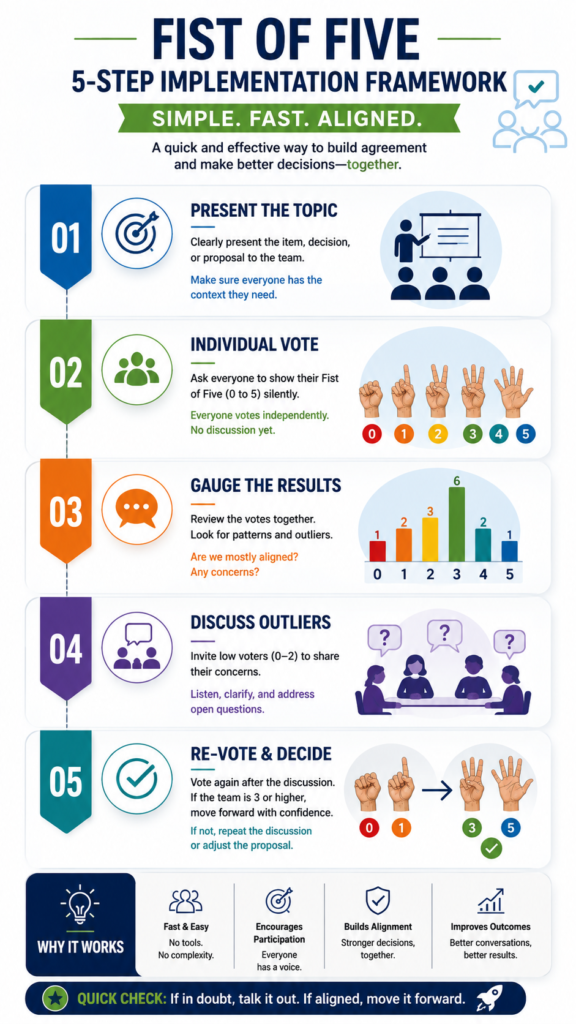
4. The Baseline Alignment Allow the Product Owner and the team to address the specific concerns raised during the dissent discovery phase. Rewrite the acceptance criteria on the spot if necessary. Clarify the unknown variables. Once the adjustments are made, call for a second Fist of Five vote. Repeat this rapid, iterative cycle until the entire room is showing threes or higher. You have now successfully established a rock-solid reference baseline of understanding.
5. The Fibonacci Transition Now, and only now, do you pivot to your actual estimation technique. Because you have utilized the Fist of Five to guarantee that everyone possesses the exact same mental model of the user story, your Planning Poker session will be incredibly fast and highly accurate. The junior developer and the senior architect will suddenly find themselves aligned. They will debate the minor technical nuances between a five and an eight, rather than fighting blindly across the massive communication chasm between a three and a thirteen.
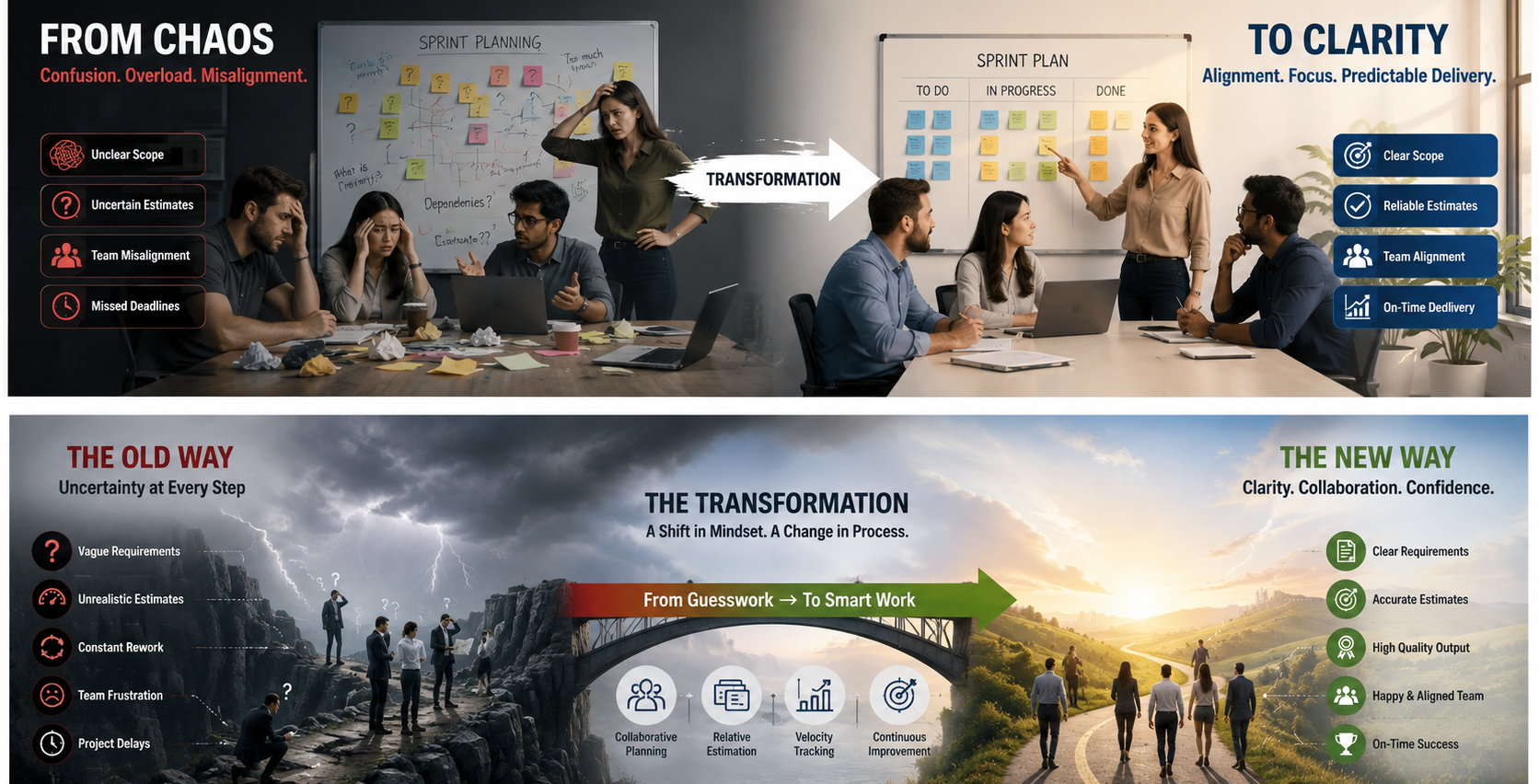
Shifting from Project Chaos to Predictable Elite Delivery
Implementing the Fist of Five framework is not just a neat facilitation trick. It is a fundamental, structural shift in how your organization handles risk and communication. When you master the art of gauging understanding before assigning metrics, the transformation is immediate and profound.
Imagine a workplace where sprint planning meetings actually finish early. Picture a development team that executes complex deliverables with absolute precision, entirely free from the mid-sprint panic that occurs when hidden requirements suddenly emerge. By utilizing this methodology, you eliminate the toxic culture of scope creep and replace it with predictable, elite delivery. The team stops arguing endlessly about story points and starts focusing their energy on building exceptional software products.
Furthermore, this operational transformation dramatically alters your personal professional trajectory. Leaders who master these nuanced project management mechanics do not remain stuck in middle management. When you demonstrate the unique ability to unite fractured teams, uncover hidden technical risks, and deliver perfect sprints consistently, executive leadership takes notice. You transition from being viewed as a mere administrative meeting referee to being recognized as a highly strategic, indispensable operational leader.
Learning project management the right way is the ultimate career accelerator for an ambitious professional. It is the defining difference between merely surviving a chaotic corporate environment and actively commanding it. The professionals who deeply understand the psychology of consensus and the mechanics of baseline estimation are the exact ones who get promoted, secure the highest-profile clients, and command the highest salaries in the B2B industry.

Stop Guessing and Start Leading
Assigning story points without first securing a baseline of true understanding is a guaranteed recipe for project failure. By injecting Fist of Five voting into your pre-estimation routine, you force structural visibility into the open. You give a vital voice to the skeptics, you actively align the vision of the team, and you build a rock-solid foundation for every single sprint that follows. Elite project management is never about rushing to assign a number. It is about taking the strategic time to ensure that the number actually means something.
If you are ready to stop guessing, move up the corporate ladder, and learn project management the right way, reach out to Skillsetify. We do not just teach frameworks: we show you your exact career growth trajectory.