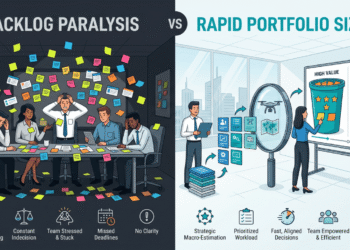
How Frozen Reference Baselines Prevent Velocity Decay in Agile Teams
Imagine standing before an executive steering committee. The quarterly burndown chart is projected on the main board screen, and the delivery trend line is pointing off a cliff. The Vice President of Product looks across the table with visible frustration.
“Two quarters ago, this engineering organization was burning down 45 story points per sprint. This quarter, your team is averaging 22 story points. Are our developers working half as hard, or are we simply failing to manage capacity?”
You know the team is actually shipping features faster than ever. Code quality is up, cycle time is down, and customer satisfaction metrics are hitting historic highs. Yet, on paper, your team looks like it is spiraling into productivity collapse.
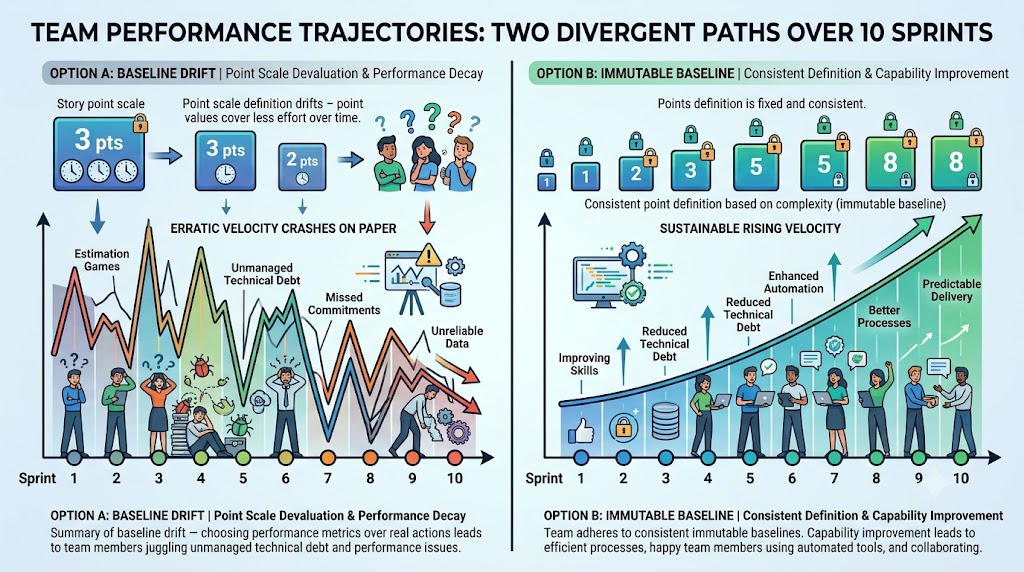
What caused this disconnect? An insidious phenomenon known as Baseline Drift. Six months ago, an engineering lead decided that building a standard API endpoint, originally classified as a 5-point task, had become so routine that it should now be estimated as a 1-point task. As the team grew more efficient, they continually shrank the point values assigned to recurring work. They altered the yardstick while trying to measure distance.
Here is the corporate myth that ruins project predictability across enterprise IT: “Story points should shrink as the team gets faster at completing tasks.”
This logic is completely broken. Story points do not represent raw time; they represent relative complexity, effort, and risk. When you shrink your point scale to reflect developer mastery, you destroy the immutability of your baseline, invalidate historical velocity metrics, and turn executive reporting into a chaotic fantasy.
The Physics of Relative Estimation: Why Absolute Time Fails
To understand why an immutable reference scale is mandatory, we must first examine the inherent flaws of estimating software development in absolute units such as hours or days.
When project managers force software engineers to estimate in hours, two psychological traps occur: Parkinson’s Law (work expands to fill the time allotted) and the Student Syndrome (planned effort is delayed until the last possible moment). Furthermore, an hour of senior architect effort is radically different from an hour of junior developer effort. An absolute hour is not a uniform unit of measure across a human workforce.
Agile methodology solves this through Relative Estimation. Instead of calculating absolute time, the team compares new work items against an established reference point. Human cognitive architecture is poorly wired for absolute unit prediction, but highly optimized for relative comparison. A person may struggle to guess the exact weight of a dog in kilograms, but can easily tell you that a Doberman is twice as large as a Pomeranian.
The Mechanics of the Fibonacci Scale
Most high-performing engineering teams utilize a modified Fibonacci sequence for relative sizing: 1, 2, 3, 5, 8, 13, 21, and 34.
The expanding gaps between numbers in the sequence reflect the compounding uncertainty of larger tasks:
Low Complexity (1 to 3 Points): Trivial UI copy changes, simple configuration updates, or well-understood bug fixes with zero external dependencies.
Moderate Complexity (5 to 8 Points): Standard feature development, new database schema additions, or API integrations with well-documented third-party services.
High Complexity (13 to 21 Points): Architectural refactoring, multi-system data migrations, or features heavily constrained by strict security and compliance standards.
Epic Level (34+ Points): Unscoped initiatives that must be broken down into smaller, actionable user stories before entering sprint planning.
The mathematical gap between 8 and 13 is intentional. It prevents teams from wasting hours debating whether a task is a 9 or a 10. The jump in scale forces the team to acknowledge increased ambiguity and risk.
The Core Principle: Freezing the Golden Reference Story
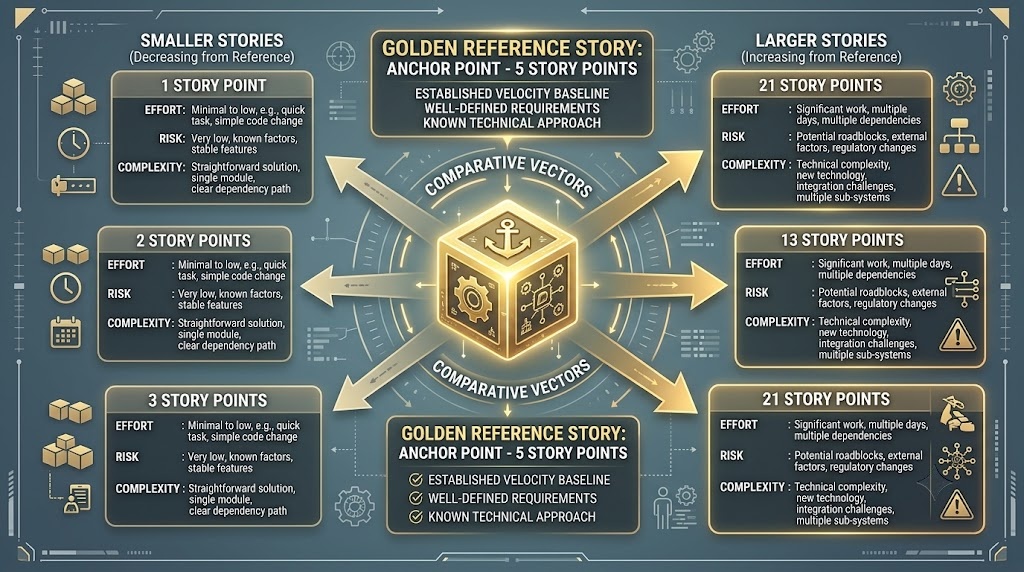
Relative estimation falls apart without an anchor. To maintain statistical integrity over a multi-year project lifecycle, you must select and permanently freeze a Golden Reference Story.
An Immutable Scale requires the project manager to identify a representative user story during the project’s inception, assign it a fixed point value, and lock that baseline into project governance rules permanently.
Why the Reference Story Must Remain Frozen
Consider the standard platinum-iridium kilogram prototype stored in a vault in France. If the mass of that physical prototype altered every time global manufacturing processes improved, every scientific scale on earth would become useless overnight.
In software delivery, your reference story is your prototype kilogram:
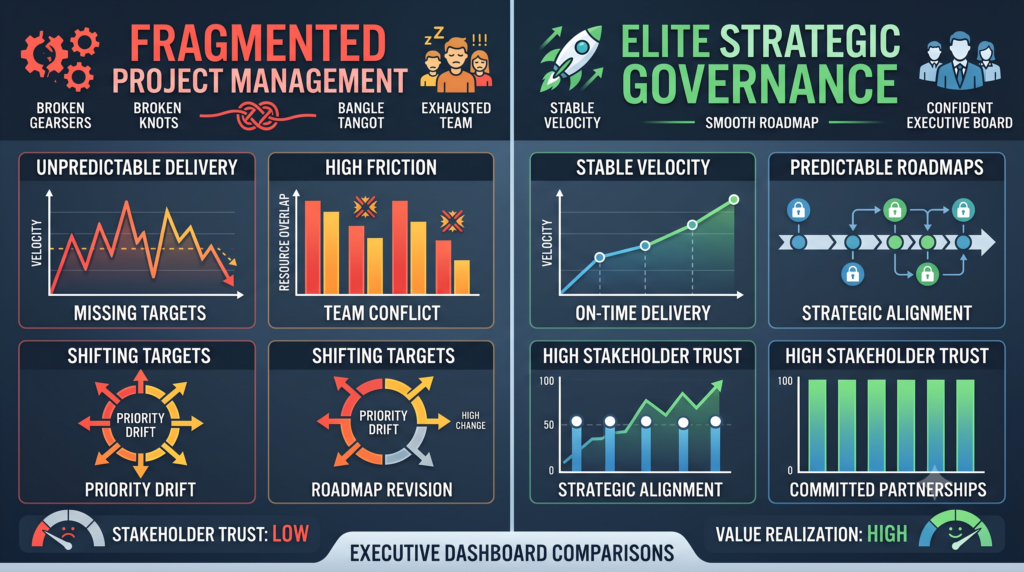
If the Reference Baseline drifts: A 5-point story in Sprint 1 becomes a 2-point story in Sprint 15. The team’s completed story points per sprint drop, creating the illusion of declining productivity to external stakeholders.
If the Reference Baseline is frozen: A 5-point story in Sprint 1 remains a 5-point story in Sprint 15. As the team writes automation scripts, builds reusable modules, and masters the domain, they complete more 5-point stories in a two-week window. Velocity rises linearly, accurately reflecting improved operational capacity.
Step-by-Step Framework for Implementing an Immutable Scale
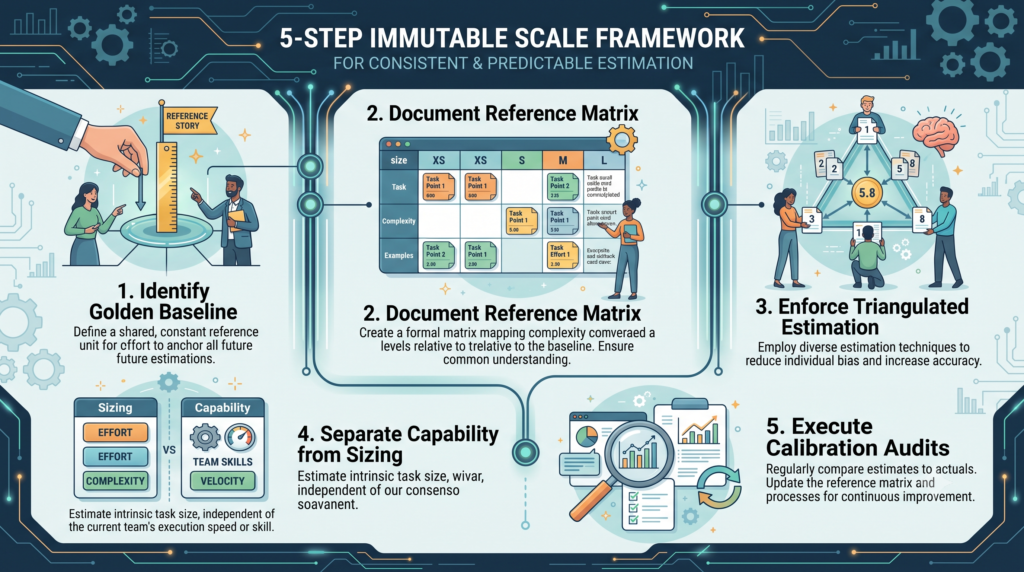
For project managers seeking to eliminate estimation drift and establish true operational predictability, implement this five-step governance protocol.
Step 1: Identify and Audit the Golden Baseline
During initial backlog refinement, select a user story that represents moderate, well-understood complexity.
Criteria: It must contain backend development, UI updates, automated testing, and deployment overhead.
Assignment: Assign this item a mid-tier value on your scale, such as 5 or 8 Story Points.
Step 2: Formally Document the Reference Matrix
Document the Golden Baseline in your team’s central repository (such as Confluence or Jira project guidelines).
Detail the exact scope of the reference story.
Explicitly list the effort, architectural complexity, and technical risk factors that defined its point value.
Include secondary reference anchors for 1, 3, and 13-point stories to build a complete visual comparison scale.
Step 3: Enforce Triangulated Estimation During Planning Sessions
When conducting planning poker or estimation sessions, never ask developers: “How many hours will this take?”
Instead, enforce comparative triangulation:
Present the new user story to the team.
Place the new story side-by-side with your Golden Reference Story.
Ask: “Is this story larger, smaller, or equal in complexity, effort, and risk compared to our 5-point Golden Reference?”
Reveal estimation cards simultaneously to reveal cognitive discrepancies without peer bias.
Step 4: Separate Capability Growth from Complexity Sizing
Educate engineering leads that technical efficiency manifests in throughput, not in re-sizing. If your team builds a script that reduces deployment time from four hours to five minutes, the underlying complexity classification of similar historical stories does not shrink. Instead, the team’s capacity to complete more total points per sprint increases.
Step 5: Execute Baseline Calibration Audits
Every quarter during retrospectives, review your team’s historical estimates against the original Golden Reference. If team turnover or domain shifts have subtly inflated or deflated estimates, run a calibration exercise to re-align the team’s collective understanding back to the frozen baseline.
From Estimation Chaos to Strategic Delivery
When you implement an immutable scale and protect your baseline from drift, the transformation within your engineering organization is immediate and profound.
No longer will you suffer through toxic retrospective meetings arguing over burn-down chart anomalies. You eliminate the friction between engineering teams and executive leadership because your velocity metrics finally tell a truthful, consistent story. When you report a velocity increase from 30 to 45 points, it represents a real 50% expansion in shipped value, backed by statistical evidence.
For the ambitious project manager, mastering baseline mechanics elevates your corporate position entirely:
You evolve from an administrative task tracker into a strategic delivery leader who forecasts enterprise roadmaps with mathematical precision.
You gain the confidence to defend engineering capacity before executive boardrooms using unassailable data governance.
You demonstrate the high-level operational rigor required to manage complex multi-million-dollar portfolio budgets.
This level of mastery is what separates average project coordinators from elite management professionals who command respect and drive enterprise strategy.
Take Control of Your Project Management Career
Maintaining an immutable reference baseline is not merely a technical nuance of Agile methodology: it is the cornerstone of corporate delivery governance. By freezing your story point scale, respecting relative complexity, and separating developer efficiency from task sizing, you unlock consistent velocity, stakeholder trust, and predictable business outcomes.
If you are ready to stop guessing, move up the corporate ladder, and learn project management the right way, reach out to Skillsetify. We do not just teach frameworks: we show you your exact career growth trajectory.