The Power of the Servant Leadership Stance
It is two weeks before the planned rollout of a high-stakes enterprise fintech platform. Millions of dollars in projected quarterly revenue hang in the balance. Inside the project war room, tension is thick. The project manager, operating under intense executive pressure, adopts a classic command-and-control posture. He demands hourly status reports, micromanages individual task assignments, overrides engineering architectural choices, and publicly reprimands team members for missed sub-estimates.
The result is immediate and catastrophic. Instead of accelerating output, the engineering team completely disengages. Developers stop raising early flags about critical security vulnerabilities, fearing punitive backlash. Quality Assurance engineers passively test only what is written in strict user stories, ignoring obvious edge-case errors. Silent resentment replaces creative problem-solving. On launch day, the platform suffers a severe architecture crash during peak load, costing the organization over two million dollars in lost transactions and client churn.
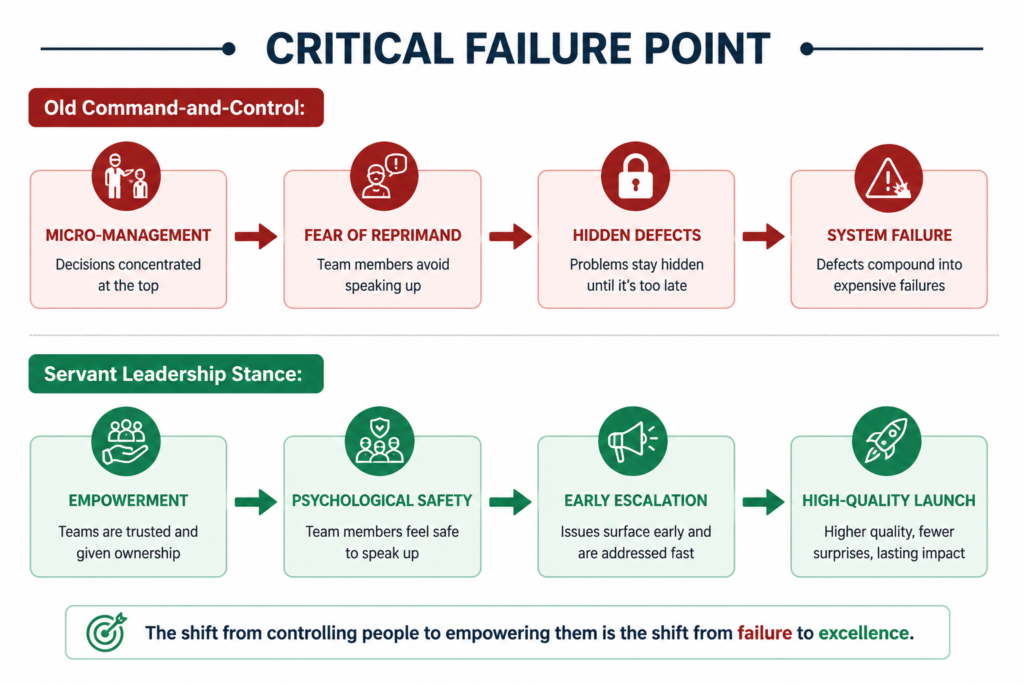
The underlying tragedy of this real-world corporate crisis is that the project manager believed he was doing his job. Corporate culture has long conditioned leaders to believe that control equals predictability, and that authority is the only tool for driving accountability.
Dispel the Common Corporate Myth
The most dangerous misconception in modern project management is the myth that servant leadership equals passive management, weak decision-making, or the total abdication of managerial authority.
In traditional corporate circles, critics mistakenly label servant leaders as mere administrators or conflict-averse facilitators who let teams run wild without structure. This could not be further from the truth. Servant leadership is not a passive stance. It is an active, highly disciplined, and strategic operational posture. It requires far more courage, tactical skill, and emotional intelligence than issuing top-down mandates. True servant leaders do not abandon authority: they reallocate their power to dismantle systemic barriers, elevate technical performance, and build self-organizing teams capable of delivering elite results.
Decoding the Servant Leadership Stance: Mechanics & Philosophy
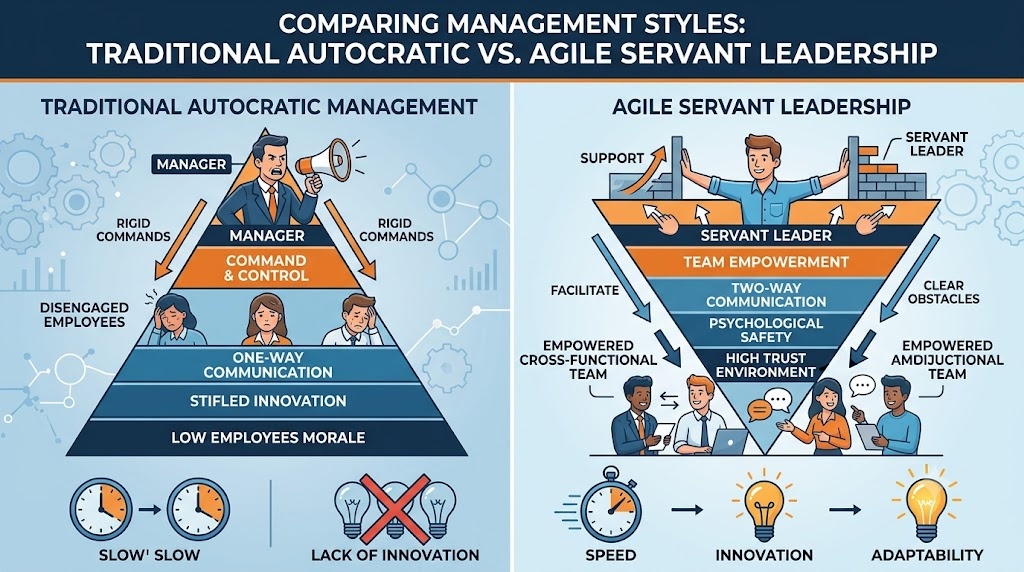
To understand why agile leaders must lead by serving, we must examine the origin and mechanics of the methodology. Coined by Robert K. Greenleaf in his seminal 1970 essay, The Servant as Leader, the concept posits a simple yet radical rule: a true leader focuses primarily on the growth and well-being of people and the communities to which they belong. While traditional leadership involves the accumulation and exercise of power at the top of the pyramid, the servant leader shares power, puts the needs of others first, and helps people develop and perform as highly as possible.
When Agile frameworks like Scrum, Kanban, and SAFe transformed software development and enterprise business operations, Greenleaf’s philosophy became the cornerstone of modern project delivery. In complex knowledge work, no single manager possesses all the technical solutions. Developers, cloud architects, UX designers, and data analysts understand the nuanced details of the work far better than any project manager ever could. Therefore, attempting to assert authoritative command over knowledge workers creates an immediate operational bottleneck.
Directives vs. Facilitation: Clearing Structural Blockers
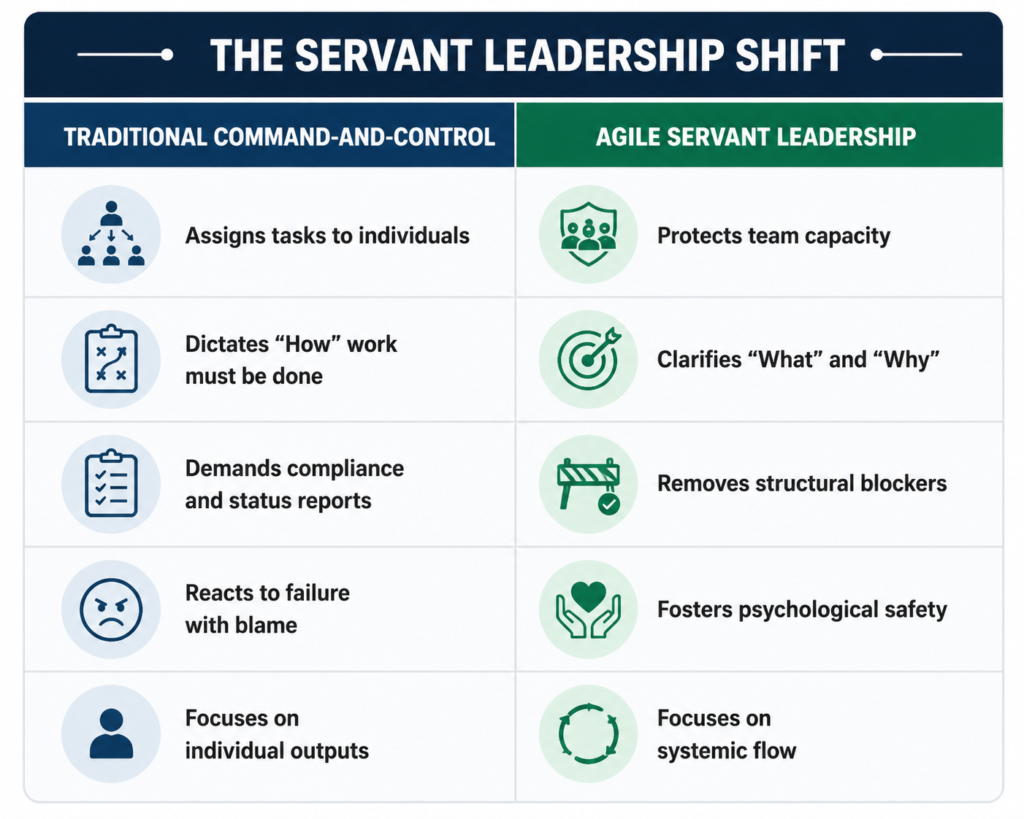
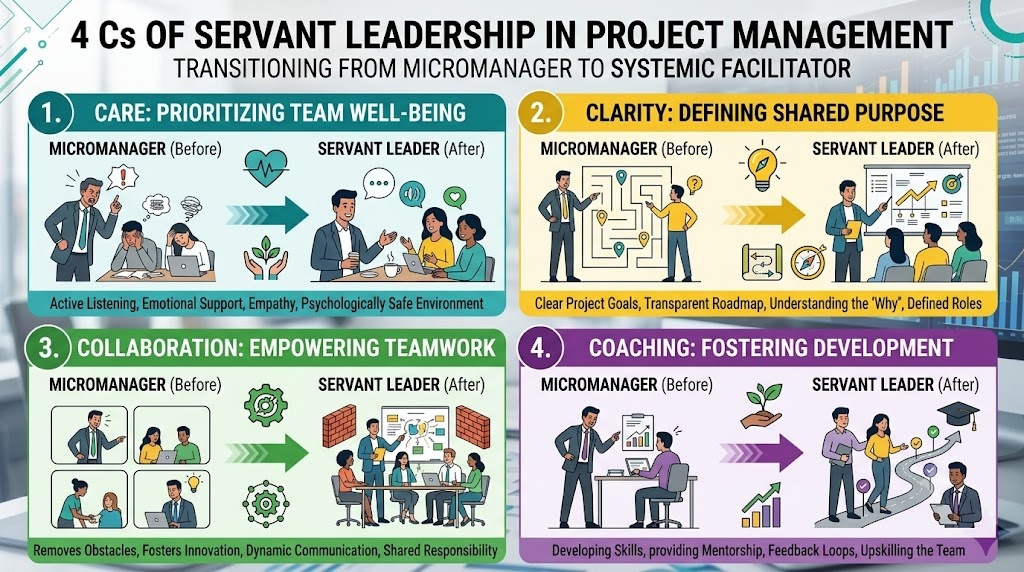
Agile leaders guide, facilitate, and clear structural blockers rather than asserting authoritative command. The fundamental shift in daily posture can be distilled down to a single question. A command-and-control manager asks, “Why isn’t this task finished yet?” A servant leader asks, “What systemic impediment is stopping you from finishing this task, and how can I clear it out of your way?”
Structural blockers represent the invisible drag forces within an enterprise that drain team velocity. These impediments are rarely caused by individual team laziness. Instead, they stem from organizational friction:
Inter-departmental Bureaucracy: Waiting three weeks for a security governance board or compliance team to approve a basic API endpoint release.
Resource Starvation & Tooling Bottlenecks: Forcing high-salaried engineering teams to work with outdated local sandbox environments instead of modern cloud infrastructure.
Toxic Dependency Cycles: Cross-team misalignment where Team A cannot deploy sprint deliverables because Team B prioritized a completely different feature set.
Ambiguous Business Priorities: Constant executive context-switching that forces developers to drop work mid-sprint, creating massive cognitive re-learning costs.
When an Agile leader steps into the servant stance, their daily mission becomes identifying, escalating, and obliterating these structural roadblocks. Rather than acting as a task-master who tracks hours, the leader acts as an enterprise bulldozer, clearing the runway so the cross-functional team can sprint without interruption.
The 5-Step Implementation Framework for Project Managers
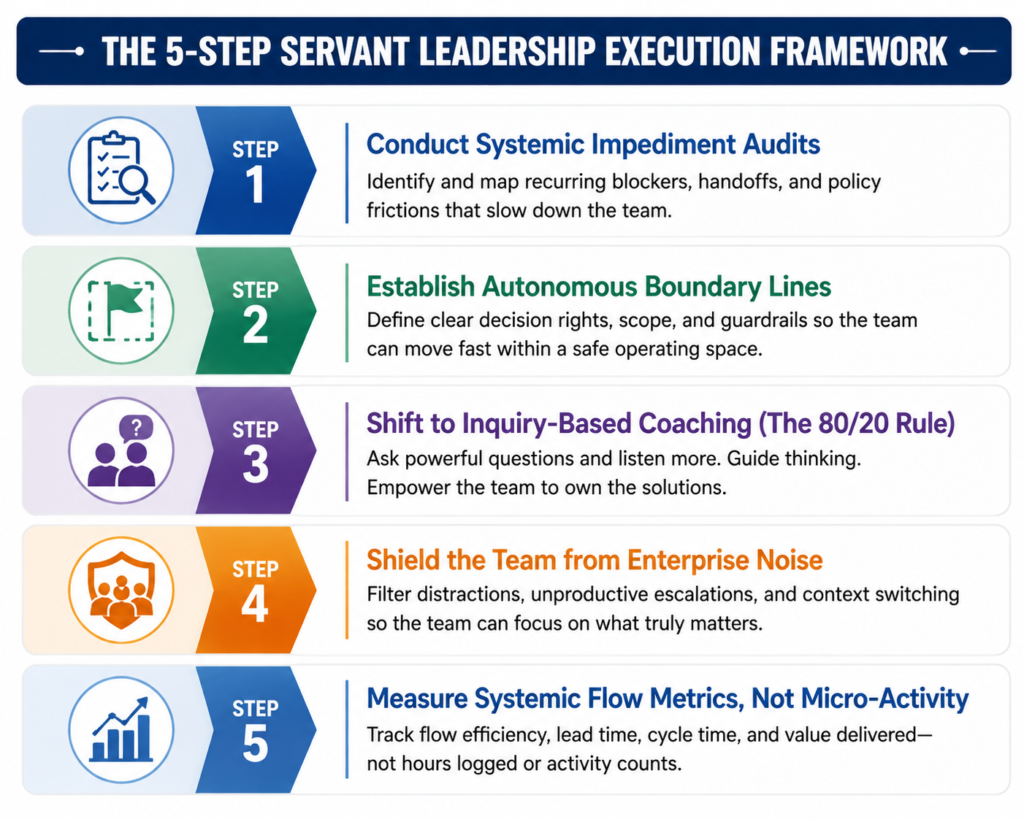
Transitioning from a traditional manager to an elite Agile servant leader requires more than good intentions. It demands a structured, repeatable operational methodology. Here is a battle-tested, 5-step framework that any project manager can implement immediately within their organization.
Step 1: Conduct Systemic Impediment Audits
Do not wait for retrospectives to discover what is delaying your team. Institute a transparent, real-time Impediment Backlog alongside your product sprint backlog. During daily standups, explicitly prompt the team to surface structural friction points. Categorize these blockers by impact and ownership:
Internal Blockers: Code review delays, technical debt, testing environment stability. (Owned and resolved by the development team).
External/Structural Blockers: Vendor delays, legal approvals, cross-departmental dependencies. (Owned and aggressively resolved by the Agile Leader).
Step 2: Establish Autonomous Boundary Lines
Self-organizing teams require clear structural guardrails. As an Agile leader, your job is to explicitly define the “What” and the “Why” alongside Product Owners, while granting total autonomy to the team over the “How”. Set unambiguous boundaries regarding quality standards, definition of done, budget constraints, and delivery timelines. Within those boundaries, empower team members to make technical and tactical decisions without seeking managerial approval.
Step 3: Shift to Inquiry-Based Coaching (The 80/20 Rule)
Eliminate directive problem-solving. When a team member brings a complex technical or operational problem to your desk, resist the urge to dictate a solution. Practice the 80/20 rule: listen 80 percent of the time, and speak 20 percent. Ask open-ended coaching questions:
“What options have you considered so far?”
“What are the trade-offs between option A and option B?”
“What support or resources do you need from me to make this decision?”
Step 4: Shield the Team from Enterprise Noise
Enterprise environments are inherently chaotic. Unplanned requests, ad-hoc executive inquiries, and sudden scope-creep demands constantly threaten sprint focus. An elite servant leader acts as an operational shield. Establish a strict intake policy: no work enters the sprint backlog without going through formal product prioritization. Defend the team’s cognitive focus fiercely, allowing them to remain in a state of high-velocity flow.
Step 5: Measure Systemic Flow Metrics, Not Micro-Activity
Ditch outdated vanity metrics like individual lines of code written, hours logged in Jira, or desk time. Focus instead on systemic flow metrics that accurately reflect team health and operational efficiency:
Cycle Time: The total elapsed time from when work begins on an item until it is delivered.
Throughput: The total number of completed work items delivered within a specific time window.
Blocker Resolution Time: The average time it takes for leadership to resolve escalated structural impediments.
Navigating High-Stakes Interviews: The Servant Leadership Scenario
In senior management and Agile leadership interviews, executive hiring panels continuously test candidates on their real-world leadership philosophy. They look for subtle signs of hidden command-and-control tendencies.
Here is how to answer a classic high-stakes interview scenario using the Servant Leadership stance:
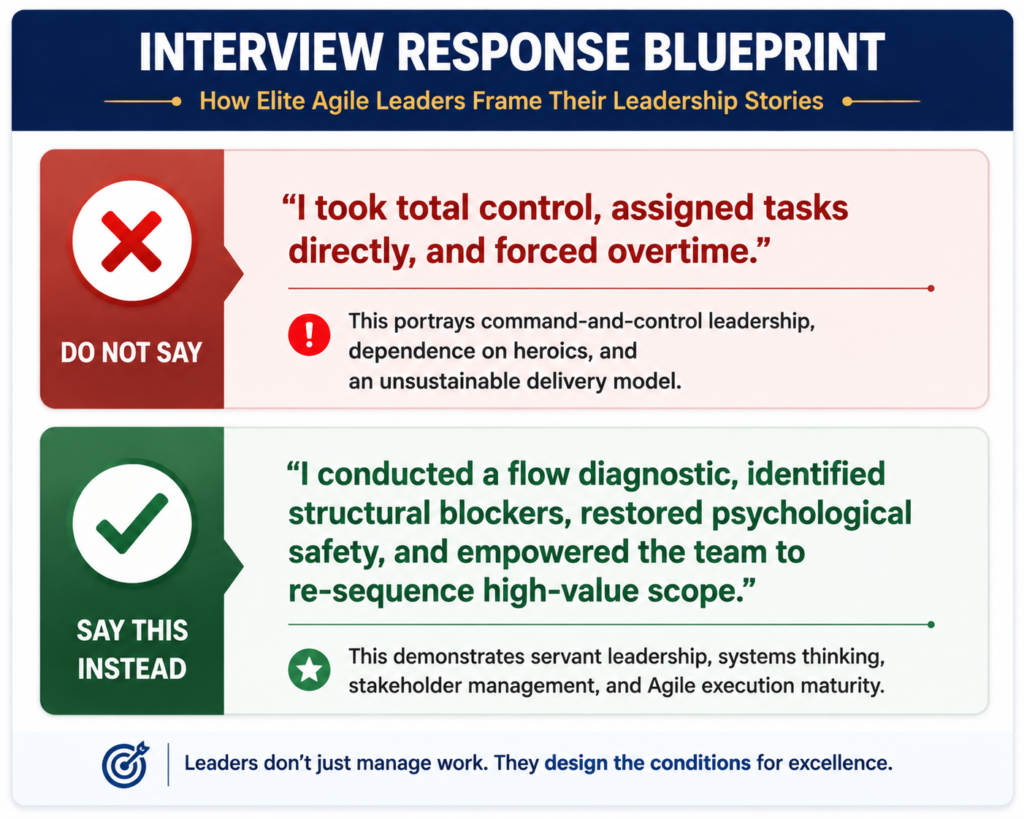
Interview Question: “Tell me about a time when a critical project was falling severely behind schedule. How did you step in to pull the team back on track?”
Elite Candidate Response Strategy:
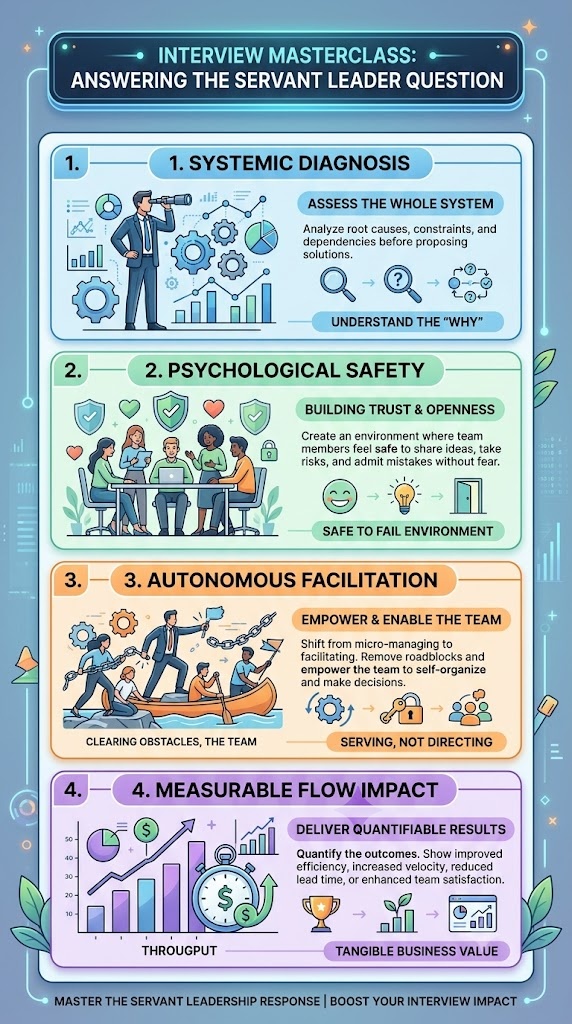
Diagnose Root Causes Systemically: Explain that your first action was not to panic or issue commands, but to analyze the delivery system. Highlight how you evaluated cycle time data, identified hidden dependency bottlenecks, and interviewed team members to uncover underlying structural blockers.
Foster Psychological Safety: Describe how you held an alignment session to eliminate fear and shift focus toward collective problem-solving. Show how you encouraged the team to speak openly about architectural flaws or unrealistic scope assumptions without fear of blame.
Facilitate Autonomous Scope Trade-offs: Explain how you partnered with the Product Owner and development team to re-prioritize the backlog, stripping away low-value requirements and focusing ruthlessly on the Minimum Viable Increment.
Clear the Path and Measure Impact: Detail how you personally took ownership of clearing external dependencies, securing additional cloud resources, or negotiating with external stakeholders. Conclude with tangible metrics showing how team velocity recovered, cycle time dropped, and the project successfully delivered its core objectives.
From Firefighting Chaos to Elite Delivery Engine
When you successfully transition from an authoritative manager to an Agile servant leader, your professional reality changes dramatically.
Imagine leading a project environment where team members do not wait for instructions, but proactively identify risks, optimize code, and self-correct drift before it impacts milestones. Imagine walking into executive status meetings backed by predictable delivery metrics, knowing that your team’s sprint commitment is grounded in real velocity rather than fabricated promises forced upon them by top-down pressure.
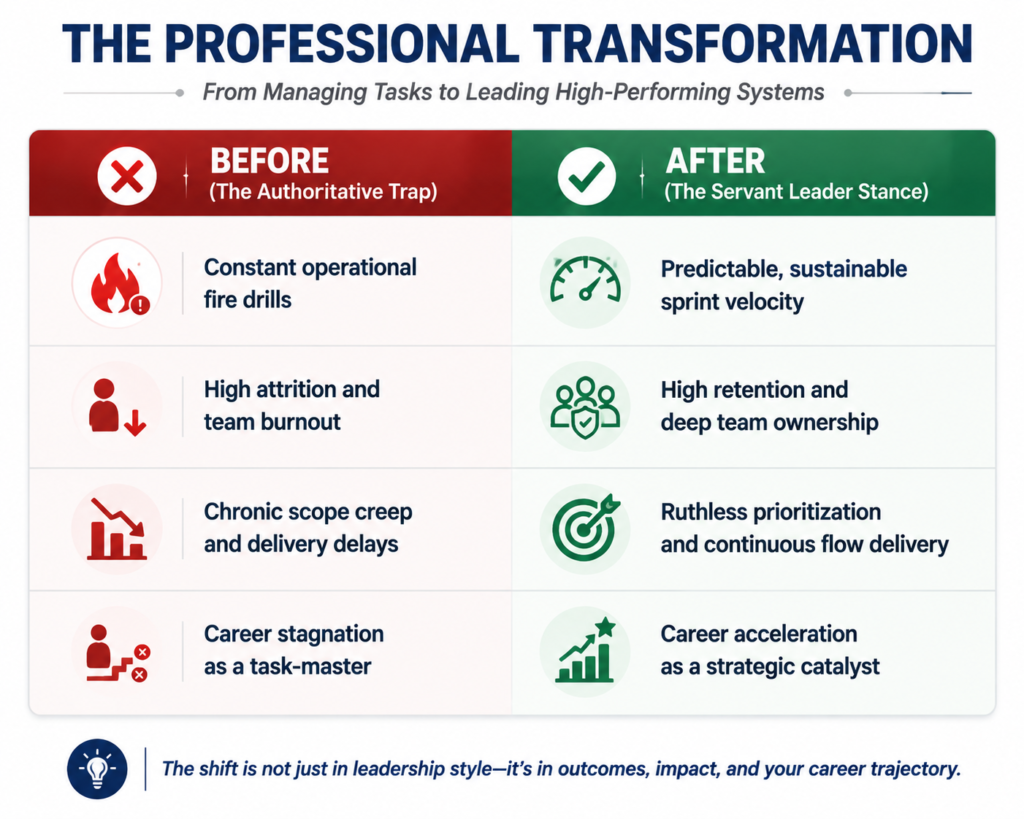
This operational shift transforms team dynamic and performance metrics:
Predictable Sprint Velocity: Teams that operate with psychological safety and clear boundaries consistently hit their sprint goals because estimates are honest and blockers are surfaced instantly.
Sustainable Throughput: Firefighting and mandatory weekend overtime are replaced by steady, repeatable delivery cycles that eliminate team burnout.
Voluntary Innovation: When engineers are given ownership over the “How”, they introduce creative architectural improvements, automated testing suites, and process optimizations that cut operational costs.
Elevating Your Executive Trajectory
In modern enterprise organizations, senior executives, Vice Presidents, Chief Product Officers, and CTOs are actively trying to phase out micromanagers. They recognize that managers who rely on command-and-control tactics create fragile, low-trust organizations that fail to scale.
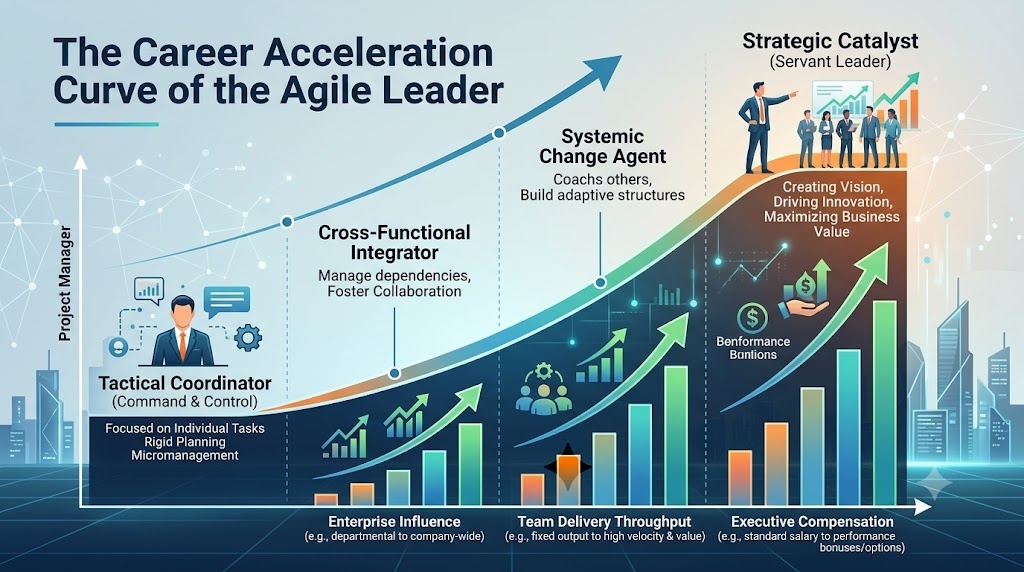
When you master the Servant Leadership Stance, you elevate your career from a tactical project coordinator to a high-value strategic force multiplier. You become recognized as a leader who can take troubled, chaotic teams and transform them into autonomous, self-healing, elite delivery units. That is the precise capability that commands executive influence, opens doors to Director and VP-level opportunities, and sets top-tier project management professionals apart in competitive markets.
Master the Stance, Elevate Your Career
The transition from traditional authority to servant leadership is not a subtle shift in terminology: it is a complete revolution in how you view power, governance, and project execution. By stepping back from micro-management, establishing psychological safety, and focusing relentlessly on clearing structural blockers, you unleash the full potential of your teams and position yourself as an indispensable asset in modern corporate landscapes.
If you are ready to stop guessing, move up the corporate ladder, and learn project management the right way, reach out to Skillsetify. We do not just teach frameworks: we show you your exact career growth trajectory.