Why Your Continuous Improvement Is Failing and How to Fix It
The Growth Trap and Corporate Reality
It is Friday. The quarterly review meeting has just descended into chaos. The VP of Product is staring at a dashboard of red status indicators, while project managers scramble to explain why velocity has plunged despite three consecutive retrospectives. The team is burning through sprint budgets, deadlines are sliding, and the promise of “continuous improvement” feels like a cruel corporate joke.
This scenario plays out in modern enterprise organizations daily. Leaders fall for a dangerous corporate myth: that continuous improvement happens automatically once a team adopts Agile ceremonies.
Organizations install retrospectives, launch stand-ups, and mandate backlog refinement, expecting performance to compound naturally. Yet, without clear baseline metrics, continuous improvement execution deteriorates into performative routine. Real, sustainable growth does not spring from vague sprint retrospectives or enthusiastic team-building exercises. Realistic growth stems from measuring team capabilities transparently using baseline SWOT metrics.
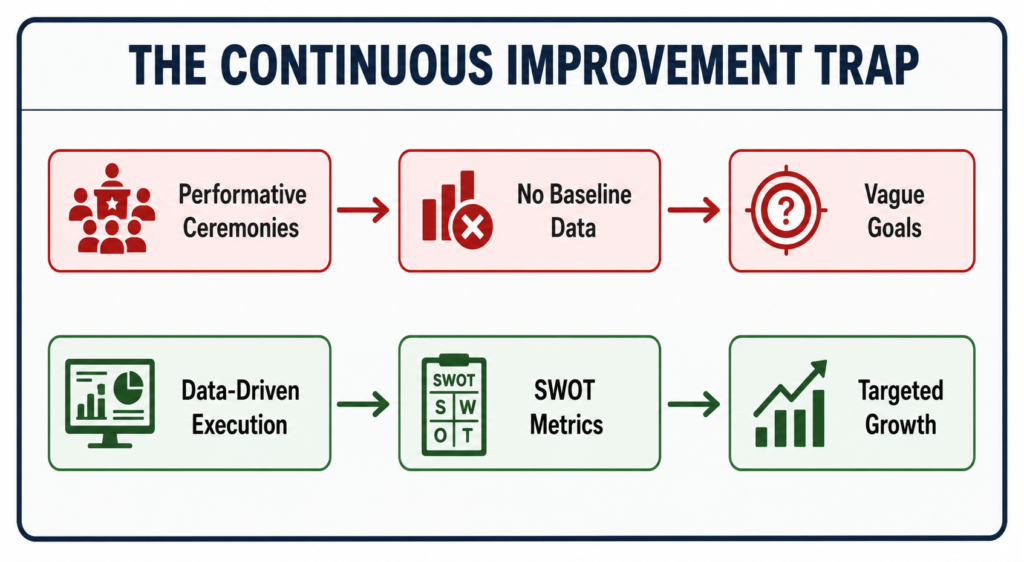
Without an objective baseline, your team is simply driving in the dark. To transform continuous improvement from an abstract philosophy into a measurable delivery engine, you must anchor your strategy in empirical self-assessment.
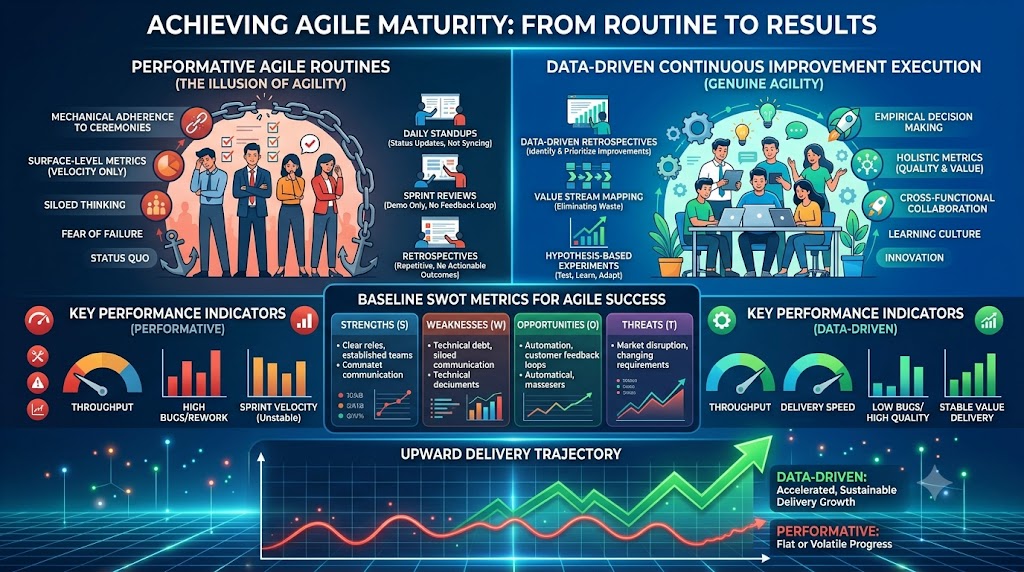
Building the Baseline SWOT Execution Engine
To move beyond superficial retrospective feedback, project leaders must institute an operational framework that quantifies performance, exposes structural bottlenecks, and converts strategic insights into daily execution.
What Is Baseline SWOT Metric Analysis?
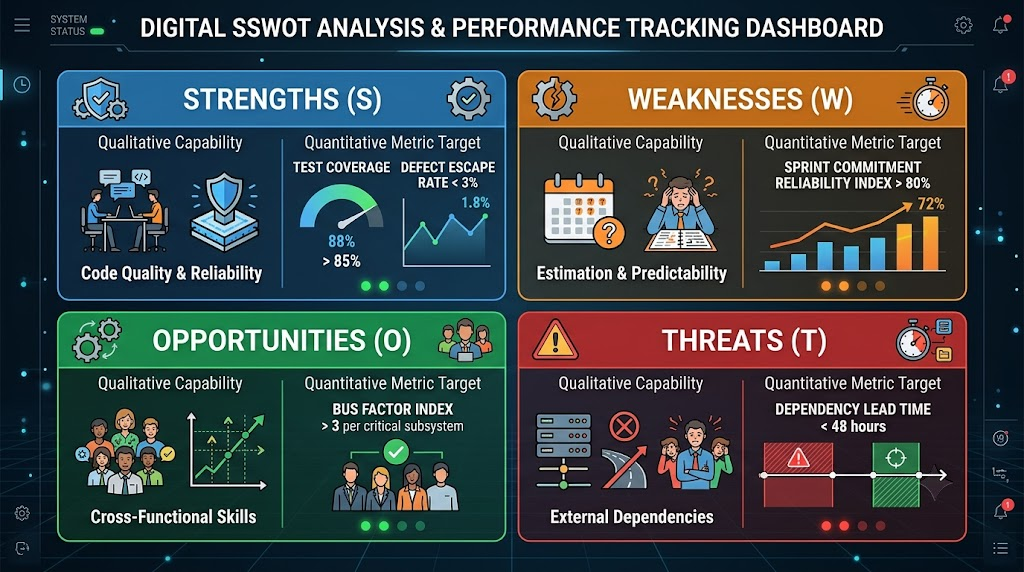
Traditional SWOT (Strengths, Weaknesses, Opportunities, Threats) analyses are often relegated to yearly strategic retreats and discarded in slide decks. In high-performing execution environments, a Baseline SWOT Metric Framework converts qualitative observations into operational indicators.
Strengths: Capabilities that consistently yield high-quality increments, measured via throughput stability and predictable story point completion.
Weaknesses: Internal friction points that degrade velocity, measured through defect spillover, technical debt accumulation, and dependency blockages.
Opportunities: Process efficiencies and tool optimizations that can accelerate delivery, measured through automation potential and cross-training coverage.
Threats: External risks and systemic organizational dependencies that threaten delivery schedules, measured through scope creep frequency and resource volatility.
The Core Mechanics of Data-Driven Continuous Improvement
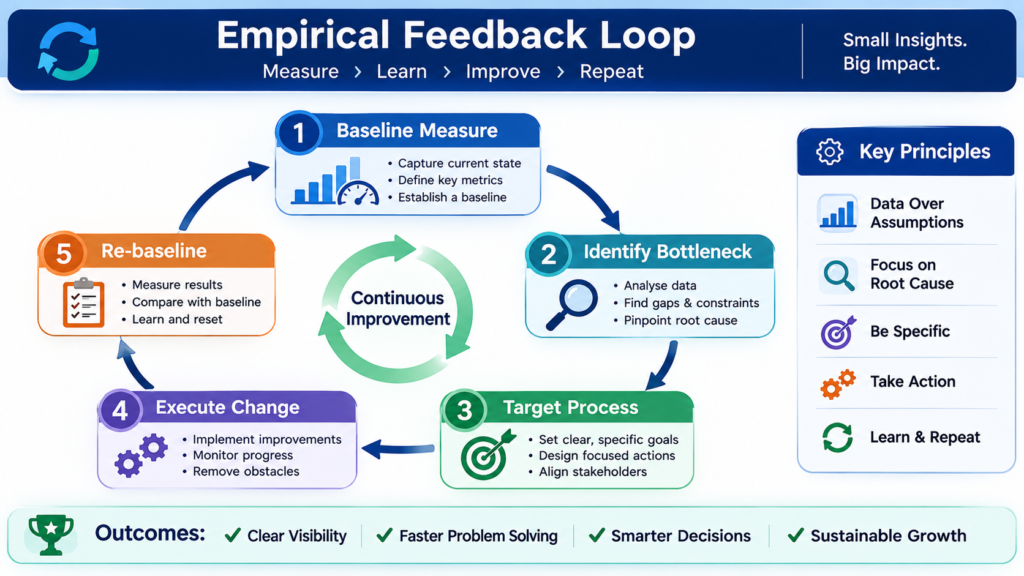
Continuous improvement operates on an empirical feedback loop: Measure, Identify, Target, Execute, and Re-baseline.
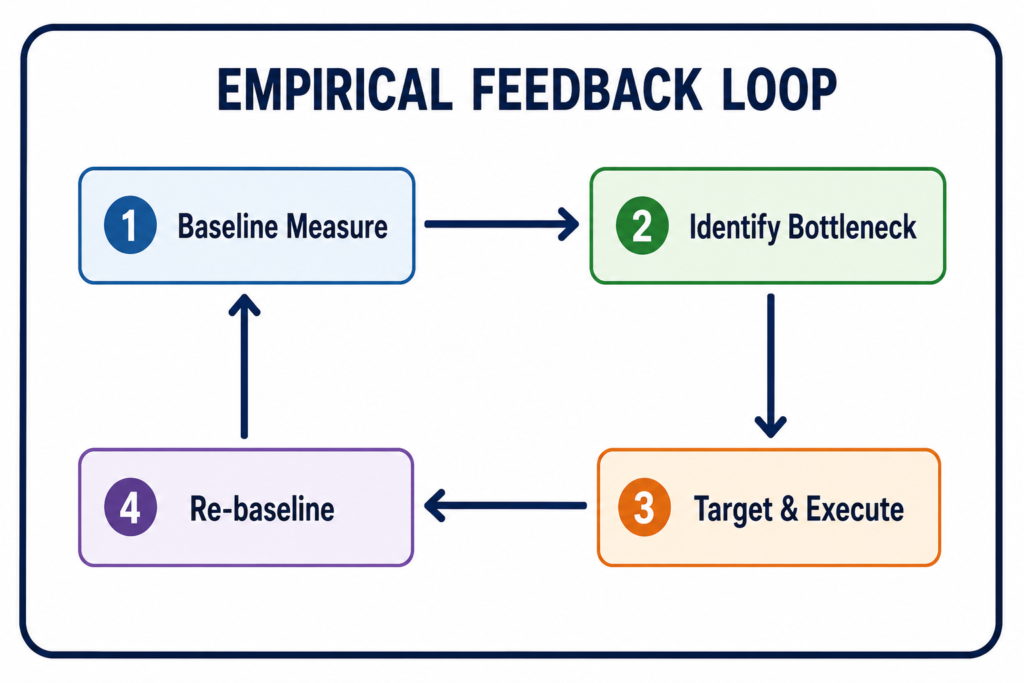
Establish Ground Truth: Measure current capabilities using objective historical data rather than subjective sentiment.
Isolate Structural Issues: Use baseline SWOT indicators to separate minor sprint anomalies from systemic organizational blockers.
Target High-Impact Targets: Select one or two high-leverage process adjustments per execution cycle instead of attempting massive organizational shifts all at once.
Execute and Re-baseline: Implement targeted process changes, verify their impact against your initial metrics, and establish a new baseline for future growth
Step-by-Step Implementation Framework for Project Managers
Here is an actionable implementation playbook you can deploy within your execution pipeline starting today:
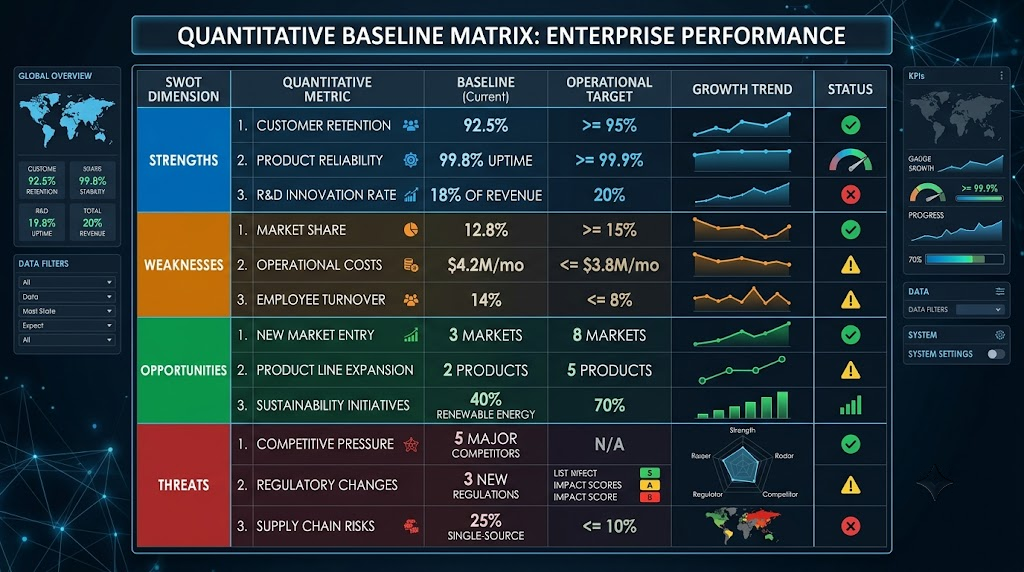
Step 1: Establish Your Quantitative Baseline Matrix
Map qualitative team capabilities against quantitative metrics across four primary quadrants:
Step 2: Conduct the Empirical SWOT Assessment
Gather Objective Metrics: Extract historical data from your project management and tracking systems over the last 4 to 6 iteration cycles.
Evaluate Capabilities: Hold a structured 90-minute alignment session dedicated strictly to capability mapping rather than feature delivery.
Score Quadrants: Assign a numerical score (1–10) to each identified variable based on verified data points rather than team opinion.
Step 3: Convert SWOT Insights into Targeted Growth Epics
Transform every identified weakness or threat into a structured, trackable improvement item within your backlog:
Identify Bottleneck: “Code review turnaround takes an average of 36 hours, stalling cycle times.”
Create Action Item: “Automate static code analysis within the CI/CD pipeline and limit open Pull Requests to two per engineer.”
Define Key Success Indicator: “Reduce mean code review lead time to under 12 hours within two cycles.”
Step 4: Monitor Execution via Rolling Iteration Cycles
Focus team bandwidth on current operational priorities while maintaining a high-level roadmap for future capability improvements. Track your process changes in every review cycle to ensure improvement initiatives remain on schedule.
From Delivery Chaos to Elite Performance
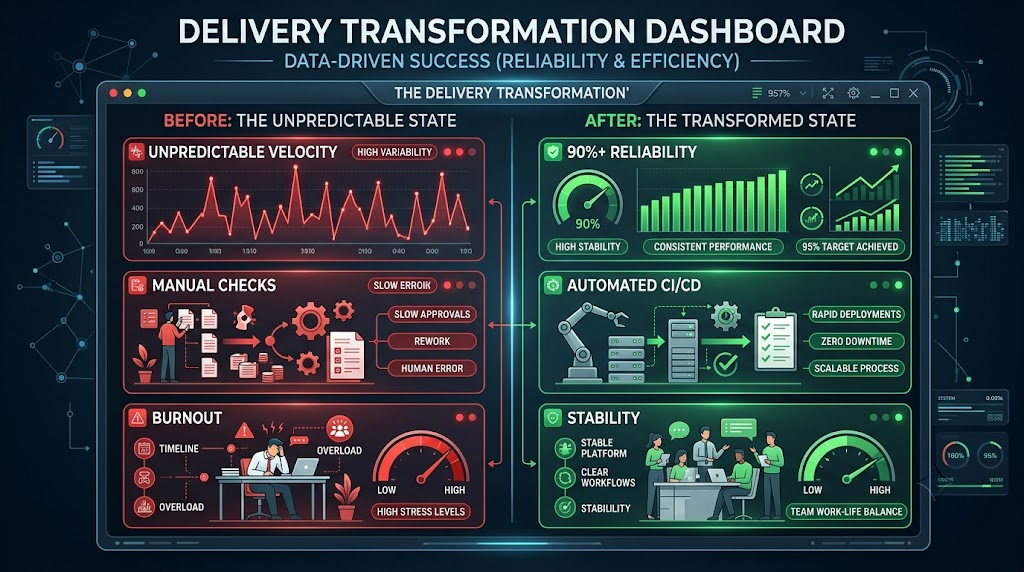
Imagine stepping into your executive quarterly review with absolute confidence. Instead of defending missed targets or offering vague assurances, you present a clear, data-driven dashboard tracking your team’s operational trajectory:
Predictable Velocity: Sprint commitment reliability increases from an unpredictable 50% to a dependable 90%.
Eliminated Friction: Mean time to resolution drops significantly as automated checks catch defects long before production deployments.
Eliminated Burnout: High-visibility baselines protect your team from unrealistic scope demands, creating a stable, sustainable working rhythm.
Transparent Growth: Stakeholders enjoy real-time visibility into operational capabilities, establishing organizational alignment and building trust.
Mastering continuous improvement execution transforms your daily operations and fundamentally alters your executive profile. Project managers who rely on gut feel and static frameworks remain trapped in fire-fighting mode. Leaders who measure capabilities transparently, leverage objective baselines, and execute process optimizations consistently become indispensable assets to modern enterprise organizations.
When you master the art of data-driven process execution, you stop managing tasks and start driving strategic organizational growth.

Accelerate Your Executive Trajectory with Skillsetify
Executing true continuous improvement requires moving past basic theoretical frameworks and mastering real-world, high-stakes project leadership.
If you are ready to stop guessing, move up the corporate ladder, and learn project management the right way, reach out to Skillsetify. We do not just teach frameworks: we show you your exact career growth trajectory.
Partner with Skillsetify Today
Master Enterprise Frameworks: Learn how to build quantitative baselines, manage strategic dependencies, and drive continuous improvement across complex enterprise portfolios.
Accelerate Your Career: Gain direct mentorship from industry leaders who have led large-scale business transformations at top-tier global companies.
Unlock Your Strategic Potential: Move beyond tactical project coordination and position yourself as a high-value, data-driven executive leader.
Take control of your execution strategy today. Visit Skillsetify to book your executive career trajectory assessment now.