How Elite Project Managers Pivot Infrastructure When Local Servers Fail
Here is the stark reality facing modern technology projects: local data centers are silently killing enterprise AI initiatives.
Picture this executive nightmare. You are leading a high-stakes enterprise financial application project. Your team spent six months building out the core backend, securing local server infrastructure, and mapping out every database query within your company’s physical data center. Then, three weeks before the beta release, executive leadership requests the integration of a custom, context-aware AI engine to process real-time transaction analytics.
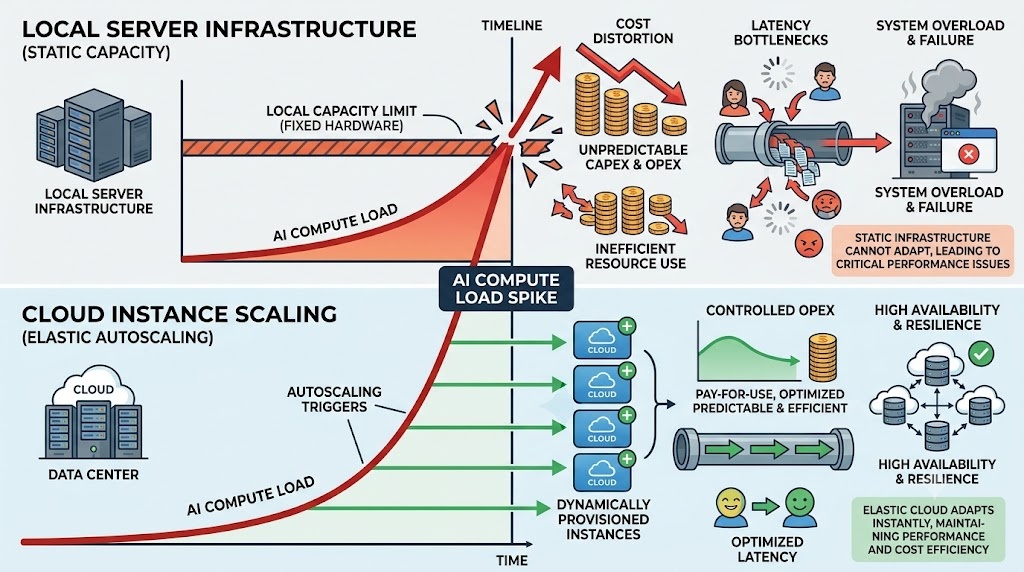
Within 72 hours of testing, local server utilization hits 99%. GPU procurement lead times are quoted at eight months, local energy costs soar, and query latency degrades user response times from 200 milliseconds to nearly 30 seconds. The project budget is completely blown, and the launch timeline is shattered.
The Corporate Myth: Most IT steering committees believe that keeping AI workloads on local enterprise servers is always safer and more cost-effective than cloud instances. This myth relies on the flawed assumption that infrastructure demands remain predictable. In reality, while standard web applications scale linearly, AI compute demands scale unpredictably and exponentially. Attempting to force heavy AI inference models onto fixed local hardware distorts capital expenditures, causes operational paralysis, and traps the organization in rigid procurement cycles.
Understanding the Infrastructure Pivot: Why Local Architectures Collapse
When unexpected AI compute requirements distort baseline budgets, rigid project managers double down on their original plan. Elite project managers execute an infrastructure pivot. An infrastructure pivot is the strategic re-architecting of a project’s foundational hosting environment mid-lifecycle: transitioning from local physical servers to elastic cloud compute instances (such as AWS EC2 GPU instances, Azure N-Series, or Google Cloud TPUs) without abandoning the overarching business objective.
To pull off this transformation seamlessly, project managers must leverage two critical project management concepts: Progressive Elaboration and Rolling Wave Planning.
The Mechanics of Progressive Elaboration in Infrastructure
Progressive elaboration is the continuous process of refining and elaborating a project plan as detailed information and specific requirements become available. In technical projects, you rarely possess complete data on operational performance at day one. As live testing reveals true compute requirements, progressive elaboration allows you to adjust your hosting strategy dynamically. You keep the end goal intact: delivering the financial application: while modifying the delivery mechanism to incorporate cloud-based AI scaling.
Rolling Wave Planning for Cloud Migration
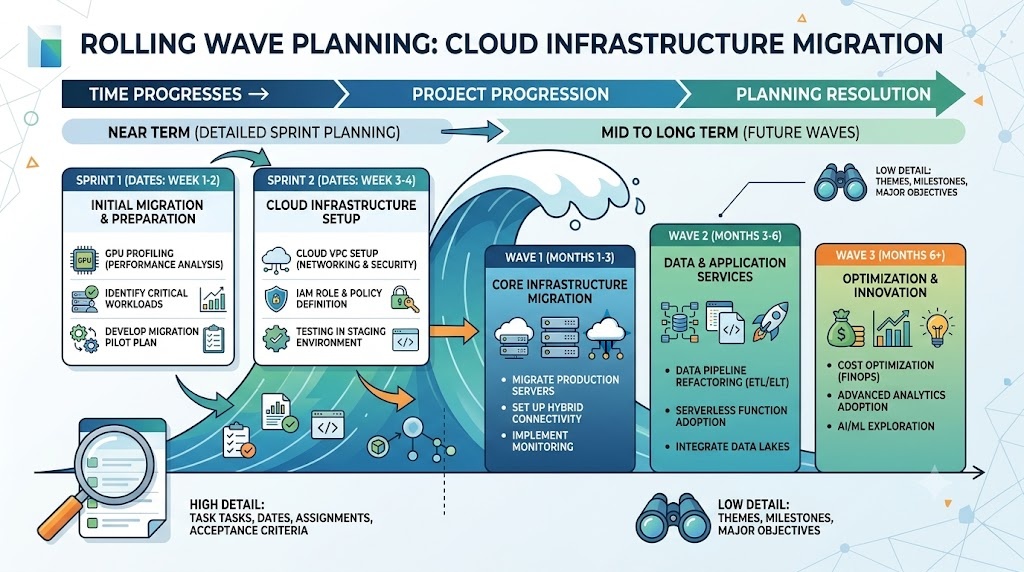
Rolling wave planning is an iterative planning technique where work to be accomplished in the near term is planned in detail, while work far in the future is planned at a higher level. When forced into an infrastructure pivot, trying to map out every cloud migration task for the next year causes analysis paralysis. Instead, you plan the immediate migration wave in granular detail, while maintaining high-level milestones for subsequent phases.
The Step-by-Step PM Implementation Framework for Cloud Pivots
When unexpected compute demands distort costs, use this four-stage execution framework to transition from local servers to elastic cloud instances cleanly.
Stage 1: Financial & Compute Load Profiling (FinOps Audit)
Before moving a single line of code, establish complete visibility over your current local hardware bottlenecks and projected compute costs.
Conduct a GPU/CPU Utilization Audit: Measure peak inference loads, memory bandwidth bottlenecks, and hardware power draw under stress testing. Identify the baseline hardware limits of your local data center.
Model the Total Cost of Ownership: Compare local server expansion (hardware purchasing, thermal management, maintenance, idle capacity costs) against cloud pay-as-you-go elastic pricing.
Isolate Cost Distortions: Isolate the specific AI components driving the cost surge. In most cases, 80% of the cost distortion stems from fine-tuning and heavy inference models, while standard application backend tasks consume minimal resources.
Stage 2: Architectural Decoupling & Hybrid Mapping
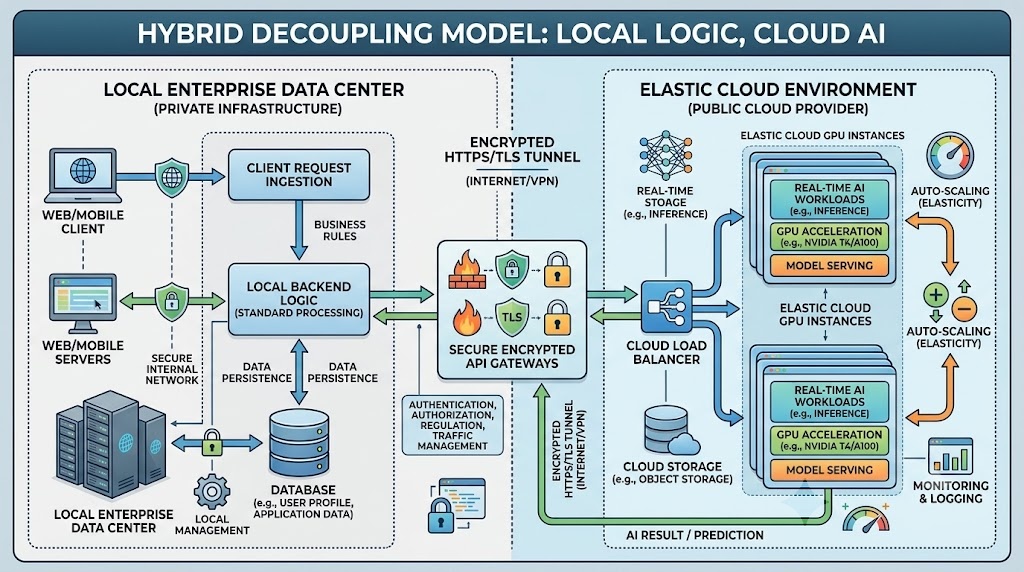
You do not always need to lift and shift your entire database. Decouple the application architecture to route heavy AI workloads to cloud instances while keeping sensitive core data on local databases if compliance requires it.
Isolate AI Microservices: Containerize AI workflows using Docker or Kubernetes clusters to separate compute-heavy modules from core transactional logic.
Establish Elastic Cloud Gateways: Map out cloud instances (such as spot instances for batch training or auto-scaling GPU clusters for live inference) to absorb compute spikes dynamically.
Define Security Boundaries: Configure virtual private clouds, encrypted transit tunnels, and strict identity access management policies to protect data moving between local environments and cloud providers.
Stage 3: Rolling Wave Migration Execution
Execute the migration in tight, rolling waves to preserve project momentum and control cost risks.
Wave 1 (Immediate 14 Days): Provision cloud VPCs, configure container registries, and run initial benchmark workloads in cloud sandbox environments.
Wave 2 (Days 15 to 30): Route non-critical staging workloads to cloud instances. Measure latency, cost per query, and scaling behavior under simulated traffic spikes.
Wave 3 (Days 31 to 45): Execute full production cutover for AI microservices, implementing automated scaling policies to prevent unexpected cost runaways.
Stage 4: FinOps Governance & Progressive Optimization
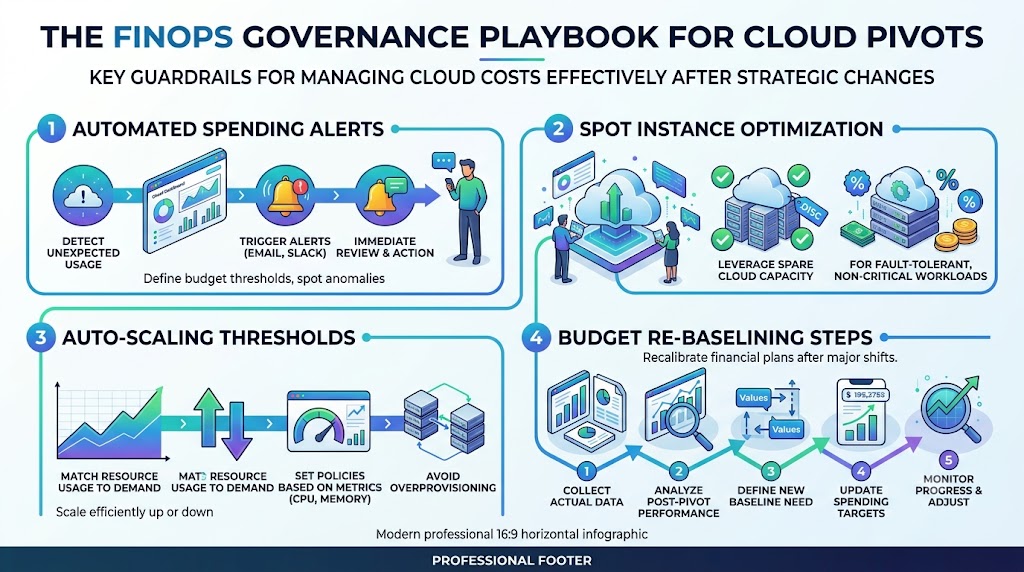
Cloud instances eliminate hardware bottlenecks, but without strict governance, they can create unmonitored cloud spending.
Implement Cloud Spending Guardrails: Set automated budget alerts, resource quotas, and scheduled shutdown scripts for non-production environments.
Refine Instance Sizing: Continuously monitor compute metrics during progressive elaboration. Swap fixed cloud instances for spot instances or reserved instances to reduce runtime costs by up to 60%.
Update Baseline Timelines and Budgets: Re-baseline project budgets, scope documents, and milestone schedules using approved change management protocols.
From Project Chaos to Strategic Executive Leadership
Mastering the infrastructure pivot fundamentally transforms your career as a Project Manager.
Without a structured methodology, an unexpected AI compute bottleneck leads to budget panic, missed deadlines, degraded product performance, and team burnout. You become trapped in reactive fire-fighting, explaining cost overruns to skeptical executive boards.
When you execute an infrastructure pivot correctly using progressive elaboration and rolling wave planning, the entire narrative changes. Instead of delivering a broken, budget-busting product, you present a flexible, enterprise-grade architecture that scales effortlessly with demand. You protect project margins, maintain delivery velocity, and demonstrate deep strategic agility.
This distinction is what separates tactical task managers from high-impact project leaders. Senior executives do not promote project managers who simply follow static plans off a cliff. They promote leaders who can analyze operational reality, make decisive architectural adjustments, and lead cross-functional teams through complex technical pivots. Learning project management the right way equips you with the decision-making frameworks necessary to turn corporate disruptions into career-defining successes.
Confronting unexpected technical shifts is an inevitable reality in modern enterprise environments, but navigating them should never rely on guesswork. By mastering iterative frameworks, dynamic re-baselining, and technical change management, you position yourself as an indispensable leader capable of guiding complex initiatives through volatile market conditions.
If you are ready to stop guessing, move up the corporate ladder, and learn project management the right way, reach out to Skillsetify. We do not just teach frameworks: we show you your exact career growth trajectory.