How Elite Project Managers Reroute Complex Delivery Without Burning Budget
Imagine you are leading a multi-million-dollar digital transformation for an enterprise organization. The initiative spans five distinct workstreams across global markets, scheduled over twelve months. Three months into execution, a critical dependency breaks. A major regulatory compliance shift halts your third workstream in Europe, while a unexpected vendor delay freezes the backend architecture integration.
For a traditional project manager, this is an existential crisis. The original baseline plan is shattered. The team spiraling into idle capacity, executive leadership demands answers, and daily panic meetings consume the schedule. The team attempts to force their way through the blocked workstream, burning budget and exhausting engineers against an unyielding wall.
This failure stems from one of the most toxic corporate myths in modern business: the belief that changing your execution route means your project is failing.
In reality, an initial baseline plan is a compass, not a rigid railroad track. Elite project leaders understand that when a bridge is washed out, you do not park the train and wait for the bridge to rebuild itself over six months. You reroute.
The World Tour Analogy
To understand how modern enterprise delivery actually succeeds, consider The World Tour Analogy.
Imagine you are planning a year-long journey across five distinct countries: Japan, the United Kingdom, Brazil, Kenya, and Australia. You have a crystal-clear vision of the destination. You know the strategic purpose of visiting all five territories, you have secured the overarching budget, and you have defined what success looks like in each region.
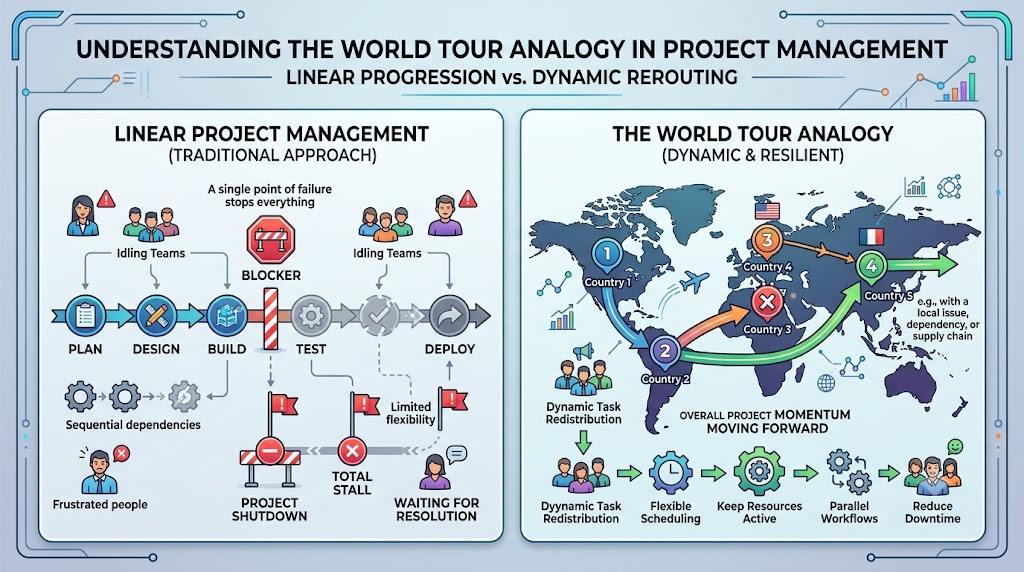
Now, imagine you arrive in Country 2, and news breaks that a sudden political storm or natural blocker has closed the borders to Country 3 for the next sixty days.
What does an amateur traveler do? They sit at the border of Country 3, paying hotel bills, burning daily allowances, and complaining that reality did not match their printed itinerary.
What does an elite traveler do? They pull up the map, re-sequence the flight routes, fly directly to Country 4 or Country 5, execute those legs of the journey, and return to Country 3 once the political weather clears. The ultimate five-country destination vision remains 100% intact, but the route was dynamically rearranged to bypass active friction.
In enterprise project management, your strategic goals represent the five countries. Your sprints, roadmaps, and release schedules represent the flight itineraries. When corporate friction, technical debt, or market shifts block a phase, master project leaders do not halt delivery. They deploy Progressive Elaboration and Rolling Wave Planning to reroute the organization seamlessly.
Deconstructing the Mechanics of Dynamic Delivery
To execute dynamic rerouting without causing team confusion or scope drift, you must understand the two core mechanisms behind adaptive execution.
Progressive Elaboration vs. Rolling Wave Planning
While many professionals use these terms interchangeably, they represent two distinct pillars of strategic delivery:
Progressive Elaboration: This is an inherent characteristic of complex project environments. It acknowledges that at the start of any initiative, you possess the least amount of information you will ever have. As the project progresses, fresh data, technical feedback, and market realities emerge, allowing you to continually refine the project requirements and design.
Rolling Wave Planning: This is the tactical execution technique used to operationalize Progressive Elaboration. Instead of attempting to detail every single task for Month 11 on Day 1, you plan immediate work packages in high detail while keeping far-horizon work packages defined at a macro, thematic level.
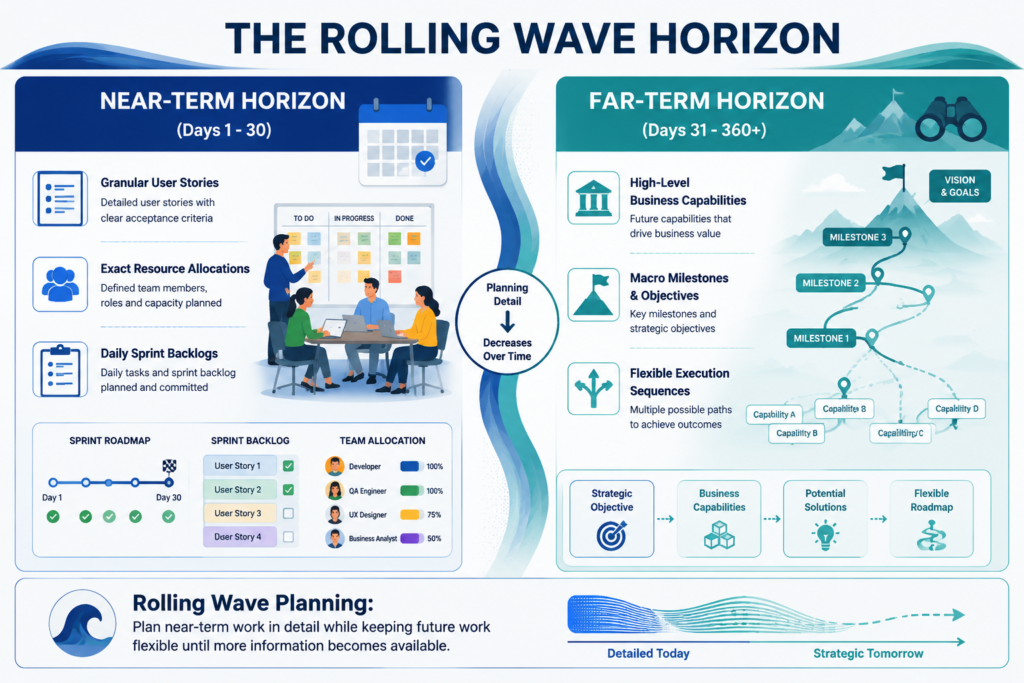
When you combine these two concepts within the World Tour Framework, your project roadmap becomes a dynamic navigation tool rather than a fragile commit statement.
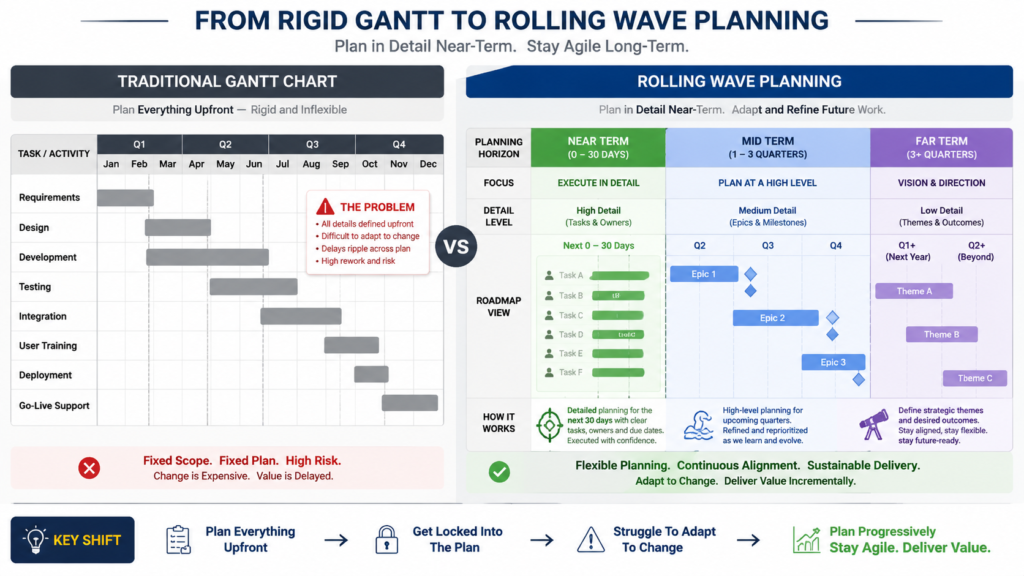
Why Traditional Roadmaps Break Corporate Teams
Traditional project planning falls apart because it relies on the illusion of perfect foresight. Organizations spend months crafting massive, static Gantt charts where Phase C strictly depends on Phase B, which strictly depends on Phase A.
When a geographic or political blocker inevitably arises in Phase B:
Resource Stagnation Occurs: Specialized team members assigned to Phase B sit idle or work on low-value tasks while waiting for blockers to clear.
Context-Switching Tax Rises: Teams are forced to bounce between half-finished tasks, creating severe cognitive friction and technical debt.
Executive Trust Erodes: Status reports turn red, and leadership receives updates focused on why work cannot happen rather than how value is being delivered.
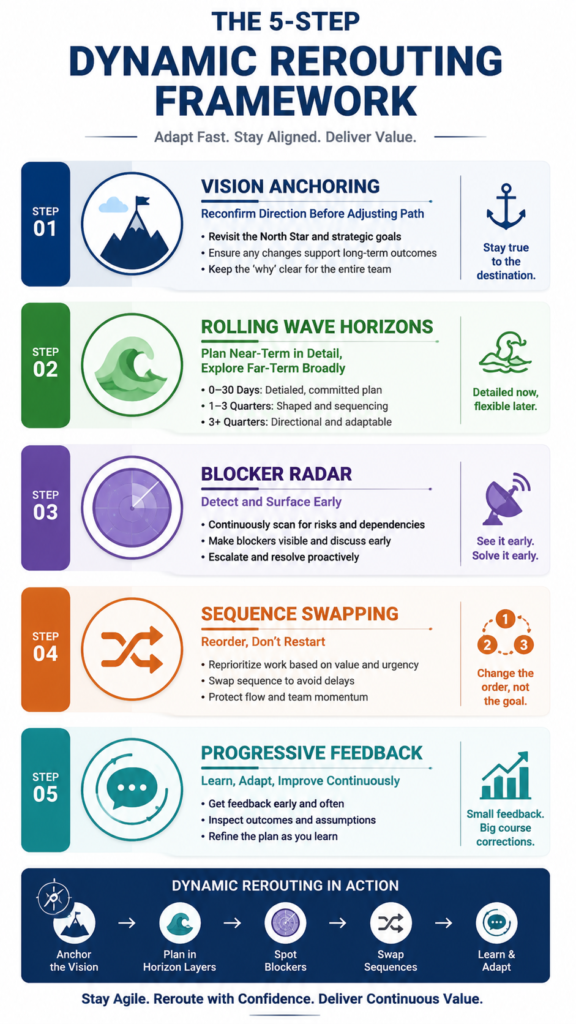
Step-by-Step Framework: Implementing Dynamic Route Rearrangement
How do you implement this in your enterprise? Here is the step-by-step framework top-tier delivery leaders use to manage multi-faceted projects.
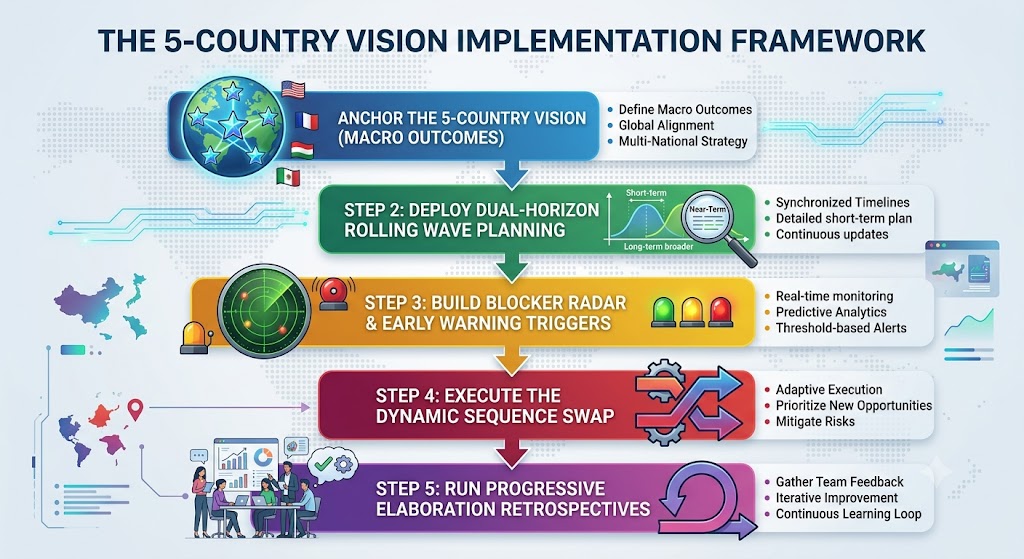
Step 1: Anchor the 5-Country Vision (Macro Outcomes)
Before touching a scheduling tool, define the non-negotiable strategic outcomes of your initiative. What are the five core business capabilities that must exist at the end of this project?
Document each “Country” as an outcome, not an activity. For example, render “Country 1” as Automated Customer Onboarding System rather than Build API Endpoint X.
Gain executive alignment on the principle that while the five outcomes are non-negotiable, the sequence in which they are delivered can change based on operational reality.
Step 2: Deploy Dual-Horizon Rolling Wave Planning
Structure your project planning across two operational horizons:
The Tactical Wave (Immediate 14 to 30 Days): Fully articulate every user story, technical dependency, resource assignment, and acceptance criterion. This is the territory you are actively navigating.
The Strategic Horizon (Months 2 through 12): Maintain high-level epic definitions, target milestones, and key business requirements. Do not waste engineering hours estimating tasks six months in advance when the underlying architecture may evolve.
Step 3: Build Blocker Radar and Early Warning Triggers
Establish explicit risk thresholds to detect when a “Country” is experiencing political or geographic storms before your delivery team collides with them.
Political Blockers: Pending organizational restructures, delayed executive sign-offs, changing regulatory landscapes, or shifting corporate priorities.
Geographic/Technical Blockers: Third-party integration delays, unexpected architectural bottlenecks, legacy system instability, or critical skill set shortages.
Set a hard rule: If an active dependency blocker cannot be resolved within five operational business days, trigger an immediate route evaluation meeting.
Step 4: Execute the Dynamic Sequence Swap
When Country 3 hits a confirmed blocker, do not halt the team. Review your Strategic Horizon for Country 4 and Country 5 to identify independent work streams that can be pulled forward into the Tactical Wave.
Isolate modular scope blocks in Country 4 that do not rely on Country 3’s output.
Shift delivery capacity immediately to Country 4, keeping velocity high and preventing morale degradation.
Maintain a skeleton task force or designated lead to resolve Country 3’s blocker quietly in the background without tying down the broader team.
Step 5: Run Progressive Elaboration Retrospectives
As you complete Country 4, harvest the real-time data gathered during its execution. Use this new clarity to update your estimates, refine architectural models, and reassess Country 3.
Has the storm passed? If yes, re-insert Country 3 into the immediate Tactical Wave. If no, evaluate Country 5.
The Professional Transformation
Mastering the World Tour Framework transforms both your delivery organization and your career trajectory.
When you shift from rigid baseline obsession to strategic route flexibility, the atmosphere inside your project environment changes instantly:
From Chaos to Calm: Instead of panicking when external blockers strike, your team knows there is a pre-built mechanism to re-sequence work without losing momentum.
From Scope Creep to Value Optimization: Stakeholders stop seeing changes as project failures. They recognize that dynamic route adjustments protect the ultimate target date and budget.
From Micromanagement to Autonomy: Cross-functional teams operate with clear boundaries. They focus on executing high-value, unblocked items rather than spinning their wheels on blocked tasks.
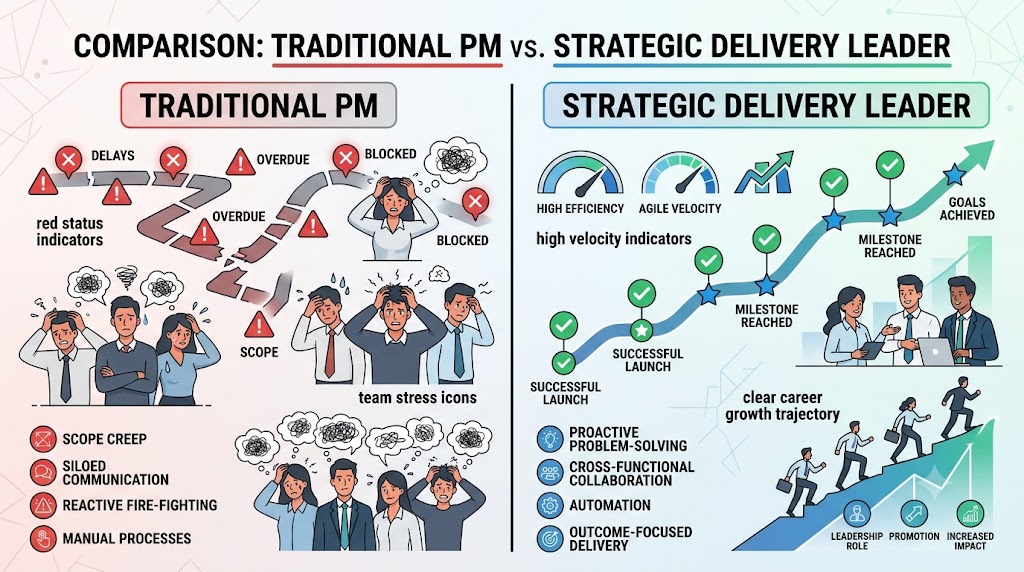
More importantly, this mindset shift changes how senior leadership views you.
Task-tracking project managers focus on maintaining static spreadsheets, delivering excuses when timelines redline due to uncontrollable external blockers. Strategic delivery leaders master the art of navigational adaptability. They present executives with clear solutions and alternative execution pathways, preserving momentum and delivering bottom-line results.
When you demonstrate the ability to guide complex enterprise initiatives through unforeseen turbulence without losing sight of the strategic destination, you cease to be a coordinator: you become an indispensable strategic partner.
Elevate Your Career Strategy with Skillsetify
Navigating enterprise project environments requires far more than memorizing terminology or building Gantt charts. It requires elite, battle-tested frameworks that allow you to lead through complexity, manage executive expectations, and deliver predictable value in an unpredictable business world.
If you are ready to stop guessing, move up the corporate ladder, and learn project management the right way, reach out to Skillsetify. We do not just teach frameworks: we show you your exact career growth trajectory.
Key Takeaways to Remember
The Destination is Fixed, The Route is Flexible: Define non-negotiable strategic outcomes, but keep your execution pathways dynamic.
Plan in Waves: Detail the immediate 30 days exhaustively, maintain long-term phases as high-level strategic epics.
Reroute Early: When blockers arise, do not burn budget sitting at the border. Re-sequence independent scope blocks to maintain operational velocity.
Progressive Elaboration is Your Advantage: Leverage fresh data at every retrospective to continually refine future execution horizons.
Ready to transform your delivery capability and accelerate your professional advancement? Discover how Skillsetify can elevate your project leadership career today.