Why 70% of Agile Products Fail at Scope Governance (and How Elite Product Owners Fix It)
Ahead of a critical enterprise release deployment, leadership is celebrating the upcoming rollout of an automated financial reporting dashboard in the executive boardroom. Down the hall, marketing is finalizing press releases highlighting a new customer self-service portal. Meanwhile, in the engineering wing, developers are putting the final touches on backend database migration scripts because of an informal Slack exchange.
Nobody built the dashboard. Nobody finalized the portal. Panic erupts, emergency war rooms are spawned, finger-pointing ensues, and the release is postponed indefinitely.
This nightmare scenario occurs daily across enterprise organizations. The root cause is almost never technical incompetence. It is a fundamental breakdown in scope management and product backlog ownership.
A common corporate myth asserts that Agile product development operates without rigid documentation, allowing backlogs to function as open-ended, public wish lists where stakeholders can inject demands at any time. This assumption is completely false. An unmanaged, open-access backlog is not Agile: it is strategic anarchy. True agility requires absolute discipline, structured boundaries, and a single, centralized source of truth governed by a single accountable leader.
What Is a Product Backlog? The Centralized Source of Truth
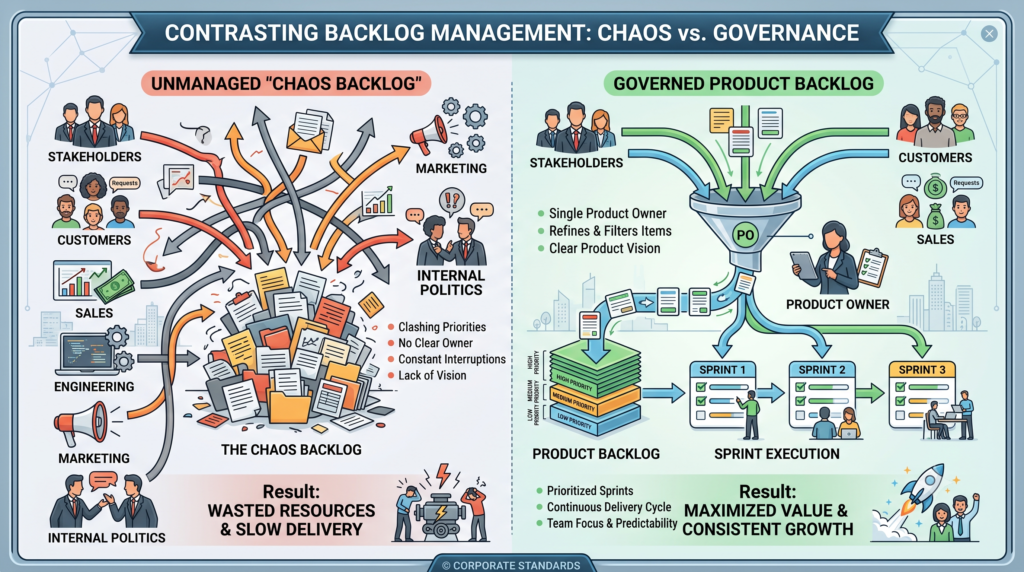
The Product Backlog is an ordered, dynamic inventory of everything required to improve, evolve, and deliver a product. It serves as the ultimate, single source of truth for project scope. If a feature, user story, bug fix, or technical refinement is not recorded in the Product Backlog, it does not exist for the delivery team.
In modern B2B project management, the Product Backlog is not a static project plan locked down during an initial planning phase. Unlike traditional Waterfall requirements documents, an Agile backlog constantly evolves to reflect changing market dynamics, stakeholder feedback, regulatory updates, and technical learnings.
However, dynamic evolution does not mean uncontrolled expansion. For a backlog to remain effective, every requirement must be captured as a structured work item, assigned clear criteria, and evaluated against the broader strategic vision.
The Sacred Role of Single-Threaded Product Ownership
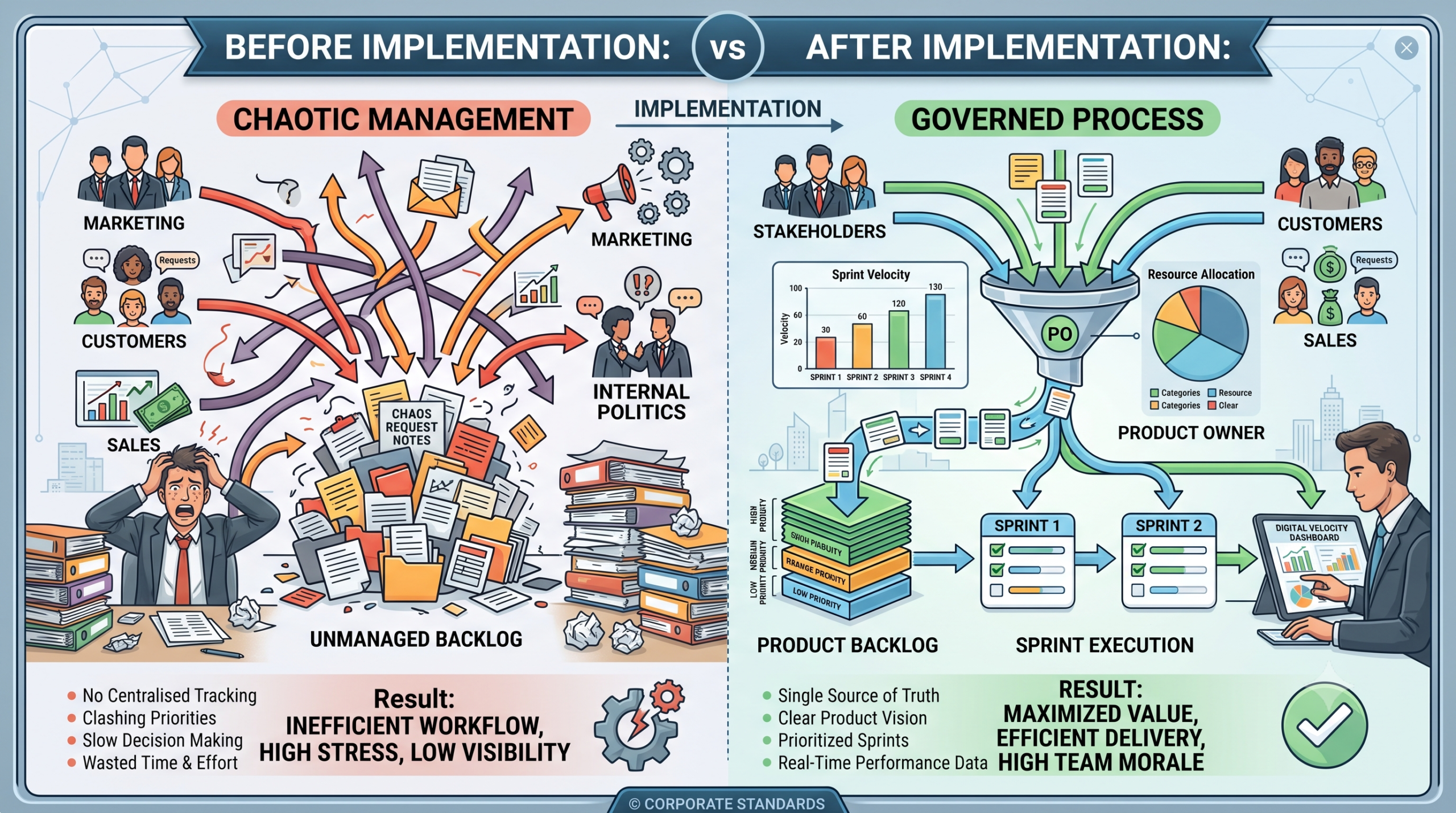
A primary structural failure in backlog management is ownership by committee. When steering committees, functional heads, or multiple department leads hold equal authority over the backlog, conflicting priorities paralyze the engineering team.
Agile frameworks resolve this bottleneck through single-threaded ownership:
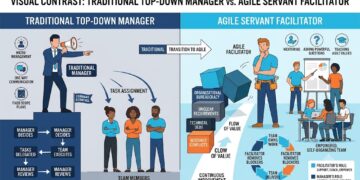
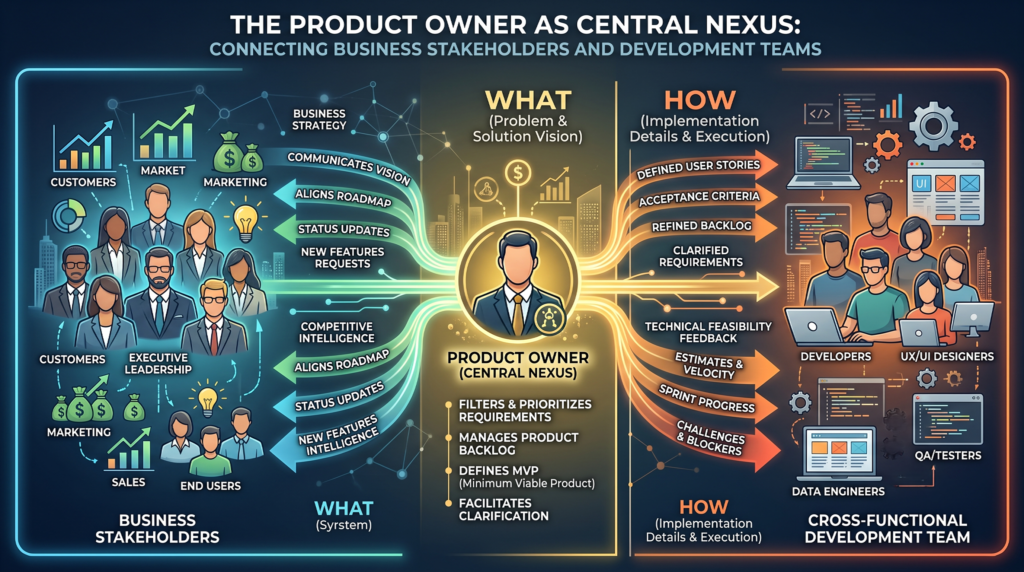
One Individual Accountable: The Product Owner is a single individual, never a committee or a working group. While the Product Owner gathers inputs from executives, customers, sales, and support, final accountability for backlog order and scope retention rests solely on their shoulders.
The Strategic Translator: The Product Owner acts as the primary interface between business stakeholders and cross-functional delivery teams. They translate high-level business goals into precise user stories for developers, while translating technical risks and architectural constraints back into business terms for executives.
The “What” vs. “How” Boundary: The Product Owner owns what gets built and why it carries business value. The cross-functional development team owns how the solution is engineered within technical boundaries. Product Owners dictate priority and criteria, but they never dictate execution mechanics to the engineering team.
When organizations bypass the Product Owner to assign tasks directly to developers, team velocity collapses, context switching spikes, and strategic alignment vanishes.
The DEEP Framework for Backlog Excellence
To maintain a healthy backlog that drives continuous delivery, elite product managers evaluate their backlog against the DEEP criteria:
Detailed Appropriately: Work items near the top of the backlog, targeted for upcoming sprints, must be granular, fully articulated, and backed by clear acceptance criteria. Items scheduled for months in the future remain high-level epics. Over-specifying items far in advance wastes time, as requirements naturally shift before execution.
Emergent: The backlog is never finished. It continuously adapts, growing and refining as new market data, customer behavior patterns, and technical insights emerge.
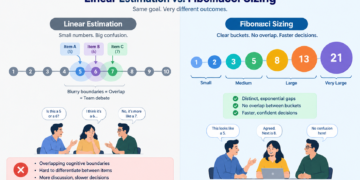
Estimated: Every user story near the top of the backlog must contain a relative estimate, typically calculated using story points and Fibonacci sequences rather than rigid hour guesses. This relative sizing allows the team to forecast capacity and velocity accurately.
Prioritized: Backlog items are strictly ordered from top to bottom based on business value, ROI impact, risk mitigation, and strategic alignment. The highest-value items are always executed first.
Step-by-Step Backlog Governance Playbook for Project Managers
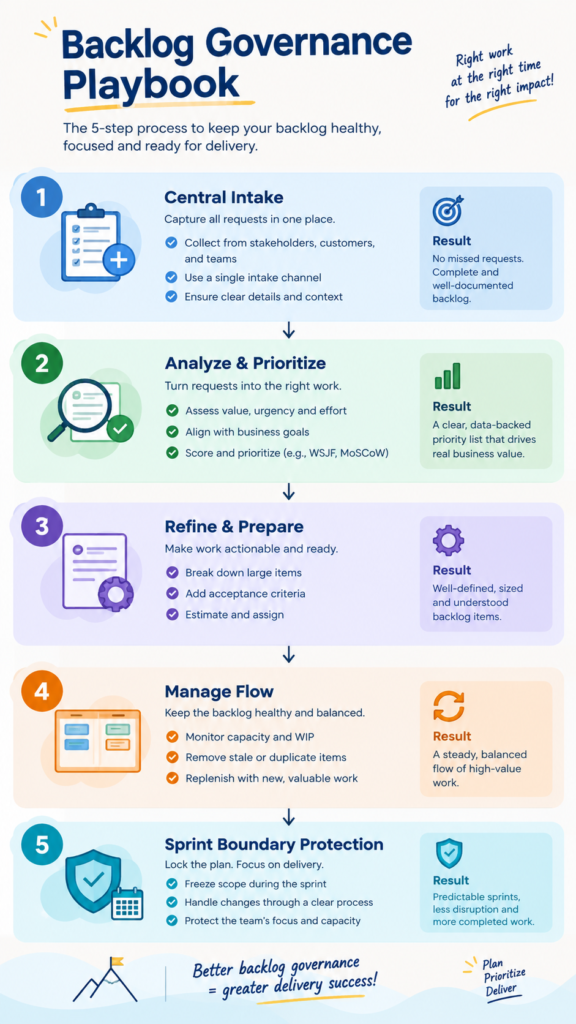
Transforming a chaotic requirement dumping ground into an engine of predictable delivery requires a systematic governance framework. Project managers and product leaders can implement this five-step playbook immediately:
Step 1: Centralize Requirements and Channel All Scope Intake
Establish a strict single-intake portal for all project requests. Eliminate side-channel requests coming through instant messages, hallway conversations, or direct emails to developers. Educate stakeholders that any request not submitted through the central intake pipeline will not be estimated or scheduled.
Step 2: Enforce Strict Definition of Ready (DoR) Standards
Do not allow ill-defined ideas to enter upcoming sprint planning cycles. Implement a strict Definition of Ready threshold. A user story is only marked ready for team commitment when it meets core criteria:
Formatted cleanly as a user persona journey statement.
Accompanied by testable, non-ambiguous Acceptance Criteria.
Dependencies identified and cleared.
Sized and estimated by the cross-functional delivery team.
Step 3: Institute Weekly Backlog Refinement Cadences
Lorem ipsum dolor sit amet, consectetur adipiscing elit. Ut elit tellus, luctus nec ullamSchedule recurring, time-boxed backlog refinement sessions with the delivery team. Use this time to break down large epics into smaller user stories, clarify acceptance criteria, answer developer questions, and update relative estimations. Consistent refinement prevents sprint planning meetings from becoming long, exhausting requirement workshops.corper mattis, pulvinar dapibus leo.
Step 4: Apply Value-Driven Prioritization Frameworks
Avoid ordering the backlog based on whoever shouts the loudest in executive meetings. Use objective prioritization metrics such as Weighted Shortest Job First (WSJF) or value-versus-effort scoring matrices. Focus the team on delivering maximum business impact early in the project lifecycle.
Step 5: Protect the Sprint Backlog Boundary
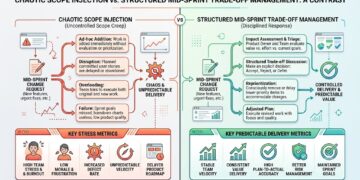
Once a sprint planning session concludes and the team commits to a Sprint Backlog, lock the scope for that iteration. If an urgent, business-critical request emerges mid-sprint, enforce a strict swap policy: to add a new requirement into an active sprint, an item of equal story-point complexity must be pulled out and returned to the Product Backlog.
The Transformation: From Firefighting Chaos to Strategic Delivery
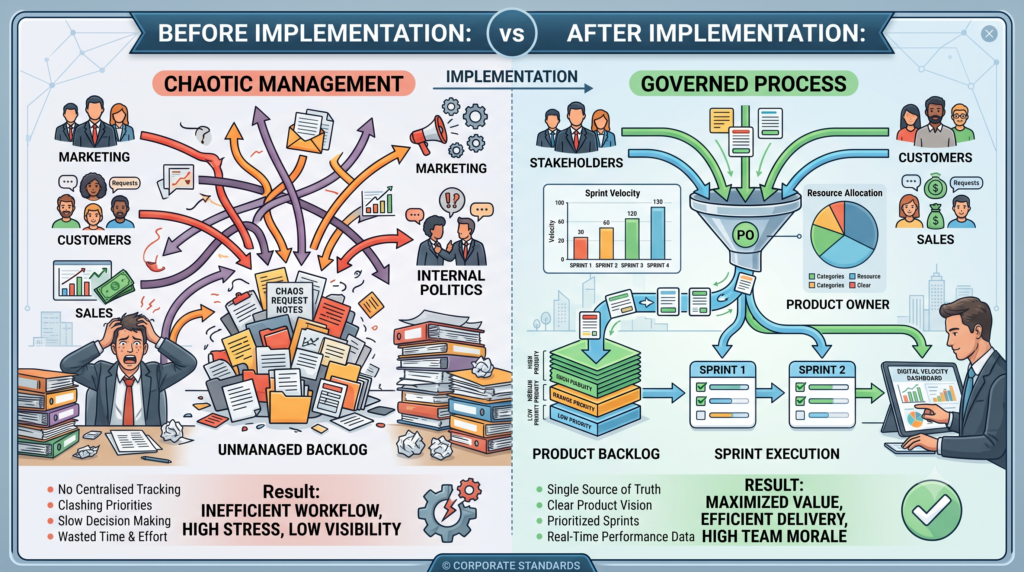
When an organization masters Product Backlog scope governance and single-threaded ownership, the cultural and operational shift is immediate.
Project environments transition from constant emergency firefighting, bloated scope creep, and team burnout to a state of calm, highly predictable release velocity. Stakeholders gain full visibility into delivery roadmaps, engineering teams operate with uncompromised focus, and executive leadership receives reliable data on product rollouts.
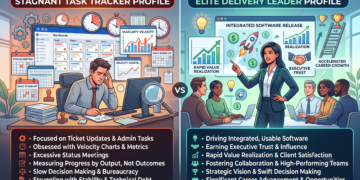
For project managers and emerging product leaders, mastering these backlog mechanics is the single fastest way to transition from a reactive task coordinator to a strategic enterprise driver. Professionals who can successfully maintain scope boundaries, align multi-disciplinary teams, and maximize business value delivery become invaluable assets to high-growth organizations.
Stopping scope creep and mastering Agile governance is not about memorizing theoretical definitions. It requires practical execution, real-world frameworks, and expert guidance.
If you are ready to stop guessing, elevate your corporate standing, and master project management the right way, reach out to Skillsetify. We do not just teach theoretical frameworks: we show you your exact career growth trajectory and equip you with the advanced skills needed to lead complex enterprise initiatives with complete confidence.