Why Your "Scrum Master" Is Secretly Killing Team Velocity
The sprint burn-down chart sits frozen as a flat line. Critical user stories remain completely blocked due to an unapproved API integration, the senior backend engineer is quietly updating their resume, and the Product Owner just dumped unrefined feature requests directly into the active sprint backlog. In the middle of this operational crisis sits the Scrum Master. Instead of resolving the underlying systemic friction, they log into the ticketing tool, clear their throat, and demand to know why tasks are moving so slowly and who will take ownership of the new requests.
This scenario unfolds inside thousands of enterprise engineering organizations daily. The delivery pipeline collapses, burnout peaks, and the individual hired to facilitate agility morphs into an administrative micromanager.
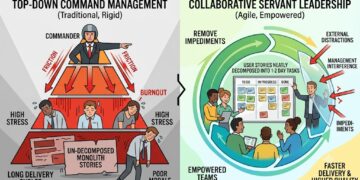
The corporate myth driving this disaster is dangerous: the assumption that a Scrum Master is merely a traditional project manager tasked with assigning tickets, enforcing top-down deadlines, and tracking status updates. When an organization treats the Scrum Master as a glorified taskmaster, velocity plummets, self-organization dissolves, and elite talent resigns. True Agile transformation requires a fundamental structural shift. The Scrum Master is not a boss: they are a servant leader whose primary mandate is to empower the team, facilitate friction-free collaboration, mentor cross-functional experts, and relentlessly dismantle organizational impediments.
Deconstructing the Servant Leader: Mechanics, Mindset, and Value
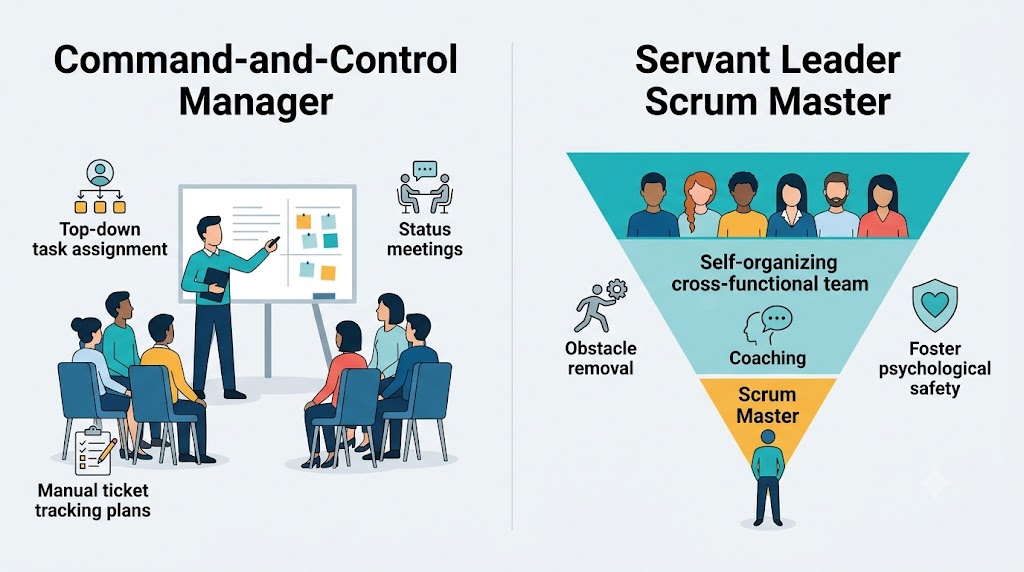
Servant leadership is not a passive, hands-off management experiment. Originating from Robert K. Greenleaf’s foundational leadership philosophy, servant leadership in a Scrum environment flips traditional corporate hierarchy on its head. The Scrum Master serves the team first, ensuring developers and product owners have the environment, clarity, and psychological safety required to deliver maximum business value.
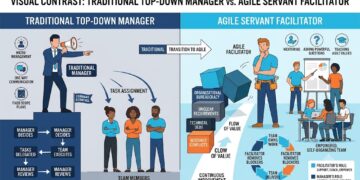
| Functional Responsibility | Traditional Top-Down Manager | Servant Leader Scrum Master |
| Team Interaction | Directs assignments, dictates task distribution, and demands constant status updates. | Facilitates self-organization, allowing cross-functional experts to pull work autonomously. |
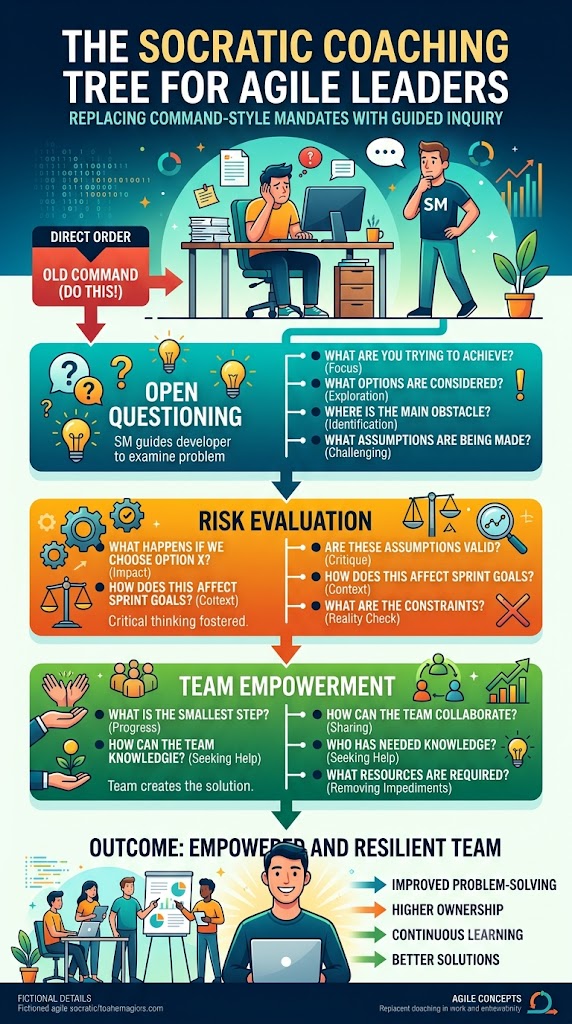
| Problem Solving | Tells engineers how to fix technical bugs or makes unilateral decisions. | Mentors team members using Socratic questioning so they discover optimal solutions. |
| Impediment Handling | Expects engineers to clear their own bureaucratic blockers or logs issues passively. | Actively escalates and dismantles organizational, cross-departmental friction. |
| Sprint Events | Chairs Daily Standups as a status interrogation session. | Keeps daily coordination focused on sprint goal progress and emergent blockers. |
Pillar 1: Facilitating True Cross-Functional Collaboration
Cross-functional teams consisting of backend developers, frontend engineers, database specialists, and quality assurance analysts often operate in functional silos. A traditional manager attempts to force alignment through directives. A servant leader fosters organic collaboration by building clear boundaries and shared operational context. Facilitation means designing environments where technical and business alignment happens seamlessly. The Scrum Master serves as a translator between technical terminology and business objectives, ensuring the Product Owner understands technical debt while engineers understand customer value.
Pillar 2: Mentoring and Coaching Over Directing
When an engineer encounters a roadblock, a directive manager dictates a specific fix and imposes a tight deadline. This creates complete dependency on the manager. A servant leader acts as an agile coach. They mentor team members to evaluate trade-offs independently. By teaching the team how to think critically within established architectural and operational boundaries, the Scrum Master builds a self-organizing unit that functions flawlessly even when leadership is absent.
Pillar 3: Active Impediment Removal
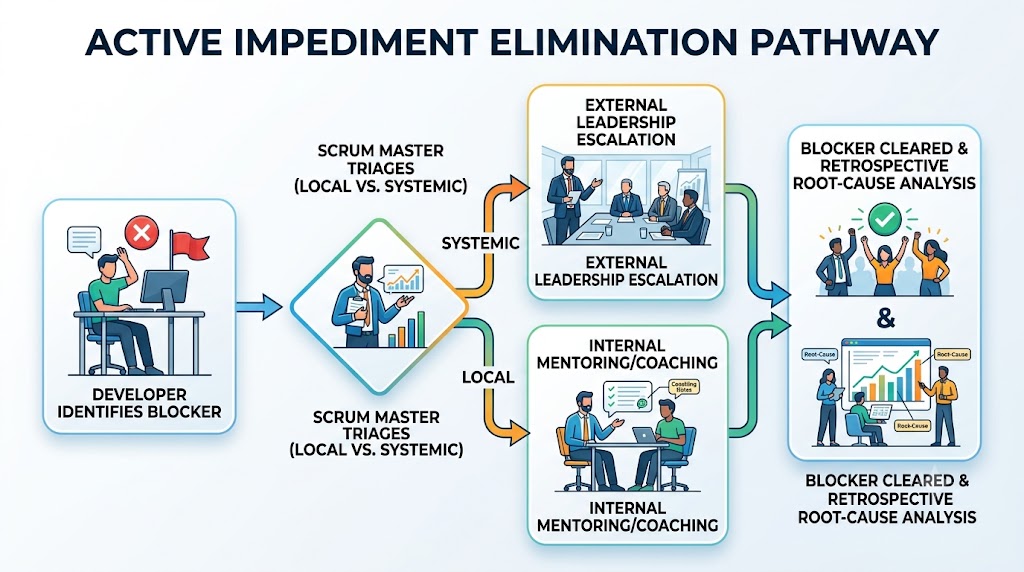
An impediment is anything that impedes the team’s ability to deliver value and cannot be resolved by team members themselves within a reasonable timeframe. Servant leaders do not tell engineers to figure it out when corporate red tape stops progress. They take active ownership of systemic blockers, whether that means negotiating with external infrastructure teams, escalating resource delays to executives, or insulating the team from mid-sprint scope changes.
The 4-Stage Servant Leadership Implementation Framework
Transitioning from top-down management to high-impact servant leadership requires a structured, repeatable framework. Project Managers and Scrum Masters can apply this four-stage operational playbook immediately to turn struggling teams into high-velocity delivery units.
Stage 1: The Impediment Triage and Escalation Protocol
Not all issues are created equal. The Scrum Master must establish a clear classification system during daily standups to filter team friction efficiently:
Tactical Blockers (Level 1): Code-level bugs or minor technical questions. The Scrum Master encourages peer-to-peer developer pairing to resolve the issue internally within the current working cycle.
Operational Friction (Level 2): Missing API documentation, pending code reviews, or minor hardware requests. The Scrum Master tracks the issue and directly intervenes if remaining unblocked past an acceptable window.
Systemic Organizational Impediments (Level 3): Cross-departmental dependencies, delayed vendor deliverables, or conflicting executive priorities. The Scrum Master owns this completely, logging it on an Impediment Board and escalating directly to department heads with clear risk metrics.
Stage 2: The Socratic Mentoring Protocol
To break team reliance on top-down direction, adopt the Socratic coaching model during technical or process discussions. When team members ask for answers, guide them through four specific prompts:
Clarification: What is the exact outcome we are trying to achieve with this user story?
Option Generation: What are two distinct technical approaches we could take to solve this?
Trade-Off Analysis: What are the risks or technical debts associated with each approach?
Autonomous Choice: Based on our Sprint Goal, which path do you and the team feel most confident executing?
Stage 3: Operational Shielding and Capacity Defense
To maintain flow, a servant leader builds an operational shield around the delivery team. This involves enforcing strict rules of engagement for external stakeholders:
Zero Unrefined Injections: No user stories are pulled into an active sprint unless they meet the formal Definition of Ready.
Context-Switching Defense: External requests from sales, executives, or support are routed exclusively through the Product Owner and Scrum Master.
Capacity Conservation: Ensure team capacity accounts for non-coding overhead, testing, and backlog refinement rather than booking engineers at maximum theoretical output.
Stage 4: Retrospective Actionability Audit
A servant leader does not let Sprint Retrospectives devolve into complaint sessions. They convert retro feedback into measurable continuous improvement items:
Limit retrospective outputs to one or two high-impact process changes per sprint cycle.
Assign clear accountability metrics and explicit criteria for completion to every retrospective action item.
Place retrospective items directly into the top of the upcoming Sprint Backlog as first-class operational tasks.
From Chaos to Elite Delivery: The Professional Transformation
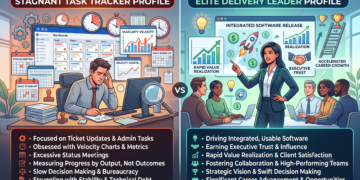
When you shift from top-down management to true servant leadership, the transformation across your delivery pipeline is immediate and dramatic.
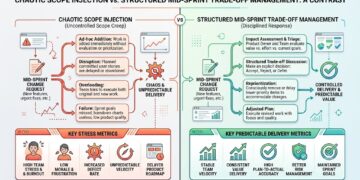
Chaos gives way to operational predictability. Sprint commitments stop feeling like arbitrary executive gambles and turn into reliable delivery milestones. Scope creep is managed gracefully at the product backlog level rather than causing mid-sprint panics. Team members evolve from passive order-takers into proactive problem solvers who take pride in their collective velocity. High-performing engineers stop quitting due to micro-management, and team morale stabilizes into a sustainable, repeatable rhythm.
For your career, mastering servant leadership is the single fastest way to transition from a tactical coordinator to a strategic enterprise leader. Organizations do not lack people who can update task boards or read Gantt charts. They are desperate for transformational leaders who can build high-trust environments, navigate complex corporate politics to remove structural blockers, and turn cross-functional groups into elite delivery engines. Demonstrating the ability to elevate team throughput without top-down authority marks you immediately as executive-caliber talent.
Master Enterprise Agile Leadership with Skillsetify
Executing true servant leadership requires far more than reading a framework guide or passing a basic certification exam. It demands deep operational mastery, real-world scenario training, and expert guidance on how to navigate complex enterprise dynamics.
If you are ready to stop guessing, step out of tactical administrative work, move up the corporate ladder, and learn project management the right way, reach out to Skillsetify. At Skillsetify, we do not just teach theoretical frameworks: we show you your exact career growth trajectory. Our industry-leading programs equip you with the practical toolkits, real-world leadership strategies, and hands-on mentoring needed to master modern Agile roles and stand out as an elite project leader. Connect with Skillsetify today and transform your project management career.