Why Unbounded Self-Organization Is Killing Corporate Agile Teams
A major financial technology enterprise recently faced a catastrophic sprint review. After six weeks of quiet development on a critical customer onboarding portal, the engineering team proudly demonstrated their deliverable to executive leadership. The code was elegant, modular, and built using a cutting-edge open-source framework the engineers were eager to adopt. However, the system failed to comply with corporate security standards, lacked single sign-on integration, breached data sovereignty regulations, and blew through the cloud infrastructure budget by 200%. The Chief Information Security Officer was furious, the Chief Product Officer was blindsided, and two quarters of strategic go-to-market planning dissolved into immediate rework.
When asked how this happened, the engineering lead responded with genuine confusion: “We are an Agile team. We self-organize, and we decided this was the best technical approach to build the product.”
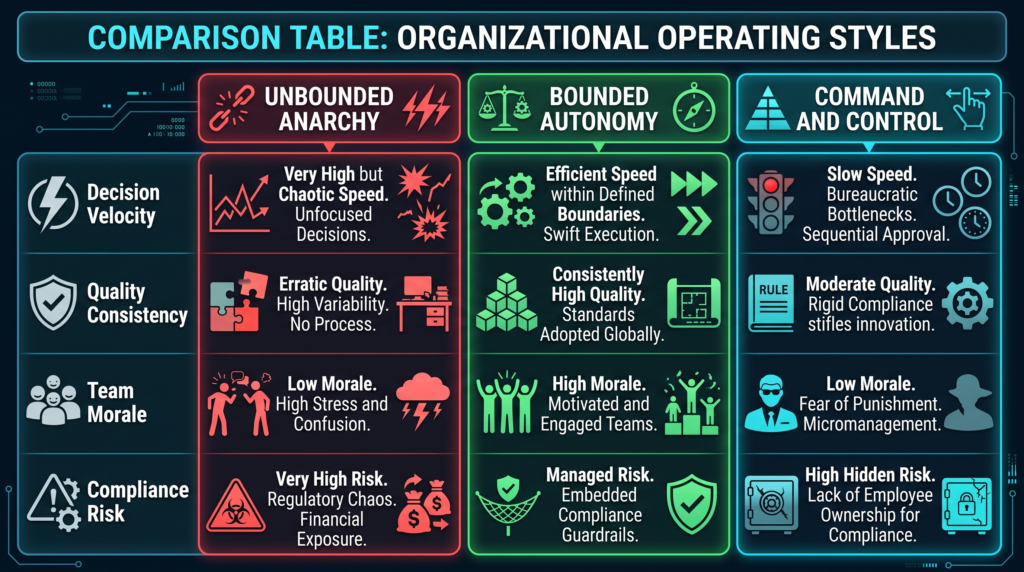
This corporate crisis illustrates a pervasive myth in modern software and product development: the misinterpretation of Agile self-organization as absolute, unrestricted operational freedom. Senior executives often fear Agile because they envision an anarchic environment where development teams operate without management oversight, architecture discipline, or financial constraints. Conversely, misguided development teams treat self-organization as a license to ignore enterprise standards, business priorities, and governance structures.
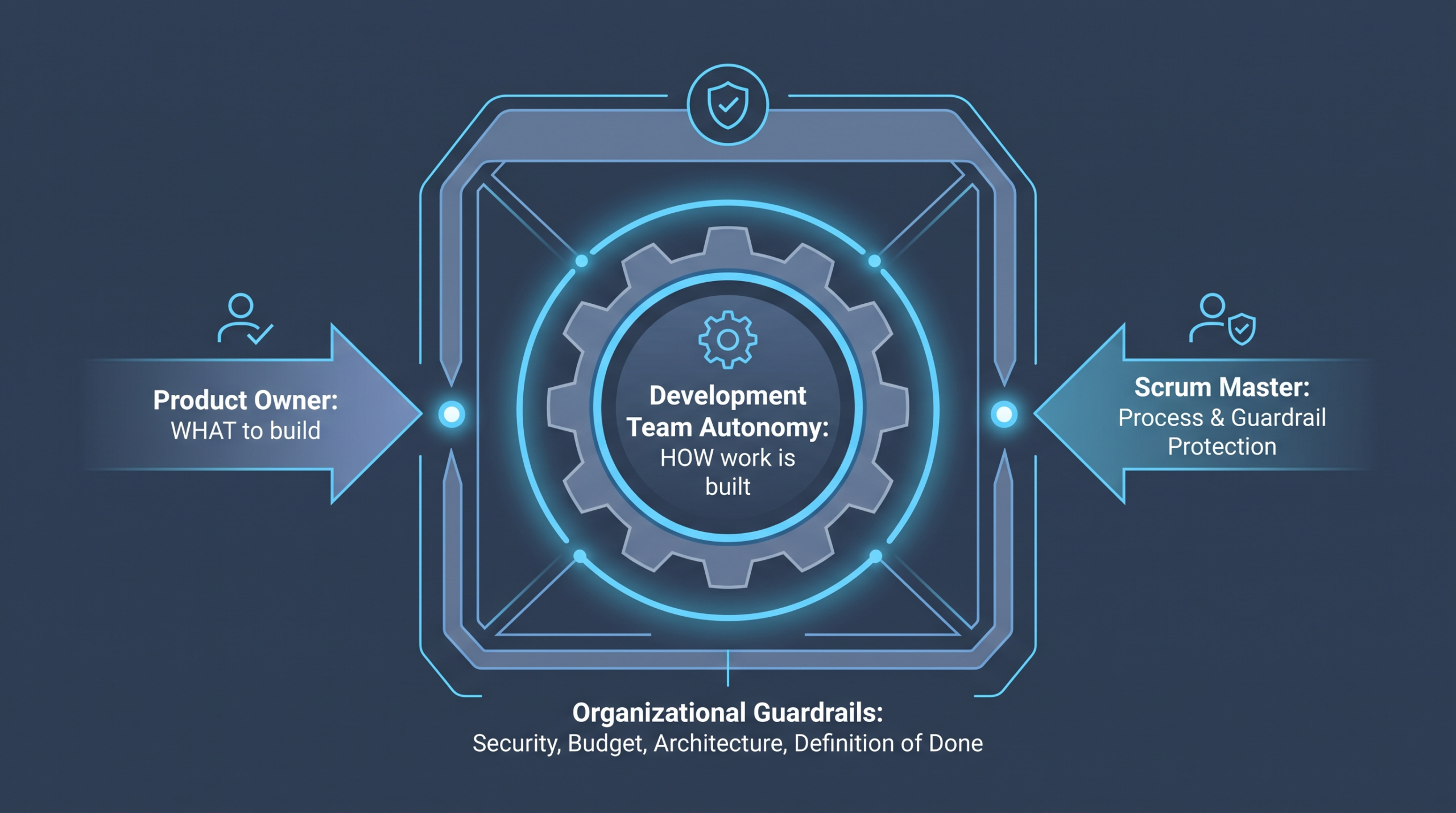
Both views are fundamentally flawed. True Agile self-organization does not mean operating in an isolated vacuum without governance. It means operating within bounded autonomy. In Scrum, self-organization functions like an executive sandbox: leadership constructs the non-negotiable perimeter walls (security standards, budget caps, regulatory compliance, and business goals), while the cross-functional development team retains complete authority over how to construct the sandcastle (technical architecture, task allocation, and sprint execution).
The Mechanics of Bounded Autonomy: Aligning Roles and Guardrails
To build an efficient delivery engine around team self-organization, organizations must enforce clear role boundaries. Misinterpretation of who owns what creates friction between project managers, product owners, and development teams.
The Triad of Responsibility in Scrum
Scrum divides accountability across three distinct roles to create balance between business strategy, technical execution, and process discipline:
-
The Product Owner (WHAT to build): The single point of accountability for maximizing business value. The Product Owner manages the Product Backlog, prioritizes user stories based on customer needs, and defines the acceptance criteria. They do not dictate how code is written or how daily tasks are assigned to individual developers.
-
The Development Team (HOW to build): A cross-functional group of professionals possessing all necessary skills to deliver a working increment. The team holds complete authority over task decomposition, technical design, relative estimation, and work distribution. No external manager assigns specific tickets to developers: the team pulls work voluntarily based on capacity during Sprint Planning.
-
The Scrum Master (ENABLEMENT & GUARDRAILS): The servant leader and process guardian. The Scrum Master coaches the team in self-organization, shields developers from external distractions, and actively removes organizational impediments.
When operating correctly, the Product Owner defines the business destination, enterprise leadership establishes the highway guardrails, and the Development Team chooses the route, vehicle, and driving strategy.
The 4-Pillar Operational Guardrail Framework
For self-organization to produce predictable business outcomes rather than enterprise risk, management must establish four explicit categories of guardrails.
| Guardrail Pillar | Scope & Boundaries | Concrete Corporate Example |
| Architectural & Technical | Non-negotiable enterprise engineering standards, security protocols, and compliance frameworks. | All microservices must pass automated static code security analysis and adhere to standard enterprise REST API guidelines. |
| Process & Quality | Agreed criteria for work readiness and completion that protect product stability. | Strict enforcement of a Definition of Ready (DoR) before sprint intake and a Definition of Done (DoD) before release. |
| Resource & Structural | Team composition limits, skill balances, and fiscal parameters. | Team size maintained between 3 and 9 cross-functional members; cloud hosting spend capped per development environment. |
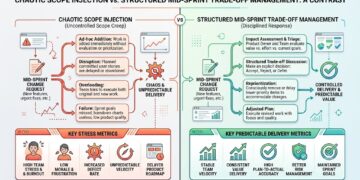
| Scope & Commitments | Protection against mid-sprint scope injection and external task assignments. | Zero mid-sprint scope additions unless equal story points are removed with explicit Product Owner alignment. |
Without these explicit guardrails, empowerment becomes chaos. With them, teams gain the confidence to make fast, decentralized decisions without constant management escalation.
Operational Boundaries: DEEP Backlogs, DoR, and DoD
Self-organizing teams require clear operational markers to determine when to pull work and when work is finished.
The Product Owner maintains the Product Backlog using the DEEP framework:
-
Detailed Appropriately: Near-term user stories carry comprehensive acceptance criteria, while long-term epic items remain high-level.
-
Emergent: The backlog is dynamic, continuously evolving based on customer feedback and market shifts.
-
Estimated: User stories contain relative complexity estimates generated by the development team.
-
Prioritized: Items are ordered strictly by business value and dependency sequence.
To protect sprint execution, the team relies on two critical operational boundaries:
-
Definition of Ready (DoR): The entrance boundary. The development team retains the authority to reject user stories during Sprint Planning if they lack clear acceptance criteria, dependencies, or wireframes. Pushing unrefined stories into a sprint breeds confusion and rework.
-
Definition of Done (DoD): The exit boundary. A shared, non-negotiable checklist ensuring that every completed user story meets unit testing, peer code review, security scanning, automated deployment, and documentation standards.
A Step-by-Step Implementation Framework for Project Leaders
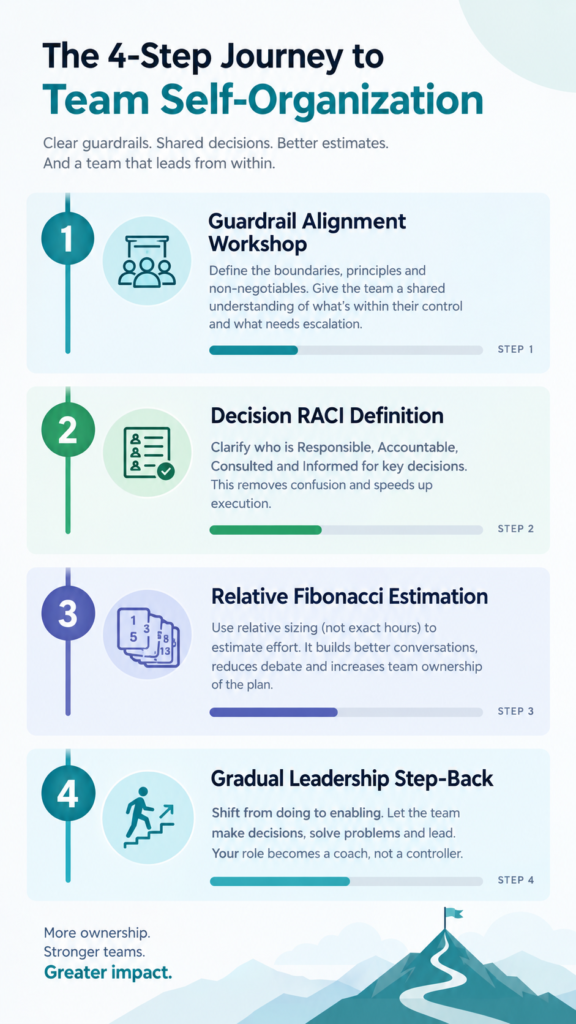
Transitioning an organization from a micromanaging command-and-control culture or an unbounded chaotic environment into a high-velocity, self-organizing unit requires structured facilitation. Project Managers and Agile leaders can execute this transition using a four-step framework:
Step 1: Execute a Guardrail Alignment Workshop
Before granting operational autonomy, convene executive leadership, the Product Owner, and the Development Team. Explicitly document non-negotiable enterprise constraints. Frame these constraints positively as safety nets rather than restrictive rules. For example, position automated continuous integration pipelines as a boundary that protects developers from releasing breaking changes into production.
Step 2: Establish a Decision Boundary Matrix
Eliminate ambiguity regarding decision-making authority. Document exactly where team autonomy starts and stops using clear governance rules:
-
Product Backlog Priority: Product Owner holds final authority.
-
Technical Design & Task Allocation: Development Team holds complete autonomy within enterprise architectural standards.
-
Adopting New Technologies or Third-Party Libraries: Development Team proposes, Enterprise Architecture Board approves.
-
Impediment Resolution: Scrum Master leads resolution; team supports execution.
Step 3: Implement Relative Sizing and Bounded Estimation
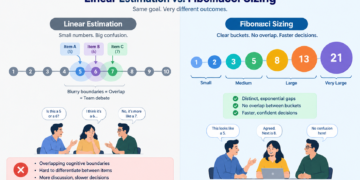
Self-organizing teams struggle when managers demand absolute hourly estimates for complex, creative engineering tasks. Human brains struggle to estimate close linear numbers accurately: developers cannot reliably distinguish between a 5-hour task and a 6-hour task.
To empower the team to self-organize their capacity, replace hourly guessing with relative sizing using the Fibonacci sequence (1, 2, 3, 5, 8, 13, 21). Relative estimation relies on comparative complexity:
Step 4: Execute the Gradual Step-Back Facilitation Pattern
Self-organization is a learned muscle. Scrum Masters and Project Managers must systematically remove the training wheels through four distinct phases:
-
Phase 1 (Direct Facilitation): Facilitate ceremonies directly and train team members on running effective Daily Standups and Sprint Planning.
-
Phase 2 (Co-Facilitation): Rotate Daily Standup leadership among team members while remaining present to provide real-time coaching.
-
Phase 3 (Silent Observation): Attend daily syncs as a silent observer, stepping in only if the team strays from Scrum principles or ignores unaddressed blockers.
-
Phase 4 (Full Autonomy): Step back completely from daily operational syncs, allowing the team to self-organize, and engaging during Sprint Retrospectives and formal escalation points.
From Firefighting Chaos to Predictable Executive Delivery
When project leaders master the art of bounded autonomy, the workplace dynamic transforms dramatically.
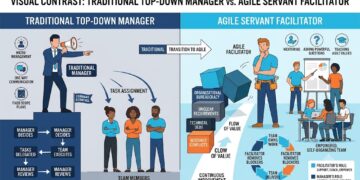
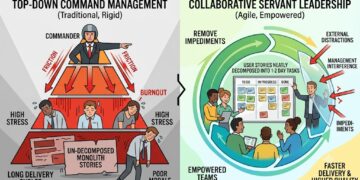
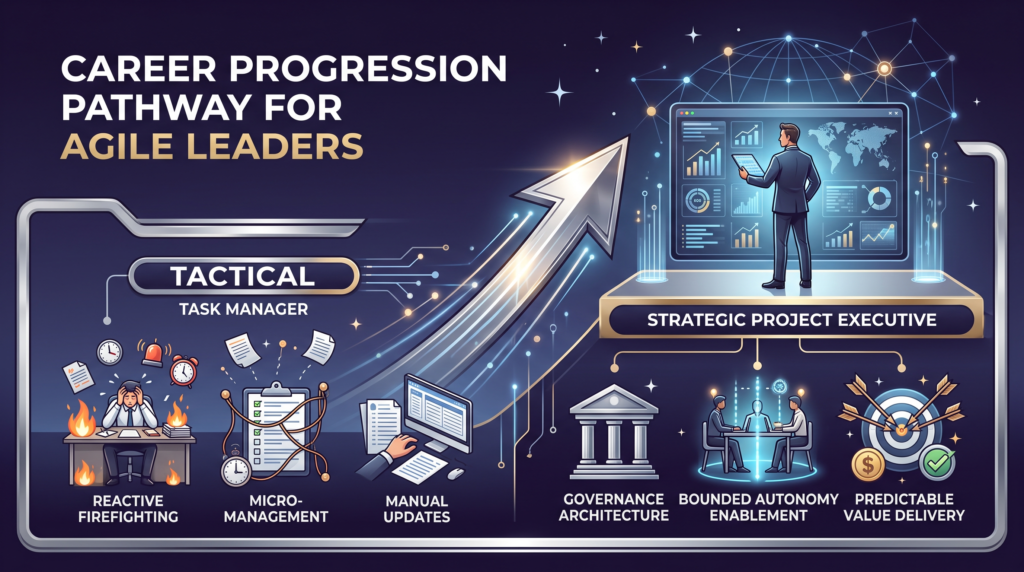
In a traditional command-and-control environment, project managers act as air-traffic controllers. They spend their days assigning individual tickets, chasing status updates, mediating micro-conflicts, and firefighting scope creep. This administrative overhead leads to team burnout, hidden bottlenecks, and continuous delivery delays because every single operational decision must funnel through a single overworked manager.
Conversely, when a cross-functional team is empowered to decide how work is built within clear organizational guardrails, remarkable efficiencies emerge:
-
Instant Decision Velocity: Technical decisions happen immediately at the ground level where engineering context exists, eliminating management approval queues.
-
High Psychological Safety and Ownership: Engineers take genuine pride in their craftsmanship when granted ownership of technical architecture and task execution.
-
Standardized Quality: Enforced Definition of Done guardrails ensure that automated testing, security checks, and compliance reviews occur continuously, eliminating end-of-project defect spikes.
-
Predictable Delivery Velocity: Relative Fibonacci estimation and historical throughput data allow project leaders to forecast multi-sprint roadmaps with high statistical precision.
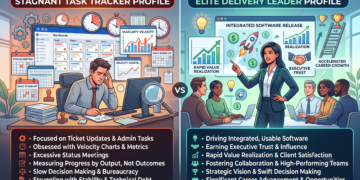
For ambitious project leaders, driving this transition elevates your career trajectory. Executives do not promote project managers because they excel at updating ticket boards or micromanaging task lists. They promote leaders who build resilient systems, establish governance frameworks, and cultivate self-sustaining, high-velocity teams capable of delivering complex business outcomes predictably.
Elevate Your Strategic Project Leadership with Skillsetify
The shift from micromanaging tasks to architecting bounded self-organization is the defining line between a tactical project coordinator and a high-impact project executive. Empowering teams while satisfying enterprise governance is not an intuitive skill: it requires mastering advanced Agile mechanics, stakeholder facilitation, relative estimation models, and strategic alignment frameworks.
At Skillsetify, we specialize in bridging the gap between theoretical project management frameworks and real-world corporate execution. Our elite training programs equip professionals with battle-tested methodology toolkits, real-world scenario simulations, and personalized mentorship designed to turn project leaders into indispensable enterprise catalysts.
If you are ready to stop guessing, move up the corporate ladder, and learn project management the right way, reach out to Skillsetify. We do not just teach frameworks: we show you your exact career growth trajectory.