Why Product Owner Accountability Is the Single Determinant of Agile Success
The engineering lead is staring at a dashboard flashing red, backend microservices are failing under synthetic load, and the product backlog looks like a chaotic graveyard of competing executive demands. Fourteen different vice presidents forced their “must-have” features into the release. Acceptance criteria are ambiguous, edge cases were skipped to meet an arbitrary deadline, and the engineering team has logged 80 hours this week trying to build everything for everyone. The result is a broken build, a exhausted development team, and zero incremental business value delivered to the end customer.
This catastrophic scenario plays out every week across corporate enterprise environments. The root cause is rarely technical incompetence or poor engineering talent. Instead, it is a structural failure of product governance: the absence of true Product Owner accountability.
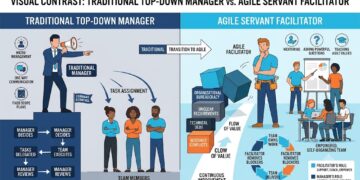
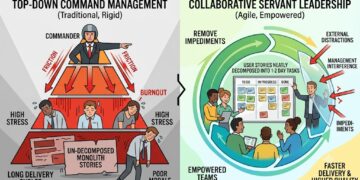
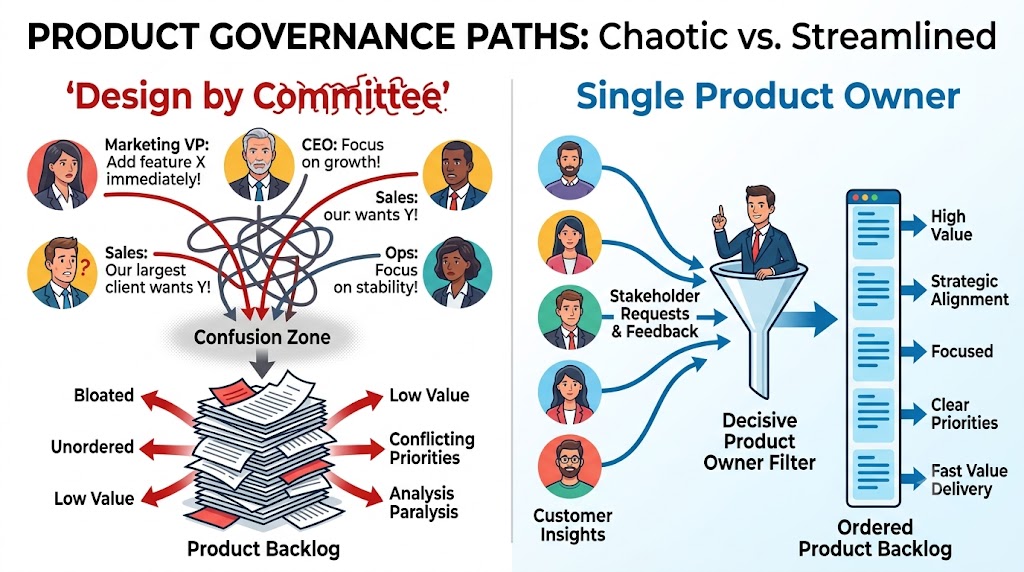
In many corporate cultures, a pervasive myth exists regarding Scrum roles. Management often views the Product Owner as an administrative order-taker, a backlog scribe, or a human buffer whose primary mandate is keeping every internal stakeholder happy. This perspective transforms product governance into a toxic “design by committee” model. When everyone owns product decisions, nobody owns them. Attempting to satisfy every executive voice turns your product team into a mindless feature factory, pumping out bloated software that drives up maintenance costs while failing to move core business metrics.
The Architecture of Absolute Product Ownership
The Single Decision-Maker Mandate
To build high-performing product organizations, enterprises must enforce the fundamental premise of Scrum: the Product Owner is a single, empowered individual, not a committee, steering group, or proxy representative.
The Product Owner serves as the single point of accountability for maximizing the value of the product resulting from the work of the development team. This role requires navigating two distinct operational directions simultaneously:
Facing the Business and Stakeholders: The Product Owner synthesizes market research, customer feedback, operational constraints, and executive strategy into a single, cohesive Product Goal. They operate as the ultimate arbiter of trade-offs, possessing the authority to say “no,” “not now,” or “that does not align with our current objectives.”
Facing the Engineering Team: The Product Owner translates high-level business vision into clear, actionable requirements without dictating technical execution. They define what needs to be built and why it matters, leaving the cross-functional team empowered to determine how to build it.
When an organization dilutes this authority by allowing stakeholders to bypass the Product Owner or override backlog priorities, Scrum devolves into a waterfall pipeline with daily standups.
Common Anti-Patterns Undermining Accountability
Recognizing anti-patterns early is essential for preserving product integrity. Two major organizational failure modes frequently compromise Product Owner accountability:
Prioritization by Proxy: Occurs when steering committees, line managers, or dominant executive stakeholders dictate backlog ordering behind closed doors. The designated Product Owner becomes a passive messenger, losing credibility with engineers and failing to drive strategic alignment.
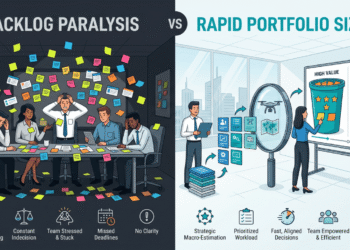
The Backlog Hoarding Trap: When a Product Owner lacks the courage or authority to reject stakeholder requests, the product backlog balloons into a dumping ground containing hundreds of stagnant user stories. Stale items sitting untouched for months create operational noise, waste refinement time, and obscure strategic priorities.
The Operational Mechanics of Value Maximization
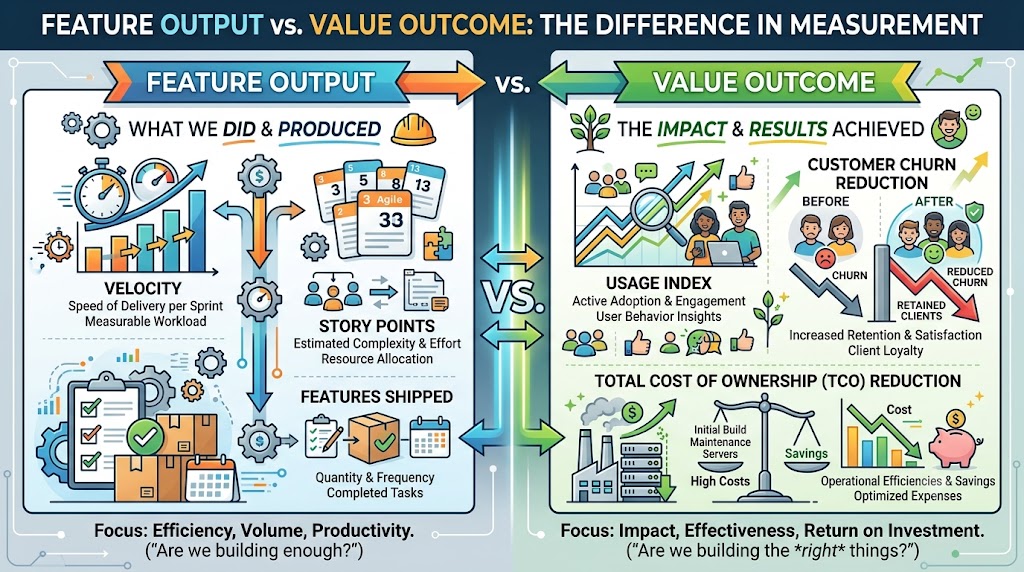
Maximizing value requires moving away from tracking pure output, such as story points completed or feature volume delivered, toward measuring true business outcomes. A release containing fifty features that no customer uses carries a negative return on investment due to ongoing technical debt and infrastructure costs.
The DEEP Backlog Framework
To maintain strategic alignment and rapid delivery cadences, accountable Product Owners manage their backlog using the DEEP framework:
Detailed Appropriately: Near-term user stories scheduled for upcoming sprints contain detailed acceptance criteria, edge case definitions, and clear wireframes. Long-term backlog items remain high-level concepts until they move closer to execution.
Emergent: The backlog is a dynamic, living asset. It constantly evolves based on real user data, market shifts, sprint review feedback, and technical discoveries.
Estimated: Backlog items possess relative size estimates provided by the engineering team, enabling data-driven forecasting and trade-off decisions.
Prioritized: Every item is rigorously ordered based on value, risk, dependencies, and strategic alignment. No two items share the top position.
The 4-Step Implementation Framework for PMs and POs
To transition from an administrative task manager to an elite, accountable Product Owner, implement this battle-tested operational framework.
Step 1: Establish Governance Rules of Engagement
Define explicit operational boundaries between stakeholders, product management, and engineering teams using a clear decision-making model:
Implement a Single Point of Entry: Mandate that all feature requests, feedback, and strategic ideas flow exclusively through the Product Owner. Direct stakeholder contact with developers for out-of-band requests must be strictly prohibited.
Formalize Scope Authority: Establish that while executive stakeholders provide strategic inputs and business constraints, the Product Owner retains sole authority over backlog ordering and acceptance of completed user stories.
Step 2: Transition to Quantitative Value Scoring
Eliminate subjective prioritization arguments by introducing objective valuation frameworks:
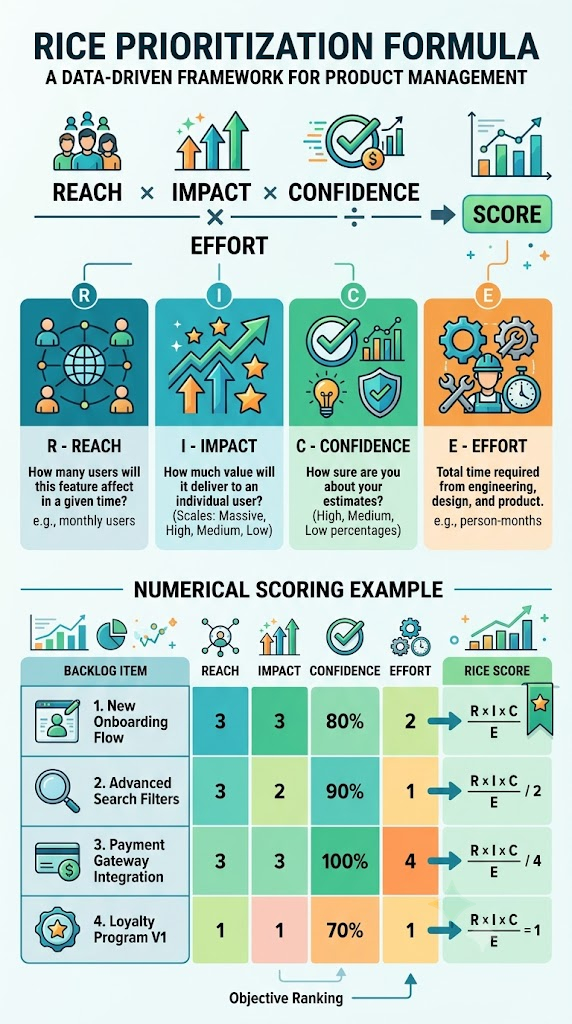
Adopt RICE or WSJF Scoring: Evaluate incoming initiatives using standardized metrics such as RICE (Reach, Impact, Confidence, Effort) or Weighted Shortest Job First (Cost of Delay divided by Job Duration).
Establish Value-to-Debt Ratios: Ensure backlog composition balances net-new business features with technical debt remediation. Allocate roughly 70% of sprint capacity to strategic feature value, 20% to technical refactoring and bug fixes, and 10% to team innovation or slack time.
Step 3: Enforce Aggressive Backlog Maintenance
A lean product backlog drives execution speed and clarity:
Cap Active Backlog Capacity: Limit the product backlog to a maximum of 80 to 100 items. If an item cannot realistically be scheduled within the next three to four months, prune it or archive it in a secondary discovery sandbox.
Institute Bi-Weekly Pruning: Regularly review items that have sat untouched for over six weeks. If a feature request loses strategic relevance, archive it immediately rather than letting it clutter the active backlog.
Step 4: Protect Sprint Boundaries and Scope Integrity
Maintain operational stability during active development cycles:
Enforce Definition of Ready (DoR): Refuse to pull user stories into a sprint unless they meet strict DoR criteria, including fully articulated user journeys, defined acceptance criteria, and explicit test cases.
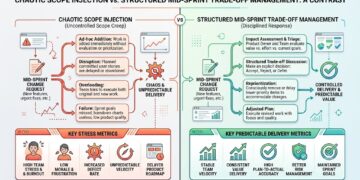
Manage Mid-Sprint Interruptions: When an urgent request emerges mid-sprint, apply a strict exchange trade-off policy. If a new request carrying a size of 5 story points must enter the active sprint, an existing item of equal or greater size must be removed and returned to the backlog.
From Operational Friction to Career Acceleration
When Product Owner accountability is fully established, the operational transformation within an enterprise is dramatic. Strategic clarity replaces chaos, mid-sprint scope creep drops significantly, and engineering teams operate with high trust and focus. Releases shift from stressful midnight firefighting sessions to predictable, value-driven business events.

Beyond team execution, mastering single-point accountability is the fastest catalyst for executive career progression. Senior leadership does not promote project managers because they managed a complex spreadsheet or pleased every stakeholder in a room. Executives promote leaders who demonstrate business ownership, make tough trade-offs under uncertainty, and consistently deliver measurable ROI.
By stepping up as an empowered decision-maker who guards team bandwidth and maximizes delivered business value, you position yourself as an indispensable strategic driver within your organization.
If you are ready to stop guessing, move up the corporate ladder, and learn project management the right way, reach out to Skillsetify. We do not just teach frameworks: we show you your exact career growth trajectory.